AI知识管理

Search documents
AI100访谈:「Get笔记」方法论 |量子位智库
量子位· 2025-11-08 02:25
Core Insights - Get Notes has rapidly gained over 1.5 million users within a year, demonstrating strong user engagement and retention in a competitive AI knowledge management market [4][10][25] - The product's success is attributed to its ability to address user pain points effectively, leveraging user feedback and co-creation in its development process [6][13][14] Market Landscape - The AI knowledge management sector is highly competitive, with major players like Baidu, Alibaba, and Tencent offering similar products [5] - Despite the crowded market, Get Notes has attracted a significant number of users, with over half being new users who had not previously engaged with the parent app, "Get" [22][24] User Engagement and Product Development - Get Notes emphasizes user co-creation, collecting feedback through user groups and allowing users to vote on feature requests, which helps prioritize development [50][51][57] - The product focuses on three core functionalities: efficient recording, easy retrieval, and user-friendly design, ensuring that it meets the actual needs of users [63][66] Unique Features and Differentiation - Get Notes offers unique features such as AI-enhanced transcription and intelligent note organization, which differentiate it from competitors [11][35][41] - The product's ability to integrate various forms of content (audio, text, images) into a cohesive knowledge base enhances its utility for users [80][81] Future Outlook and Industry Impact - The company believes that the AI knowledge management sector is still in its early stages, with significant potential for growth and innovation as user needs become more specialized [21][95] - AI is expected to create new demands and job roles within organizations, emphasizing the need for tools that facilitate AI integration into daily workflows [96][97]


通用模型无法完全理解用户,AI产品的下一站是上下文的战场|对话AI知识助手remio
量子位· 2025-10-12 07:30
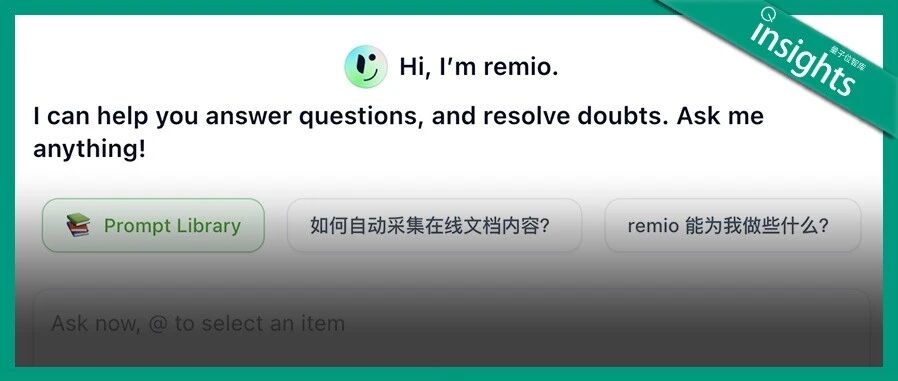
Core Insights - The article discusses the evolution of AI productivity tools, emphasizing the importance of deep user understanding and personalized experiences in enhancing user engagement and satisfaction [3][4]. - The AI knowledge assistant remio is highlighted as a product that aims to function as a "second brain," providing seamless and automated information management for users [5][11]. Group 1: Product Features and Differentiation - Remio's core functionalities include automatic information capture, intelligent knowledge management, and AI-assisted content creation, all designed to streamline knowledge workflows [11][12]. - The product prioritizes user privacy by storing all data locally on the user's device, eliminating concerns associated with cloud storage [12][23]. - Remio's unique selling proposition lies in its ability to understand and synchronize with the user's information needs, making it particularly effective for complex knowledge workers [19][21]. Group 2: Target Market and User Segmentation - The target audience for remio consists of complex knowledge workers, including managers, engineers, and consultants, with an estimated global market size of several hundred million [25][27]. - Simple knowledge workers, such as customer service representatives, are expected to be replaced by AI agents, highlighting the growing demand for tools that cater to more sophisticated tasks [25][26]. Group 3: User Engagement and Activation - New user activation is identified as a critical metric for remio, with efforts focused on educating users about the long-term benefits of investing time in the product [31][33]. - The company is exploring various strategies to enhance user onboarding, including the introduction of a "prompt repository" to showcase the potential of the product [34][35]. Group 4: Competitive Landscape and Barriers to Entry - Remio's approach to data storage and user privacy creates a significant barrier to entry against larger internet companies that typically rely on cloud-based data models [50][52]. - The product's focus on local data storage and understanding the value of personal data differentiates it from traditional collaborative platforms [50][52]. Group 5: Future Development and Iteration - Short-term development priorities include integrating comprehensive office data and expanding compatibility to Windows users, aiming to enhance the product's utility [54][55]. - The company acknowledges the need for continuous user feedback and iterative improvements to meet evolving user needs and expectations [39][49].