AI计算范式

Search documents
阿里云海外降价,部分云服务器ECS产品最高降价10%
Di Yi Cai Jing· 2025-10-14 07:16
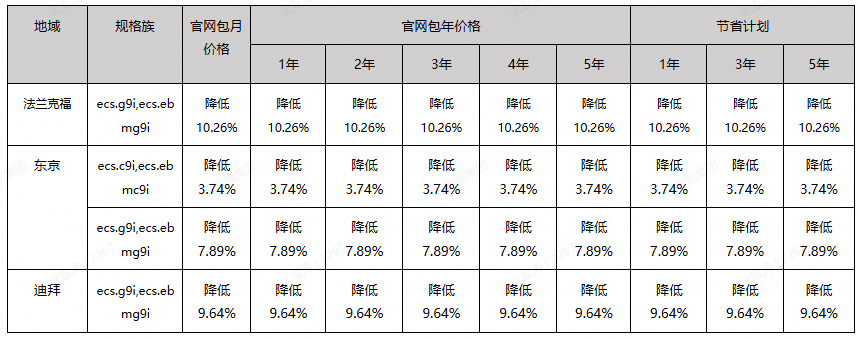
Core Viewpoint - Alibaba Cloud is initiating a price reduction strategy in overseas markets, indicating its ambition to expand internationally despite the modest scale of the price cuts [1][2]. Pricing Strategy - Starting from October 30, Alibaba Cloud will reduce prices for certain ECS products in Frankfurt, Tokyo, and Dubai, with the maximum reduction reaching 10.26% [2]. - The ECS product specifications affected include ecs.c9i, ecs.g9i, ecs.r9i, ecs.ebmc9i, ecs.ebmg9i, and ecs.ebmr9i, with specific reductions of 10.26% in Frankfurt, 7.89% in Tokyo, and 9.64% in Dubai for the ecs.g9i product [2][3]. Market Expansion - The price cuts reflect Alibaba Cloud's strategic focus on overseas markets, particularly in Europe, where Frankfurt is highlighted as a key location due to its established data centers [4]. - Alibaba Cloud ranks fourth in the global cloud market, trailing behind Amazon, Microsoft, and Google Cloud, and aims to accelerate growth in various markets amidst the AI wave [4]. Infrastructure Development - Alibaba Cloud is investing in infrastructure and AI products to capture overseas market share, with plans for new cloud computing nodes in Brazil, France, and the Netherlands, as well as expansions in Mexico, Japan, South Korea, Malaysia, and Dubai [5]. - The company anticipates that the global cloud market will consolidate into 5-6 major platforms, indicating a competitive landscape that necessitates aggressive pricing strategies [5].


AI算力秩序重建,Arm走向中心
半导体芯闻· 2025-05-30 10:08
Core Insights - The article emphasizes that Arm is transitioning from being an architecture provider to a key player in shaping the "AI computing paradigm" as major tech companies migrate their AI platform architectures to Arm [1][16]. Group 1: AI and Edge Computing - The feasibility of edge AI has been validated, with over 150 foundational models emerging in the past 18 months, enabling AI deployment on devices like smartphones and robots [3][4]. - Arm's architecture is gaining traction due to its low power consumption and high efficiency, with approximately 70% of AI workloads still relying on CPUs, highlighting the importance of Arm in AI inference processes [4][5]. Group 2: Data Center and Cloud Services - Arm predicts that by 2025, nearly half of the computing power shipped to major cloud service providers will be based on Arm architecture, reflecting its growing acceptance in the data center market [7][9]. - The energy demands of AI are reshaping data center designs, with Arm's architecture offering up to 40% energy efficiency improvements compared to other platforms, making it a preferred choice for cloud service providers [7][9]. Group 3: Hardware and Software Integration - Arm's introduction of the "Compute Subsystem" (CSS) aims to enhance performance and reduce costs across various markets, including cloud and consumer electronics [10][11]. - The Kleidi software library, with over 8 billion installations, has become a key driver for accelerating AI workloads and has integrated with major AI frameworks, fostering a positive feedback loop between hardware and software [11][12]. Group 4: Future Developments - Arm is set to release its next flagship CPU, code-named Travis, which will further enhance IPC performance and introduce scalable matrix extensions for AI workloads [12][15]. - Although Arm has not yet entered the data center GPU market, its influence in edge computing and automotive sectors is growing, positioning it as a significant player in the AI landscape [15][16].