AI赋能教学

Search documents
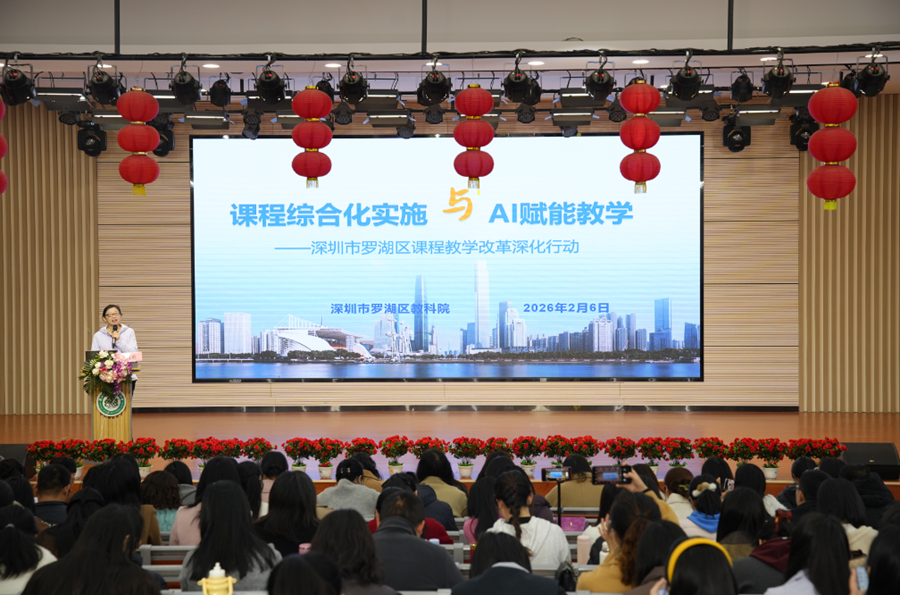
课程综合化+AI赋能 解锁教育新范式
Xin Lang Cai Jing· 2026-02-06 14:47
Core Insights - The article discusses the integration of curriculum reform and AI technology in education, highlighting a training session held in Zhanggong District aimed at enhancing educational quality through innovative teaching methods [1]. Group 1: Curriculum Integration - Curriculum integration is not merely about merging subjects but breaking down disciplinary barriers to transform students from "standard answerers" to "problem solvers" [3]. - The approach in Luohu District involves two forms: using subject-based courses for interdisciplinary project exploration and creating "expansive courses" to transition learning from "fragmented" to "integrated" [3]. Group 2: Project-Based Learning - The five-step method of "realistic context - driving questions - collaborative inquiry - results presentation - competency transfer" allows students to integrate knowledge from various subjects, enhancing their ability to solve real-world problems [4]. Group 3: AI Empowered Teaching - The RAT framework for AI application in teaching includes automating repetitive tasks to free teachers, personalized teaching through intelligent agents, and using large models and diagnostic tools to shift classrooms towards "competency cultivation" [5]. - The training session fostered active discussions among teachers regarding the development of school-based curricula and the practical implementation of AI tools, providing a clear path and practical tools for advancing educational quality in Zhanggong District [5].

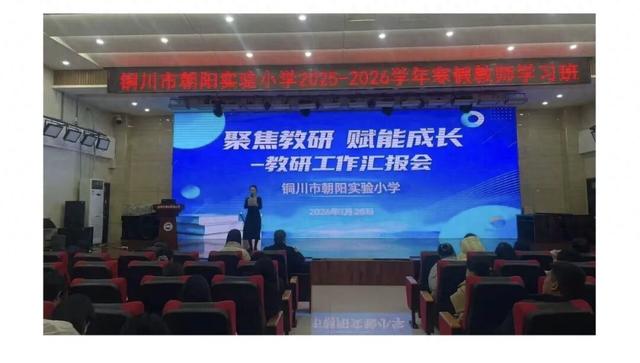
聚焦教研 赋能成长——陕西铜川市朝阳实验小学成功举办教研工作汇报会
Xin Lang Cai Jing· 2026-01-30 08:15
Core Viewpoint - The meeting focused on "Focusing on Research and Empowering Growth," highlighting the collaborative efforts of various subject teams in reflecting on the past semester and envisioning a high-quality future in education [1]. Group 1: Language Education - The sixth-grade Chinese language research group, led by teacher Hu Ting, shared insights on precise strategies and pathways for Chinese language teaching, emphasizing curriculum integration, ability transition, and skill enhancement [3]. - The first-grade Chinese language research group, led by teacher Dong Yi, discussed nurturing interest in learning during the early stages, creating an engaging and structured classroom environment, and exploring AI empowerment to promote teacher growth [4]. Group 2: English Education - The English research group, led by teacher Sun Yang, elaborated on aligning English teaching with new curriculum standards, focusing on student development and deep research on key topics such as cultivating thinking quality and integrating traditional culture [3][4]. - Various activities, including competitions and collaborative projects, were highlighted as effective means to enhance English learning and foster both student skills and teacher professional growth [3]. Group 3: Music and Mathematics Education - The music research group, led by teacher Jia Dan, presented how music education can nurture emotions and cultivate character through innovative courses and activities [4]. - The lower-grade mathematics research group, led by teacher Jiao Maomao, introduced a teaching system centered on practical experience, emphasizing hands-on learning and various engaging activities to enhance students' mathematical thinking [4]. Group 4: Overall Educational Development - The reports from the five teams showcased innovative solutions to real challenges in education and highlighted the importance of maintaining educational ideals while emphasizing subject characteristics [4][5]. - The school aims to use this meeting as an opportunity to gather collective wisdom, consolidate experiences, and continuously strengthen the teaching foundation and invigorate team dynamics [5].
大学要算好AI赋能教学的成本收益账
Xin Lang Cai Jing· 2026-01-21 12:21
Core Insights - The article discusses the challenges faced by university teachers in the U.S. due to the demands of AI-enabled teaching reforms, which distract them from academic research [1] - It highlights that while new technologies have historically been seen as transformative for education, they have not fundamentally changed the essence of university education [1] Group 1: Challenges in Education - University teachers are overwhelmed by the increasing demands of teaching and service work, particularly due to the push for AI integration in education [1] - The historical context shows that each new educational technology, from film to AI, has been met with skepticism regarding its potential to revolutionize education, yet the core nature of learning remains unchanged [1][3] Group 2: Learning Difficulties - Learning is inherently challenging and requires significant effort, which can lead to decreased interest over time, especially as knowledge complexity increases [2] - The effectiveness of AI in education is debated, with studies showing both positive and negative outcomes, indicating that learner motivation and behavior are difficult to control [2] Group 3: Recommendations for Reform - Universities should provide more autonomy to teachers and students in the AI-enabled teaching reforms to enhance engagement and effectiveness [4] - Increased technical support for teachers is essential to lower the entry barriers for using AI in teaching, which could reduce costs and improve outcomes [4] - A careful assessment of the costs and benefits of AI integration in education is necessary to avoid unnecessary reforms and maximize the benefits of AI-enabled teaching [4]
高途2025Q3财报会:盈利成为2026财年关键词
Xin Lang Zheng Quan· 2025-11-27 08:10
Core Insights - The company has positioned "profitability" as the strategic focus for the fiscal year 2026, marking a shift towards sustainable growth and efficiency [6][7][8] Financial Performance - For Q3 of fiscal year 2025, the company reported revenues of 1.58 billion yuan, a year-on-year increase of 30.7%, with cash revenue reaching 1.19 billion yuan, up 11.2% [1][2] - In the first nine months of fiscal year 2025, total revenue was 4.46 billion yuan, reflecting a 41% year-on-year growth, while cash revenue was 4.33 billion yuan, a 25.4% increase [1][2] Revenue Structure - The learning services segment contributed over 95% of total revenue, exceeding 1.5 billion yuan, with offline learning services surpassing 10% of total revenue for the first time [2] - Non-academic and traditional business segments together contributed over 1.26 billion yuan, accounting for more than 80% of total revenue, with a year-on-year growth exceeding 55% [3] Segment Performance - The non-academic business saw a revenue increase of approximately 60%, achieving its first quarterly profit, while traditional learning services grew by 15% [3] - Revenue from university and adult education services exceeded 237 million yuan, representing over 15% of total revenue, with both cash revenue and overall revenue showing double-digit year-on-year growth [4][5] Future Outlook - The company has provided revenue guidance for Q4 of fiscal year 2025, estimating between 1.628 billion and 1.648 billion yuan, with a projected year-on-year growth of 17.2% to 18.7% [6] - The management emphasizes a balanced growth trajectory for fiscal year 2026, targeting approximately 15% year-on-year revenue growth while focusing on sustainable net profitability and improved operating cash flow [7][8]