
AI To B

Search documents
恒指升138點,標普500跌19點
宝通证券· 2026-02-23 00:50
Market Overview - The Hang Seng Index (HSI) rose by 138 points or 0.5%, closing at 26,705 points after initially dropping to 26,382 points[1] - The National Index increased by 37 points or 0.4%, closing at 9,070 points, while the Hang Seng Tech Index rose by 7 points or 0.1%, closing at 5,367 points[1] - Total trading volume for the half-day session reached HKD 849.97 billion[1] U.S. Market Impact - The Dow Jones Industrial Average fell by 267 points or 0.5%, closing at 49,395 points[1] - The Nasdaq Composite decreased by 70 points or 0.3%, closing at 22,682 points, and the S&P 500 dropped by 19 points or 0.3%, closing at 6,861 points[1] Geopolitical Concerns - Investors are closely monitoring escalating tensions between the U.S. and Iran, with reports indicating that former President Trump is considering limited military strikes against Iran to compel compliance with nuclear agreements[1] - If Iran continues to reject U.S. demands regarding uranium enrichment, the U.S. may expand military actions targeting regime change[1]
钉钉变“硬”了
Xin Lang Cai Jing· 2025-12-25 11:37
Core Insights - DingTalk has launched a new AI hardware product named DingTalk Real, which integrates its office collaboration capabilities with Alibaba's AI model, aiming to create a new AI terminal entry point [1][19][20] - The return of Chen Hang to DingTalk has shifted the company's AI strategy towards a greater emphasis on AI hardware, moving away from solely software-based solutions [2][23][24] Group 1: Product Development - DingTalk Real is designed to operate independently of the DingTalk app, marking a significant evolution in its product strategy [10][30] - The previous AI hardware, DingTalk A1, was well-received in the market, becoming a top seller during the Double 11 shopping festival, indicating strong consumer interest in AI-enabled office tools [10][30] - DingTalk A1 functions as a lightweight AI recording device that enhances productivity by efficiently recording, transcribing, and summarizing voice communications [8][10][29] Group 2: Market Position and Competition - DingTalk currently holds a market share of approximately 32.7% in the enterprise collaboration sector, but faces increasing competition from rivals like Feishu and WeChat Work, which have been gaining traction [12][33] - The enterprise organization count on DingTalk has only increased by 300,000 over three years, indicating a slowdown in user growth compared to its competitors [13][35] - Feishu has reportedly captured significant clients from DingTalk, impacting its market position and revenue growth [35][36] Group 3: Strategic Shift - Under Chen Hang's leadership, DingTalk is transitioning from a broad functionality approach to a more focused strategy that emphasizes innovative collaboration tools and AI hardware [36][37] - The introduction of AI hardware is seen as a way to differentiate DingTalk from competitors and to enhance its service offerings in the enterprise market [37][38] - The company aims to redefine its role in the AI landscape by integrating its Agent OS capabilities into various hardware solutions, moving beyond traditional app-based services [31][38]

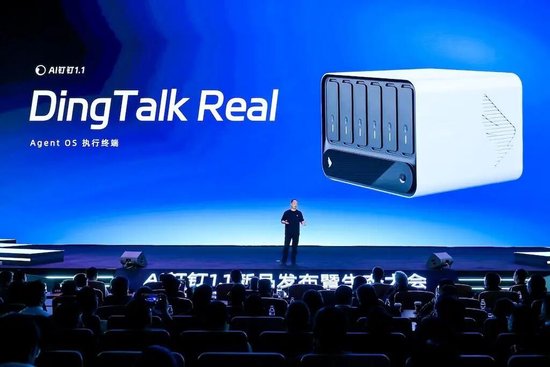
钉钉2小时发布20余款AI新品 AI To B入口战事升级
Di Yi Cai Jing· 2025-12-23 15:01
Core Viewpoint - DingTalk is expanding its AI strategy beyond office software, aiming to establish itself as an AI ToB entry point that integrates both software and hardware solutions [1][4]. Group 1: AI Product Development - DingTalk launched over 20 AI products during the AI DingTalk 1.1 product release and ecosystem conference, emphasizing its goal to connect AI with the physical world [1]. - The introduction of AgentOS marks DingTalk's first AI-focused intelligent operating system, which will serve as the foundation for all future AI agents on the platform [1]. - The core of AgentOS is to facilitate the operation and collaboration of AI agents while creating an open AI ecosystem to attract more industry players [1]. Group 2: Hardware Investment - DingTalk is accelerating its investment in hardware, highlighted by the launch of the enterprise-level AI hardware DingTalk Real, which aims to enable AI to autonomously connect and interact with the physical world [4]. - The previous hardware, DingTalk A1, has undergone over 2,000 co-creation sessions with clients in the past four months, maintaining a rapid iteration cycle of every two weeks [4]. - DingTalk Real is designed to ensure that AI operations remain within defined boundaries, maintaining human control over the system [4]. Group 3: Competitive Landscape - Alibaba has been focusing on AI hardware in the consumer sector, with the launch of Quark AI glasses and the integration of the Tmall Genie team with the Quark team to explore hardware directions [5]. - The competition among DingTalk, Feishu, and Tencent Meeting in the AI spreadsheet domain is expected to intensify, with both DingTalk and Feishu continuously enhancing their product capabilities [5]. - DingTalk is shifting its focus in AI spreadsheets to create an application development platform, allowing enterprises to generate AI applications from Excel-based data through various input methods [6].

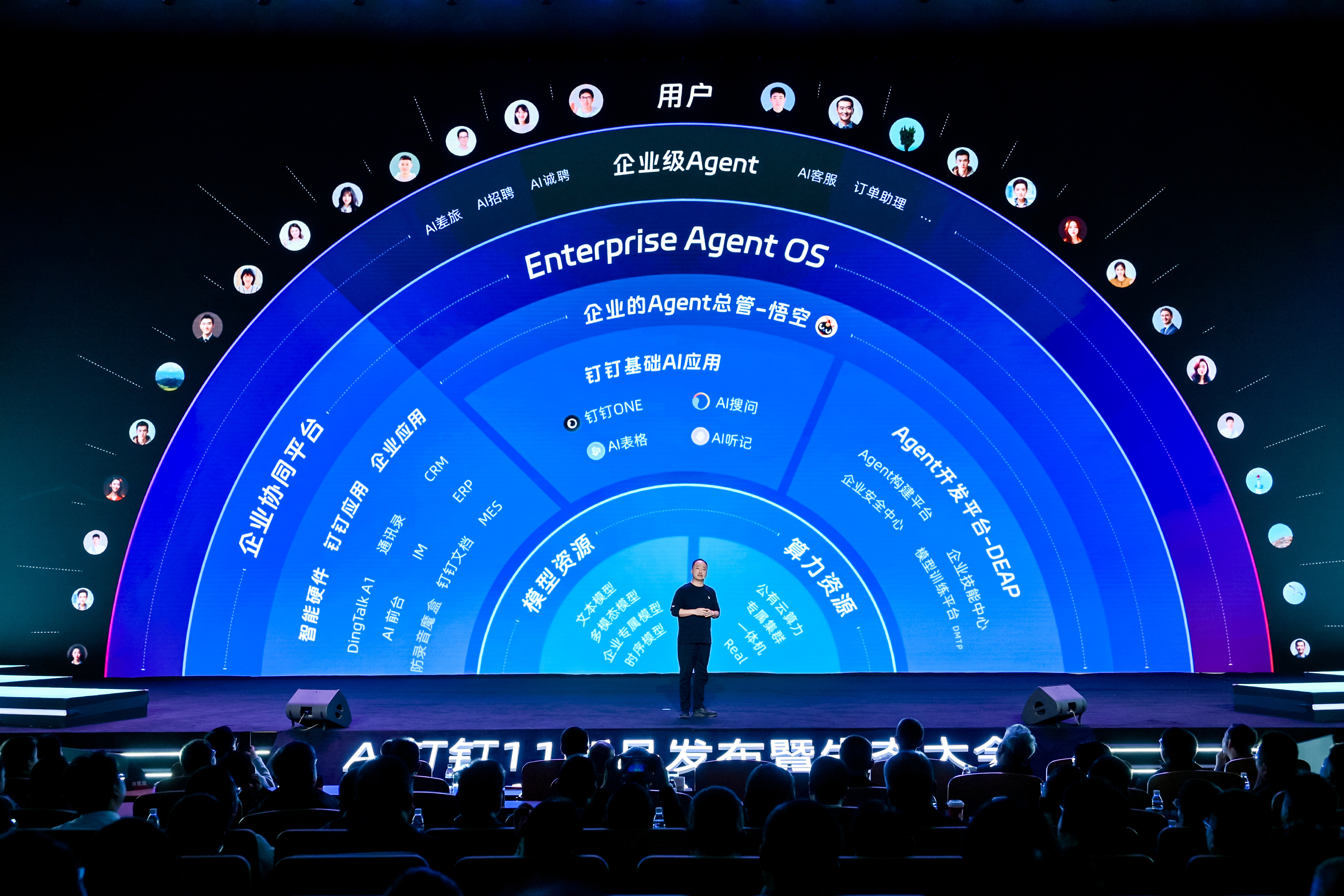
钉钉2小时发布20余款AI新品,AI To B入口战事升级
Di Yi Cai Jing· 2025-12-23 12:24
Core Insights - DingTalk aims to connect AI with the physical world, moving beyond traditional office software to become an AI-to-B (AIToB) entry point for integrated software and hardware solutions [1][4] Group 1: AI Strategy and Product Development - DingTalk's CEO, Chen Hang, announced over 20 new AI products at the AI DingTalk 1.1 launch event, including the first AI-focused work intelligence operating system, AgentOS [1] - AgentOS will serve as the foundation for all AI Agents on DingTalk, promoting an open AI ecosystem to attract more industry players into DingTalk's AI hardware market and collaborative ecosystem [1] - The company is accelerating the development of AI products while integrating external AI solutions through AgentOS to strengthen its position in the AIToB market [1] Group 2: Hardware Investments - DingTalk is increasing its investment in hardware, highlighted by the launch of the enterprise-level AI hardware DingTalk Real, which aims to enable AI to autonomously connect and interact with the physical world [4] - The previously released DingTalk A1 smart hardware has undergone over 2,000 co-creation sessions with clients in the past four months, with model iterations occurring every two weeks [4] - DingTalk Real is designed to maintain human control over AI operations through features like real identity authentication and real-time data management [4] Group 3: Competitive Landscape - Alibaba has positioned AI hardware as a key business direction within its consumer-facing AI initiatives, with the integration of the Tmall Genie team and Quark team to explore hardware opportunities [5] - The competition among DingTalk, Feishu, and Tencent Meeting in the AI spreadsheet domain is expected to intensify, with both DingTalk and Feishu continuously enhancing their product capabilities [5] - DingTalk is shifting its focus in AI spreadsheets to create an application development platform, allowing enterprises to generate AI applications from Excel-based data through various input methods [6]