Anti - money Laundering

Search documents
2025深圳金融合规观察:全年罚款破亿,160人被点名
Nan Fang Du Shi Bao· 2025-12-31 05:56
Regulatory Environment - In 2025, Shenzhen's financial regulatory environment has become increasingly stringent, with over 34 fines issued totaling more than 110 million yuan, primarily targeting banks, insurance, payment, and financial management institutions [2][3] - The "double penalty system" has been emphasized, holding both institutions and individuals accountable, with over 160 individuals facing warnings or fines, including lifetime bans for severe violations [2][3] Financial Industry Performance - Shenzhen's financial sector achieved a value-added of 245.85 billion yuan in the first half of 2025, marking a year-on-year growth of 10.9%, positioning it alongside Beijing and Shanghai [3] - The financial work meeting on December 15 highlighted the need for stronger regulatory collaboration and mechanisms to enhance compliance among financial institutions [3] Banking Sector Penalties - The banking sector in Shenzhen faced fines exceeding 69 million yuan, with state-owned banks being the most affected, particularly in loan management violations [4][5] - Major fines included 11.5 million yuan for the Industrial and Commercial Bank of China and 1.88 million yuan for Ping An Bank, indicating a focus on compliance in lending practices [5][6] Payment Institutions Oversight - The People's Bank of China issued fines totaling approximately 37.19 million yuan against payment institutions, reflecting ongoing high-pressure regulatory scrutiny [7][8] - Common violations among payment institutions included breaches of merchant management and clearing regulations, with significant penalties for repeated offenses [9] Insurance Sector Challenges - The insurance sector in Shenzhen, with total assets of 8.77 trillion yuan, has faced significant regulatory scrutiny due to issues like data authenticity and improper fund utilization [11][12] - The "double penalty system" has been applied rigorously, with personal penalties exceeding institutional fines, highlighting a shift towards individual accountability in the insurance industry [12][13]


Why Chinese Investors Don’t Welcome Dollar Stablecoins Any More
Yahoo Finance· 2025-12-05 07:52
Core Insights - Chinese crypto investors are reevaluating their reliance on dollar-pegged stablecoins like USDT due to a significant appreciation of the offshore renminbi against the dollar, which has risen from 7.4 to 7.06 over the past six months, marking its strongest level in a year [1][3] - The depreciation of dollar-denominated assets in yuan terms has resulted in a 4.6% loss for Chinese investors converting back from USDT, highlighting the risks associated with stablecoin holdings in the current currency dynamics [2][5] - The dollar index has decreased nearly 10% this year, influenced by weak US employment data and aggressive Federal Reserve rate cuts, while China's stock market rally has attracted foreign capital, further strengthening the yuan [3][4] Currency Dynamics - China's trade settled in RMB has more than doubled from January to July, with increased corporate hedging boosting practical demand for the yuan beyond speculative interests [4] - Research from Goldman Sachs indicates that a 1% appreciation of the yuan correlates with a 3% gain in Chinese equities, suggesting a self-reinforcing cycle that could further elevate the currency [4] Regulatory Environment - Tighter regulations pose additional challenges for stablecoin users, as China's central bank and 13 ministries have identified stablecoins as a concern for anti-money laundering and foreign exchange oversight [6] - Recent warnings from the central bank classify stablecoins as virtual currencies without legal tender status, raising concerns about their potential use in illegal activities [7] - The USDT-to-RMB exchange rate has fallen below 7 in peer-to-peer markets, reflecting market pressures and regulatory risk premiums, with increased transaction fees and spreads [7]
银行、保险销售违规处罚大增 183%, 反洗钱罚单翻倍丨金融合规 4 月报
2 1 Shi Ji Jing Ji Bao Dao· 2025-05-08 11:52
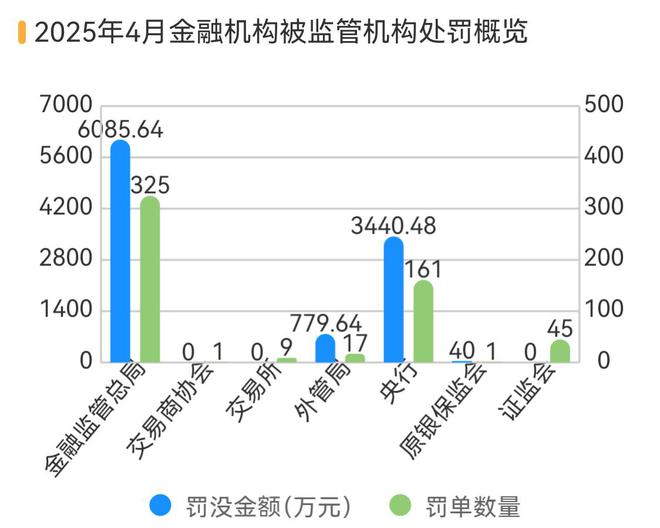
Summary of Key Points Core Viewpoint - In April, financial institutions received a total of 559 fines amounting to 103 million yuan, with the number of fines increasing by 25.9% month-on-month, while the total amount of fines slightly decreased [1]. Group 1: Penalty Overview - The National Financial Regulatory Administration issued 325 fines in April, a month-on-month increase of 16.07%, but the total amount of fines decreased by 25.75% [1]. - The central bank significantly increased its enforcement, issuing 161 fines, which is a 53.33% month-on-month increase, with a total fine amount of 34.4048 million yuan, up 48.42% [1]. - The State Administration of Foreign Exchange issued 17 fines, a 240% month-on-month increase, primarily for violations related to foreign exchange business [1]. Group 2: Institution-Specific Penalties - Banks saw a 34.88% month-on-month increase in the number of fines, while the total amount of fines slightly decreased by 8.95% [5]. - Insurance companies experienced a slight increase in both the number and amount of fines month-on-month [5]. - Securities firms received 15 fines, a decrease of 34.78% [5]. Group 3: Major Fines - In April, there were four fines exceeding 2 million yuan, with the largest being 2.3 million yuan against the Jiangxi branch of Bank of Communications for inadequate credit management [9]. - The second-largest fine was against Ningbo Donghai Bank for 2.271 million yuan due to violations of anti-money laundering laws and credit information management [9]. - Wenzhou Bank was fined 2.25 million yuan for violating financial statistical management regulations [9]. Group 4: Compliance Characteristics - The central bank intensified its anti-money laundering efforts, with related fines increasing by 107% month-on-month, totaling 118 fines in April, primarily against commercial banks [10]. - Violations included failure to perform customer identity verification and not reporting large or suspicious transactions as required [10]. - In April, five banks and four insurance companies were penalized for sales violations, with a total of 17 fines, marking a 183% month-on-month increase [11]. Group 5: Penalty Rankings - The bank with the highest total fines in April was Bank of China, with 4.3874 million yuan; Agricultural Bank of China followed with 3.39 million yuan, and Industrial and Commercial Bank of China with 3.268 million yuan [11]. - Among non-bank institutions, CITIC Financial Assets faced the highest fines at 1.8 million yuan, followed by China Life Insurance at 1.48 million yuan and Ping An Life Insurance at 1.41 million yuan [14].