Bionic Technology

Search documents
告别磁铁和吸盘!中国团队造出生物履带,让机器人真成了水陆两栖壁虎
机器人大讲堂· 2026-01-13 04:04
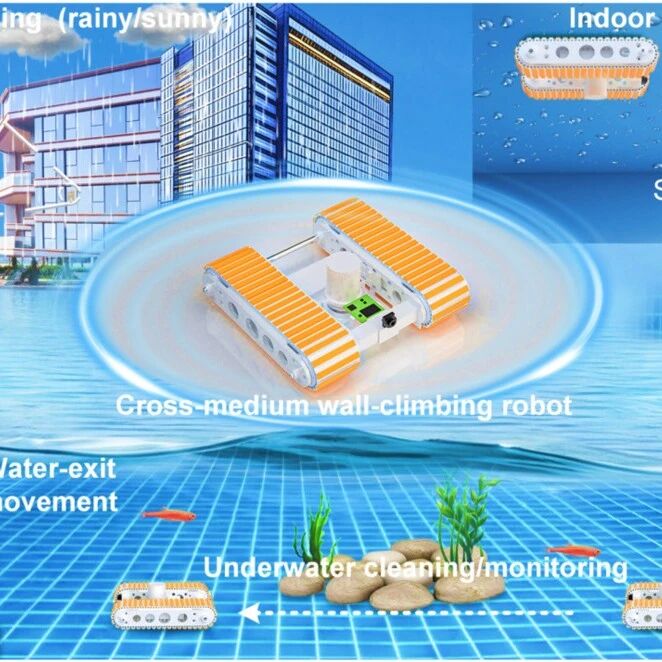
Core Viewpoint - A new adaptive hybrid track has been developed, enabling robots to seamlessly traverse between water and land, marking a significant advancement in bionic robotics [1]. Group 1: Current Challenges - Existing wall-climbing robots are limited in their capabilities, often excelling in only one environment and struggling to transition between different mediums [4][10]. - Current adhesion mechanisms have various shortcomings: magnetic adhesion is limited to ferromagnetic surfaces [6], negative pressure adhesion requires smooth, sealed surfaces and has high energy consumption [7], dry adhesion performs poorly underwater [8], and octopus suction cups lose effectiveness outside of water [9]. Group 2: Biological Inspiration - The research team drew inspiration from nature, specifically the gecko's foot and the octopus's tentacle, which have mastered the secrets of adhesion across different mediums [11][13]. - The gecko's ability to adhere to smooth surfaces is due to micro-structured hairs that utilize van der Waals forces, while the octopus uses suction cups that create negative pressure [11][13]. Group 3: Key Breakthroughs - The team designed a unique hollow mushroom-shaped adhesive microstructure (HMSAMS) that combines the advantages of both the gecko and octopus, achieving remarkable adhesion in both dry and underwater environments [14][15]. - Experimental data shows that a patch made from this microstructure can achieve a normal adhesion strength of approximately 240 kPa in dry conditions and up to 290 kPa underwater, capable of lifting about 3 kilograms per square centimeter [17]. Group 4: Advanced Design Features - The design includes discrete adhesive patches rather than a continuous layer, mimicking the biological structures of gecko toes and octopus tentacles to enhance stress distribution and peeling resistance [19][21]. - The base of the track features soft columnar structures that allow the robot to adapt to uneven surfaces, enhancing stability and contact adaptability [22]. Group 5: Application Potential - The integrated robot, weighing about 485 grams, can operate effectively on vertical glass walls in dry conditions and move freely on vertical surfaces underwater [23][24]. - It can smoothly transition between water and air, demonstrating potential applications in various scenarios such as all-weather monitoring, covert reconnaissance, hazardous environment operations, and navigating confined spaces [27][30]. Group 6: Future Prospects - This research not only creates a versatile robot capable of operating in diverse environments but also establishes a paradigm for solving complex engineering problems through passive mechanical design inspired by biological systems [31].

打破复杂水域探测困境!浙大仿生机器鱼登CELL子刊,双游动模式展现卓越环境适应性,负重54倍稳定前行
机器人大讲堂· 2025-10-16 11:59
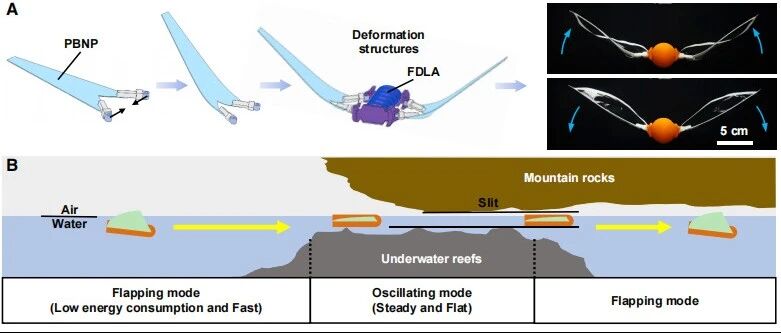
Core Insights - The article discusses the development of a bionic robotic fish by Zhejiang University, which addresses the challenges of underwater exploration and monitoring in complex marine environments [1][3]. Innovation and Design - The robotic fish features a novel drive/deformation system based on a structure called "Post-Buckling Notched Plates" (PBNP), which mimics the pectoral fins of manta rays to convert small linear movements into significant fin flapping [5][7]. - The design allows for controlled and efficient deformation, enabling the robotic fish to navigate both narrow spaces and open waters effectively [1][5]. Performance and Modes - The swimming behavior of the robotic fish is controlled by three parameters: vacuum pressure, frequency, and duty cycle, which influence the fin flapping and overall swimming performance [10][12]. - It operates in two modes: "flapping mode" for rapid propulsion and efficient cruising at low frequencies (0-4 Hz), and "oscillation mode" for stable movement in confined spaces at higher frequencies (above 4 Hz) [12][16]. Environmental Adaptability - The robotic fish demonstrates exceptional adaptability to extreme conditions, functioning in temperatures ranging from 0.6°C to 87.2°C, making it suitable for various marine environments [19][20]. - It can seamlessly switch between modes to navigate through different environmental challenges, such as strong currents and narrow gaps [22][24]. Multi-Functionality - A non-tethered version of the robotic fish integrates multiple functions, including propulsion, monitoring, and communication, into a compact design, enhancing its operational reliability [25][27]. - The system can sample water quality in real-time and distribute substances like feed or water treatment agents during operation, transforming the robotic fish into a mobile workstation for aquaculture and environmental monitoring [27][28]. Future Developments - Future research aims to optimize the fish's shape to reduce hydrodynamic drag and enhance its autonomous navigation capabilities through advanced sensor integration [29].