CRB指数

Search documents
中物联:2025年12月中国大宗商品价格指数为117.9点 环比上涨3.2%
智通财经网· 2026-01-05 07:08
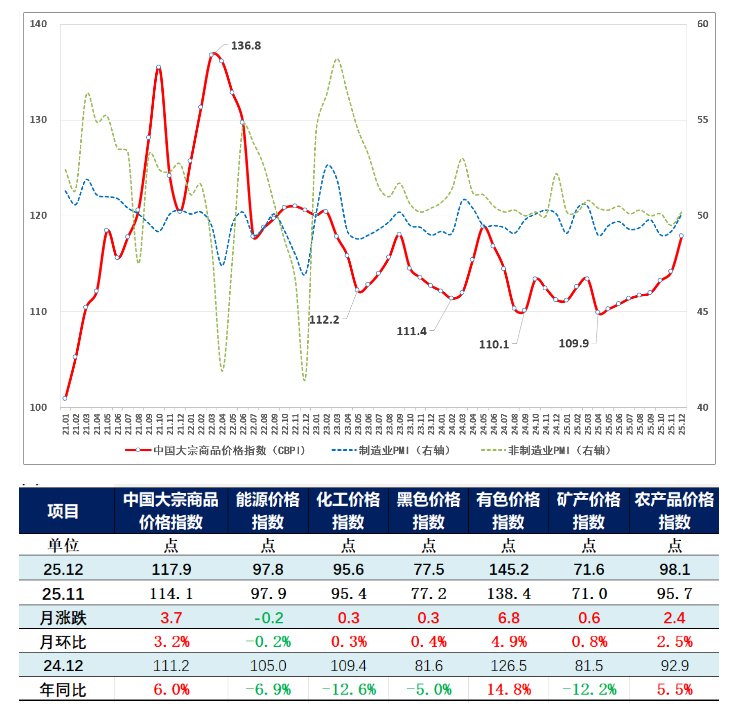
Core Viewpoint - The China Commodity Price Index (CBPI) for December 2025 reached 117.9 points, reflecting a month-on-month increase of 3.2% and a year-on-year increase of 6%, indicating a recovery in the commodity market driven by improved supply and demand dynamics and increased business confidence [1][3]. Summary by Category Overall Market Performance - The CBPI has shown a continuous month-on-month increase for eight consecutive months, reaching its highest level since June 2024, suggesting a strengthening of economic growth momentum [1]. - The outlook for 2026 indicates potential challenges from global economic recovery, but supportive macroeconomic policies and structural economic upgrades in China are expected to foster new demand for commodities [1]. Price Index Breakdown - The price indices for various categories in December 2025 are as follows: - Energy Price Index: 97.8 points, down 0.2% month-on-month, down 6.9% year-on-year - Chemical Price Index: 95.6 points, up 0.3% month-on-month, down 12.6% year-on-year - Black Metal Price Index: 77.5 points, up 0.4% month-on-month, down 5% year-on-year - Non-ferrous Metal Price Index: 145.2 points, up 4.9% month-on-month, up 14.8% year-on-year - Mineral Price Index: 71.6 points, up 0.8% month-on-month, down 12.2% year-on-year - Agricultural Product Price Index: 98.1 points, up 2.5% month-on-month, up 5.5% year-on-year [3][4]. Commodity Price Changes - Among 50 monitored commodities, 31 (62%) saw price increases, while 19 (38%) experienced declines in December 2025. The top three commodities with the highest month-on-month price increases were lithium carbonate (up 15.5%), refined tin (up 11.7%), and apples (up 8.5%). The largest declines were seen in caustic soda (down 7.2%), ethylene glycol (down 6.8%), and coking coal (down 6.5%) [5].

中物联:2025年8月中国大宗商品价格指数(CBPI)为111.7点 环比上涨0.3%
智通财经网· 2025-09-05 10:44
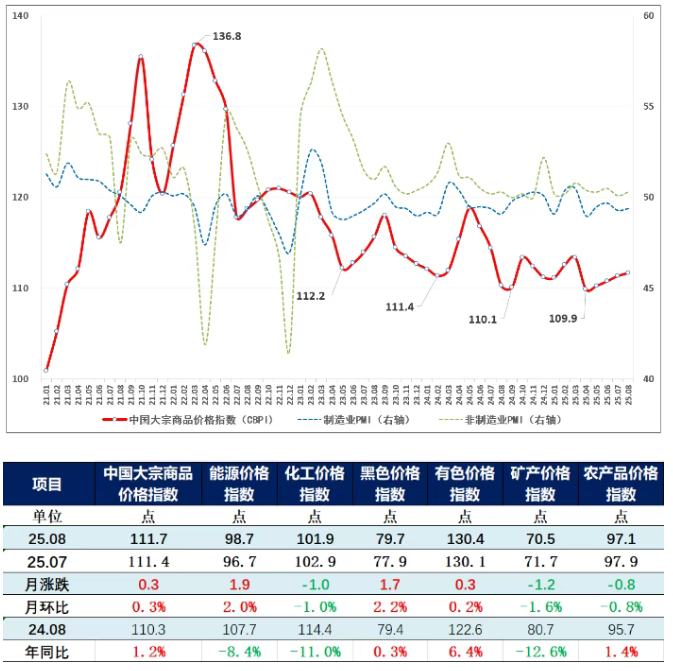
Core Insights - The China Commodity Price Index (CBPI) for August 2025 is reported at 111.7 points, reflecting a month-on-month increase of 0.3% and a year-on-year increase of 1.2% [1][3] - The index has shown a continuous month-on-month recovery for four consecutive months, indicating an expansion in enterprise production and operations due to government policies aimed at boosting domestic demand [1][3] - The upcoming traditional production peak seasons in September and October are expected to sustain the positive development trend in the commodity market, despite ongoing global economic uncertainties [1][3] Price Index Summary - The CBPI for August 2025 is 111.7 points, with a month-on-month increase of 0.3% and a year-on-year increase of 1.2% [3] - The energy price index is at 98.7 points, up 2.0% month-on-month but down 8.4% year-on-year [3] - The black metal price index is at 79.7 points, with a month-on-month increase of 2.2% and a year-on-year increase of 0.3% [3] - The non-ferrous metal price index is at 130.4 points, showing a month-on-month increase of 0.2% and a year-on-year increase of 6.4% [3] - The chemical price index is at 101.9 points, down 1.0% month-on-month and down 11.0% year-on-year [3] - The agricultural product price index is at 97.1 points, down 0.8% month-on-month and up 1.4% year-on-year [3] - The mineral price index is at 70.5 points, down 1.6% month-on-month and down 12.6% year-on-year [3] Commodity Price Movements - Among the 50 monitored commodities, 25 saw price increases while 25 experienced declines [5] - The top three commodities with the highest month-on-month price increases are coking coal (20.1%), neodymium oxide (19.1%), and lithium carbonate (16.6%) [5] - The top three commodities with the largest month-on-month price decreases are apples (-4.6%), methanol (-3.6%), and urea (-2.8%) [5] Market Context - The CBPI shows a divergence from the Producer Price Index (PPI) and aligns with the Consumer Price Index (CPI) trends [4] - The S&P 500 index reached a historical peak of 6508.23 points, supported by expectations of interest rate cuts in the U.S. and a weaker dollar, which bolstered confidence in the commodity market [4]