Carbon Peak and Carbon Neutrality

Search documents
聚焦两会 | 政府工作报告,定调储能新发展
行家说储能· 2026-03-05 03:33
Core Viewpoint - The article emphasizes the significant focus on energy storage development during the 2026 National People's Congress, highlighting its integration into national energy strategies and the push for green energy applications [2][3]. Group 1: Government Work Report Highlights - The government aims for a 4.5% to 5% economic growth target, with a strong emphasis on developing a green low-carbon economy and enhancing energy storage systems [3]. - The installed capacity of new energy storage exceeded 130 million kilowatts, with non-fossil energy consumption accounting for 21.7% [3]. - The report outlines the establishment of a national low-carbon transition fund and the promotion of hydrogen and green fuels as new growth points [3][4]. Group 2: Recommendations from NPC Representatives - Suggestions include accelerating the planning of ultra-high voltage direct current channels to enhance renewable energy consumption in regions like Xinjiang [5]. - A proposal to enforce long-duration energy storage facilities in renewable-rich areas, with a target of achieving over 8% long-duration storage by 2027 [5][6]. - Recommendations to integrate green electricity with intelligent computing and to support the development of zero-carbon parks and green hydrogen projects [6][7]. Group 3: Provincial Government Reports - 21 provinces have included energy storage in their government work reports, indicating its transition from an optional to a mandatory focus area in energy transition planning [8][9]. - Provinces like Guangdong aim to increase the share of renewable energy installations from 23.3% to 40.4% during the 14th Five-Year Plan [10]. - Various provinces are pushing for the construction of zero-carbon parks and integrating energy storage into their energy systems, with specific targets for new installations [9][10].

山西:生态筑基绘锦绣 表里山河谱新篇
Jing Ji Wang· 2026-02-12 09:54
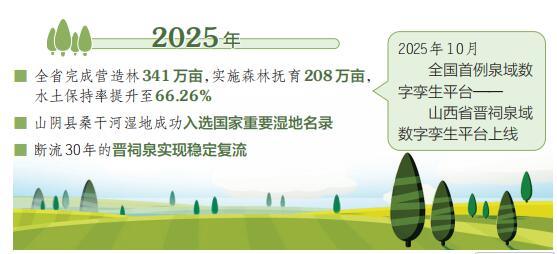
Core Viewpoint - Shanxi province is focusing on ecological protection and high-quality development by promoting carbon reduction, pollution control, and green expansion, aiming for a harmonious coexistence between humans and nature by 2025 [2]. Group 1: Ecological Protection and Restoration - Shanxi prioritizes ecological protection and restoration, utilizing a systematic approach to enhance the ecological environment, with a focus on water and forest management [3]. - The province has completed afforestation of 3.41 million acres, exceeding the annual target by 131.15%, and improved soil and water conservation rates to 66.26% [4]. - Biodiversity efforts have led to the province being the only one in China approved for a World Bank loan for sustainable ecosystem restoration and biodiversity protection projects [4]. Group 2: Water Management and Improvement - The province implements a comprehensive water management strategy, focusing on the ecological improvement of rivers and lakes, with specific plans for groundwater management in 32 counties [5]. - The restoration of the Jinxi Spring, which had been dry for 30 years, exemplifies successful water management efforts [5]. - The ecological flow monitoring rate for key rivers has reached over 90%, indicating significant progress in water management [5]. Group 3: Green Transition and Technological Innovation - Shanxi is advancing its green transition through innovation and reform, with a focus on carbon neutrality and sustainable development [6][7]. - The province has seen a significant reduction in pollution, with PM2.5 levels dropping to 30 micrograms per cubic meter and the number of heavily polluted days reaching zero for the first time [7]. - The introduction of digital platforms for ecological management enhances precision in environmental protection efforts [8]. Group 4: Community Engagement and Quality of Life - The province emphasizes community involvement in ecological initiatives, fostering a culture of shared responsibility for environmental protection [9]. - Urban and rural ecological governance improvements have led to enhanced living conditions, with projects aimed at water conservation and urban greening [9]. - The integration of ecological protection with rural revitalization has resulted in increased economic benefits for local communities, exemplified by the success of strawberry farming in Hequan Village [10][11].
“十五五”如何加快完善碳排放统计核算体系?
Zhong Guo Huan Jing Bao· 2026-02-09 23:29
Core Viewpoint - The construction of the carbon emission statistical accounting system is crucial for implementing national strategies to combat climate change and achieving carbon peak and carbon neutrality goals. The system is being developed across various levels, including regional, industrial, enterprise, and product levels, but still faces challenges that need to be addressed for effective implementation [1][6]. Group 1: National Framework and Policies - A national institutional framework for carbon emission statistical accounting has been established, with a series of policy documents released to support the carbon peak and carbon neutrality goals. The "dual control system" for carbon emissions will focus on intensity control during the "14th Five-Year Plan" and total control post-peak [3][9]. - The State Council has outlined a comprehensive policy toolbox that includes local carbon assessments, industry carbon control, enterprise carbon management, project carbon evaluations, and product carbon footprints, with clear phased goals set for implementation [3][4]. Group 2: Local Government Initiatives - Local governments are actively promoting pilot projects to translate national carbon control policies into actionable plans. For instance, Zhejiang Province is exploring carbon budget management, while Wuxi City has set a three-phase goal for carbon management [4][5]. - Cities like Zhengzhou are developing intelligent carbon management platforms to facilitate collaborative governance among government, enterprises, and individuals [4]. Group 3: Industry and Enterprise Engagement - The establishment of a carbon emission accounting and verification technical specification system is underway, with guidelines released for key industries such as power generation, steel, cement, and aluminum smelting [4][5]. - The carbon footprint management system for products has made significant progress, with national standards for carbon footprint accounting being developed for various products, including aluminum and chemical fibers [5]. Group 4: Challenges and Recommendations - Despite progress, challenges remain in policy coordination, data foundation, and international alignment. The dual control system for carbon emissions will require higher standards for data timeliness, consistency, and accuracy [6][9]. - Recommendations include enhancing policy collaboration, solidifying data foundations, deepening international exchanges, and strengthening market mechanisms to support the long-term goals of carbon neutrality by 2060 [9][10].
风光并网装机规模首超18亿千瓦,装机超火电3亿千瓦
Di Yi Cai Jing· 2026-01-28 10:53
Core Insights - China's renewable energy development has achieved a milestone with the average cost of electricity for wind and solar projects decreasing by 60% and 80% respectively over the past decade [4] - By the end of 2025, the cumulative installed capacity of wind and solar power exceeded 1.84 billion kilowatts, accounting for 47.3% of the total installed capacity [1][2] - The installed capacity of solar power reached 1.2 billion kilowatts, marking a year-on-year growth of 35.4%, while wind power capacity reached 640 million kilowatts, with a year-on-year increase of 22.9% [1] Installed Capacity Growth - In 2025, the cumulative installed capacity of wind and solar power surpassed that of thermal power by over 300 million kilowatts [2] - The average utilization hours of power generation equipment in plants with 6,000 kilowatts and above decreased by 312 hours compared to the previous year, totaling 3,119 hours [3] - The new installed capacity for solar power in 2025 was 315.07 GW, while wind power added 119.33 GW, both achieving record highs [3] Policy and Market Position - Since the 14th Five-Year Plan, 80% of new installed capacity has come from renewable energy sources, solidifying China's position as the largest market for wind and solar power globally [4] - China has established a comprehensive energy production and consumption framework, focusing on a "wind and solar dominant, multi-energy complementarity" development path [3] - Various policy documents, including the "14th Five-Year Plan for Renewable Energy Development," have been issued to promote the rapid development of renewable energy, reducing reliance on fossil fuels [3]
【建议收藏】重磅!2025年厦门市新型储能产业链全景图谱(附产业政策、产业链现状图谱、产业资源空间布局、产业链发展规划)
Qian Zhan Wang· 2026-01-27 02:54
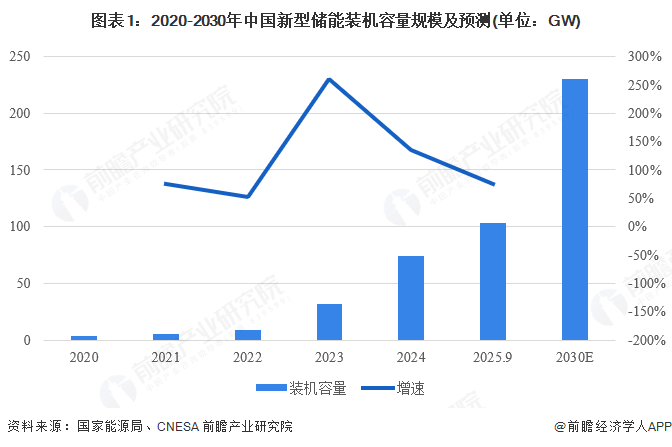
Core Insights - The new energy storage industry is crucial for China's power system and achieving carbon neutrality goals, with a significant growth forecast from 3.28GW in 2020 to 230GW by 2030, making China the global leader with 40% of the market share [1][2][18]. Industry Development Status and Value Chain Distribution - The new energy storage industry is a key technology for China's energy transition, with a cumulative installed capacity growth from 8.7GW in 2023 to 31.39GW, representing a year-on-year increase of over 260% [1]. - The industry value chain includes upstream raw materials and equipment supply, midstream system integration, and downstream applications such as power generation and commercial storage [2][4]. - Profit margins vary across the value chain, with upstream components like air compressors and heat exchangers showing 20%-40% margins, while downstream applications maintain margins above 22% [4]. Policy Environment in Xiamen - Xiamen's government has prioritized the new energy storage industry as a core driver for economic growth, aiming to create a 100 billion yuan new energy industry cluster by 2026 [6][9]. - The "Xiamen New Energy Storage Industry High-Quality Development Action Plan (2024-2026)" outlines specific goals, including a core industry scale exceeding 50 billion yuan and the development of 26 application scenarios [25][26]. Current Status of Xiamen's New Energy Storage Industry - Xiamen's new energy storage industry has seen a significant increase in registered companies, with 229 active firms as of November 2025, reflecting a growing focus on energy transition [19]. - The city's new energy industry output has doubled from 379 billion yuan in 2020 to 948 billion yuan in 2024, with a projected value exceeding 1100 billion yuan by 2025 [18]. Research and Development Investments - Leading companies in Xiamen, such as Hai Chen Energy, are investing heavily in R&D, with Hai Chen's investment reaching 530 million yuan in 2024, focusing on advanced storage technologies [22]. Future Development Outlook - Xiamen aims to establish itself as an international hub for new energy storage innovation, with plans to develop a comprehensive ecosystem that includes technology breakthroughs and market expansion [25][26].
论展结合、以展招商 深圳国家低碳城论坛亮点提前看
Nan Fang Du Shi Bao· 2025-10-27 10:52
Core Insights - The 2025 Carbon Peak and Carbon Neutrality Forum will be held in Shenzhen, focusing on "AI Empowering Urban Green Development" and gathering global wisdom to discuss a sustainable future [2] - The event will feature a combination of exhibitions and investment matchmaking, showcasing innovative low-carbon technologies and facilitating collaboration among enterprises [2][6] Group 1: Exhibition Highlights - The "New Municipal" exhibition area will present a real-life model of a city-level energy system, featuring 63 products from 37 companies, showcasing the innovative "New Municipal" framework of Longgang District [3] - The exhibition will cover five core areas, including smart parks, new energy, sanitation battery swapping, unmanned logistics, and low-altitude economy, illustrating the comprehensive green transformation path of Longgang [4] Group 2: Future Home Exhibition - The "Future Home" exhibition area will display 72 green low-carbon innovative products from 44 companies, divided into four experiential scenarios that demonstrate the application of green technologies in future living [5] - Scenarios include AI integration, smart home systems, low-carbon manufacturing, and innovative materials, highlighting the synergy of technology, culture, and low-carbon concepts [5] Group 3: Investment and Collaboration - An investment promotion conference will take place on October 28, focusing on low-carbon industries, featuring project signings and the release of a white paper on the construction of a green intelligent system [6] - This dual approach of exhibition and investment aims to accelerate the transformation of innovative technologies and promote the development of new productive forces in Longgang [6]
MyEMS:赋能能源管理数字化转型的核心引擎
Sou Hu Cai Jing· 2025-08-20 09:27
Core Insights - MyEMS is a key driver of digital transformation in energy management, leveraging unique technology architecture and significant environmental value to upgrade the energy sector [1][3] Technology Architecture - MyEMS employs a layered architecture design, consisting of a perception layer for data collection, a network layer for data transmission, a data layer for storage and management, and an application layer for user services, ensuring stability, reliability, and flexibility [1] Practical Applications - MyEMS has demonstrated significant results in various sectors, such as a large manufacturing company reducing energy consumption by 15% and saving millions annually after implementing system recommendations [2] - In commercial buildings, a high-end office utilized MyEMS to manage its air conditioning system, achieving a 20% reduction in energy consumption while enhancing indoor comfort [2] - A tertiary hospital employed MyEMS for comprehensive energy management, optimizing energy distribution and saving hundreds of thousands annually [2] Environmental Contributions - MyEMS contributes to environmental protection by helping organizations reduce energy consumption and carbon emissions, with an average reduction of 10% to 25% in carbon emissions for users [3] - The system monitors pollutant emissions during energy consumption processes, providing alerts for any exceedances to prevent environmental pollution incidents [3] Future Developments - MyEMS plans to integrate emerging technologies like artificial intelligence and blockchain to enhance data analysis, security, and collaboration within the energy management ecosystem [4] - The incorporation of AI will enable more precise energy management solutions, while blockchain will ensure data integrity and traceability [4] - MyEMS aims to foster closer cooperation with energy suppliers and regulatory bodies to create a collaborative energy management ecosystem [4]
【投资视角】启示2025:中国贵金属材料产业投融资及兼并重组分析(附投融资事件、产业基金和兼并重组等)
Qian Zhan Wang· 2025-05-27 06:13
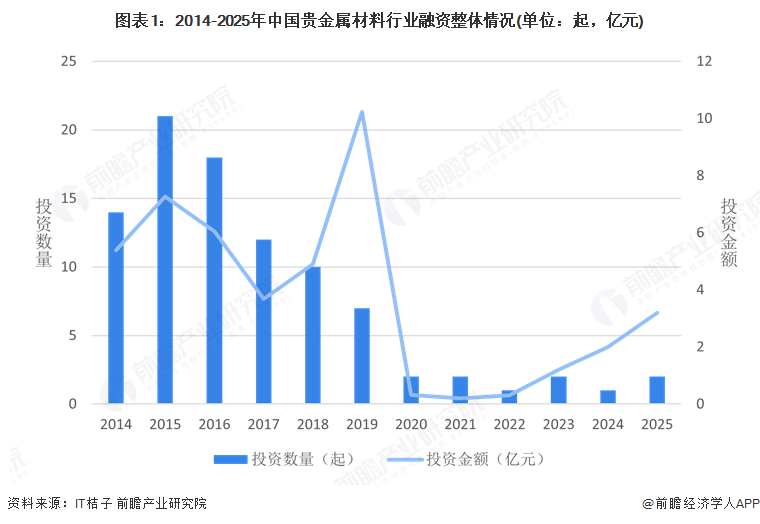
Group 1 - The financing scale of listed companies in the precious metal materials industry is relatively small, but the amount of single financing has shown an upward trend in recent years [1][2] - The number of financing events in the precious metal materials industry has not exceeded two per year in the past five years, but the financing amount has increased from 0.32 billion yuan in 2020 to 2 billion yuan in 2024 [1][2] - As of March 31, 2025, there have been two financing events in the precious metal materials industry, with a cumulative amount of 3.2 billion yuan [1] Group 2 - The average single financing amount from 2014 to 2022 was generally below 50 million yuan, with a notable increase in the last two years, exceeding 150 million yuan in 2024-2025 [2] - The main investment direction in the precious metal materials industry is advanced technology research and development [4] Group 3 - The investment entities in the precious metal materials industry are primarily domestic investment firms, with notable foreign investment activity in precious metal trading platforms [11] - There are two precious metal-related industry funds registered in China, both with management scales of 0-500 million yuan, while funds in downstream application areas are larger, with one managing 5-10 billion yuan [14][15] Group 4 - As of the first quarter of 2025, there are four precious metal materials industrial park projects under construction in China, promoting the development of the precious metal materials industry [20] - The investment amounts for these projects range from 120 million yuan to 601.2 million yuan, with funding primarily from government allocations [21] Group 5 - The mergers and acquisitions in the precious metal materials industry are mainly for horizontal integration, with numerous transactions reported from 2018 to March 2025 [22][24] - The majority of recent mergers and acquisitions involve companies expanding their scale through horizontal integration [22][24]