
Credit Growth

Search documents
Commercial credit up 15% in a year as rate cuts spur demand
The Economic Times· 2026-02-23 19:09
Core Insights - The incremental credit growth in the first 10 months of the fiscal year reached Rs 34.5 lakh crore, reflecting a 35% increase compared to the same period last year [1][7] - The gap between bank credit and non-banking sources of credit widened significantly, indicating a shift in the credit landscape [3][7] Credit Growth Analysis - Bank credit to the commercial sector increased by nearly Rs 21.7 lakh crore, while non-bank sources of credit amounted to Rs 12.6 lakh crore, which includes various financial instruments [5][7] - The share of incremental credit from non-banking sources declined, with equity issuances falling by 12% to Rs 2.97 lakh crore [6][7] - Non-Banking Financial Companies (NBFCs) experienced a 20% growth in outstanding credit, surpassing the 14% growth in credit from commercial banks [6][7] Economic Context - The increase in credit offtake is attributed to the Reserve Bank of India's rate cuts and significant liquidity infusion [5][7] - Outstanding credit to the commercial sector exceeded Rs 300 lakh crore at the end of January, marking a year-on-year increase of 14.7% [7]



Interview with chairman SC Shetty: 'SBI Will Double Its Balance Sheet In 6-7 Years'
Rediff· 2026-02-11 06:18
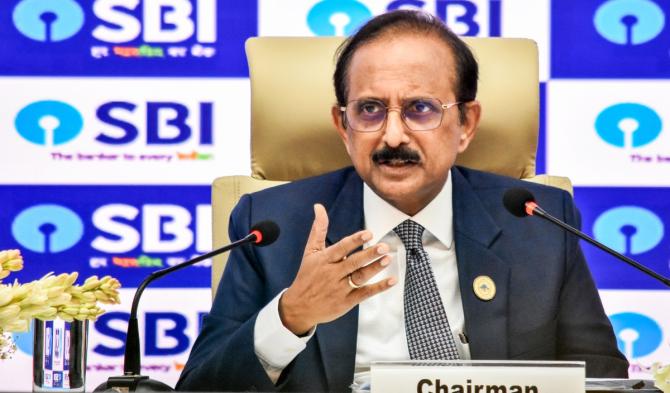
'Credit growth in India remains in double digits, even though corporate borrowing is subdued.''Corporate credit is weak because companies are cash-rich and cautious amid global uncertainty.'IMAGE: SBI Chairman Challa Sreenivasulu Setty during a Press Conference at SBI Head Office, in Mumbai. Photograph: ANI Photo CS Setty, chairman of State Bank of India (SBI), in a conversation with Tamal Bandyopadhyay, at the Business Standard BFSI Insight Summit 2025, discusses the slowdown in credit growth in the econom ...
Q3 credit growth signals economic pickup, still prefer larger banks like Axis, Kotak, ICICI, SBI: Sandip Sabharwal
The Economic Times· 2026-01-06 08:32
Economic Outlook - Double-digit loan growth across most large banks indicates rising economic activity after a prolonged phase of single-digit growth, suggesting an economic pickup [1][13] - System-wide gross NPAs have fallen to multi-year lows, strengthening the investment case for large banks [5][13] Banking Sector - Axis Bank and Kotak Mahindra Bank reported strong Q3 updates, while HDFC Bank showed stable but unspectacular growth; Axis is considered attractive from a valuation standpoint [2][13] - Preference remains with large banks over smaller lenders due to historical asset-quality risks associated with aggressive lending by smaller institutions [6][13] - Preferred banking holdings include ICICI Bank, Axis Bank, State Bank of India, and IDFC First Bank, which may benefit from lower interest rates [13] Consumption and Retail - Caution is advised on high-valuation retail stocks, with expectations for Trent being high, making sustained 20%+ growth difficult [7][13] - FMCG companies like Marico and Britannia have performed well during the consumption slowdown, while stocks such as Dabur and Godrej Consumer Products could emerge as strong performers in the next one to two years [8][13] FMCG Sector - ITC faces challenges due to a sharp excise duty hike on cigarettes, which could hurt volumes and presents risks from illicit cigarette inflows; its non-tobacco FMCG business has yet to achieve meaningful profitability [9][13] Power Sector - Preference is for transmission, transformer, and power equipment companies over pure financiers or generators due to long-term risks in solar project financing [10][11][13] Automotive Sector - Market leaders in the automotive sector continue to outperform, making turnaround bets less attractive; Mahindra & Mahindra is highlighted as a strong position [12][14] - Commercial vehicles are seen as having better prospects than passenger vehicles within Tata Motors [14] Staples Sector - A gradual recovery in staples is expected after two to three years of weak demand, with potential for double-digit returns if consumer demand picks up and inflation eases [12][14]
China's credit growth in November stays muted on low demand
The Economic Times· 2025-12-12 19:23
Credit Growth and Economic Indicators - Financial institutions extended ¥392 billion ($55.6 billion) of new yuan loans in November, falling short of the median forecast of ¥450 billion, indicating weak credit growth [1][6] - Household loans contracted for the second consecutive month, marking the first such occurrence since 2005, reflecting a trend of net debt repayment by residents due to a bleak job market and deteriorating housing market [1][6] - New medium- and long-term corporate loans weakened compared to the previous year, suggesting a lack of demand for business expansion [2][6] - Bill financing, a tool used by banks to inflate lending, more than doubled, indicating dire business demand [2][6] Future Outlook - Credit growth is expected to remain weak in the coming months, with subdued loan demand anticipated due to elevated real lending rates amid deflation [3][6] - The growth rate of the credit stock accelerated earlier in the year but has slowed recently, attributed to government bond sales and weakening economic momentum [6] EU Import Duties - The European Union finance ministers agreed to impose a three-euro duty on all small parcels imported into the bloc starting July 1, 2026, to address the influx of cheap imports, primarily from China [7][10] - This decision follows the removal of a duty exemption for packages valued under €150 ($174), which was commonly used for direct consumer imports from Chinese platforms [8][10] - In the previous year, 4.6 billion small packages entered the EU, with 91% originating from China, and the EU expects this number to rise [10]

Lenders unlikely to sharply cut deposit, MCLR rates despite repo cut, senior bankers say
BusinessLine· 2025-12-09 15:34
Core Viewpoint - The Reserve Bank of India's recent 25 basis points repo rate cut is not expected to lead to significant reductions in term deposit and marginal cost of funds-based lending rates (MCLR) by banks due to competitive pressures and the need to protect net interest margins [1][2]. Group 1: Bank Responses to Repo Rate Cut - Senior bankers, including the Chairman of State Bank of India, believe that the 25 bps rate cut will have minimal impact on deposit rates as banks are focused on maintaining their deposit base amid robust credit growth [2]. - The expectation of higher credit growth in the second half of FY26 and intense competition, particularly from smaller lenders, suggests that deposit rates will not decrease in line with repo cuts [2][3]. - ICRA Ratings indicates that any reduction in deposit rates will depend on credit growth trajectories, with minor reductions possible but not guaranteed [3]. Group 2: Liquidity and Rate Adjustments - The banking system has maintained an average liquidity surplus of ₹1.5 lakh crore since October 2025, which influences banks' decisions on deposit rates [4]. - Following a cumulative 100 bps repo rate cut from February to October 2025, the weighted average lending rate (WALR) for fresh rupee loans decreased by 69 bps, while the weighted average domestic term deposit rate (WADTDR) for fresh deposits fell by 105 bps [4]. - The MCLR is a formula-driven benchmark that will not adjust unless banks' cost of funds decreases, indicating that banks with a larger MCLR book can protect their margins despite repo rate cuts [5]. Group 3: Future Rate Expectations - Harsh Dugar from Federal Bank notes that money market rates are aligned with the policy repo rate, and a broad transmission of rates in both deposit and lending is expected to continue [7]. - ICRA's Srinivasan suggests that while banks have already reduced rates on repo-linked loans, they will be cautious in cutting MCLR rates to maintain margins, with a potential minor reduction of 5 bps anticipated [8].

The Bright Spots in India's Stock Market Right Now
Bloomberg Television· 2025-11-14 08:55
Indian Economic Outlook - India could benefit from a potential burst in the "air bubble" due to its limited exposure to hyperscaler stocks and data center capacity stocks [2][3] - Axis Bank's chief economist anticipates a cyclical recovery in the Indian economy driven by the reversal of monetary tightening and the end of hard fiscal tightening [5] - The market expects 12-month forward earnings to rise as the economic recovery comes in [6] - Mishra anticipates more than 7% growth in the Indian economy [9] Financial Services Industry Trends - Fundamentals, such as economic growth, credit build-out, and market structure, are more significant than volatility in driving the financial services industry [11] - Lending in India has grown at a nominal rate of 15% to 15.5% annualized over a 50-year period, but has come down to about 11% in the last ten years [13][14] - Government spending slowed down, impacting the economy, but is now recovering [16][17] - Credit growth in India is currently running at about 10%, with a credit growth to GDP growth ratio of 1:1, lower than the historical average of 1.25% to 1.3% [22] - India has a capital deficit, particularly in long-duration capital, and the government is working to attract long-term capital into the financial services sector [24][26] - The number of banks in India has decreased over the last ten years due to the government's merging of public sector banks, reducing competitive intensity [28][29]

The Bright Spots in India's Stock Market Right Now
Youtube· 2025-11-14 08:55
Group 1: Market Overview - Air-related stocks are experiencing a significant downturn across global markets, raising questions about India's potential to benefit if the bubble bursts [1] - India currently lacks significant air play and hyperscaler stocks, positioning it as a potential growth opportunity if investors seek alternatives [2][3] Group 2: Economic Recovery - The reversal of monetary tightening and the end of hard fiscal tightening are driving a cyclical recovery in the Indian economy, with expectations of over 7% growth [5][9] - In the past year, India faced a 12% cut in earnings revisions, making it one of the worst-performing markets, but this trend is expected to change as economic recovery takes hold [7][8] Group 3: Financial Services Sector - The financial services industry is poised to benefit significantly from the anticipated economic growth and revival in credit growth, alongside increased foreign investment and potential mergers of small public sector banks [10][9] - Lending in India has historically grown at a nominal rate of 15% annually, but this has decreased to about 11% in recent years, indicating a need for renewed growth [13][14] Group 4: Government Spending and Consumption - Government spending and personal consumption expenditure have been the main drivers of the Indian economy, with recent slowdowns in government spending impacting overall growth [15][16] - Mid-market India is performing well, with signs of recovery in consumption, particularly in urban areas, despite some softness in rural regions [17][18] Group 5: Credit Growth and Risk - Current credit growth in India is around 10%, matching nominal GDP growth, which is lower than historical ratios, indicating a conservative lending environment [22] - Lenders have become overly cautious following a credit risk jolt, leading to a stark decline in growth in unsecured credit and personal loans [20][21] Group 6: Foreign Investment and Competitive Landscape - Large foreign banks are increasingly interested in the Indian financial services sector, which is seen as a source of long-term capital needed for economic growth [23][24] - The consolidation of public sector banks has reduced the number of banks in India, leading to decreased competitive intensity in the financial services industry [29][30]

X @Bloomberg
Bloomberg· 2025-11-12 12:24
Policy Stance - Chinese policy makers are not yet panicking despite slowing credit growth [1]
X @Bloomberg
Bloomberg· 2025-11-12 01:38
Market Trends - Australian home loans surged beyond expectations to a record high in Q3 [1] - Easier monetary policy has reignited credit growth and property demand [1] Monetary Policy Implications - The surge in home loans gives the Reserve Bank another reason to stay on the sidelines [1]
Deposit rates may have bottomed out, hints RBI data
The Economic Times· 2025-11-04 00:41
Core Insights - The weighted average cost of fresh rupee term deposits has increased for the first time in six months, indicating a potential bottoming out of deposit rates and tighter liquidity as credit growth picks up [1][11] - The average rate on fresh term deposits rose to 5.60% in September 2025 from 5.56% in August, marking the first increase since March [2][11] - Analysts suggest that deposit rates are unlikely to decrease significantly from this point due to rising credit growth and competition among banks for funds [10][12] Deposit Rates and Trends - The increase in the weighted average cost of fresh term deposits by four basis points suggests that bank deposit rates may be at their lowest point in the current cycle [1][11] - Fresh term deposits have decreased from a peak of 6.65% in March, influenced by a 100 basis points repo cut by the RBI this year [6][11] - The average outstanding rupee term deposit rate fell slightly to 6.82% in September 2025 from 6.87% in August [9][12] Credit Demand and Competition - An increase in credit demand is contributing to heightened competition among banks for funds, as credit growth is improving following GST rate cuts [7][8][11] - Bankers noted that there has been an uptick in bulk deposit rates recently, which may have contributed to the rise in average term deposit rates [8][11] - Bank margins are recovering after a decline earlier in the fiscal year, with some banks already reporting improvements [9][12]