Data Infrastructure

Search documents
X @BSCN
BSCN· 2026-03-23 13:30
🤝NEW: EUROCLEAR AND CHAINLINK ARE SOLVING THE $58B CORPORATE ACTIONS PROBLEMEuroclear partnered with @Chainlink to tackle the $58B+ annual loss caused by inefficiencies in corporate action processing.Corporate actions, dividends, mergers, and stock splits are notoriously manual, error-prone, and costly at an institutional scale.Chainlink's data infrastructure is now being deployed at the heart of traditional finance's most expensive operational problem. ...
Strength Seen in Progress Software (PRGS): Can Its 10.7% Jump Turn into More Strength?
ZACKS· 2026-02-23 10:45
Core Viewpoint - Progress Software (PRGS) shares experienced a significant increase of 10.7% to $40.33, following a period of 14.8% loss over the past four weeks, driven by strong quarterly results and high trading volume [1][2]. Financial Performance - The increase in share price is attributed to solid quarterly results, with recurring revenue from the subscription model and high-margin infrastructure software contributing to margin expansion [2]. - For fiscal year 2025, PRGS completed the integration of its largest acquisition, ShareFile, ahead of schedule, and also integrated Nuclia's agentic RAG technology, enhancing its portfolio [3]. - The upcoming quarterly earnings are projected at $1.57 per share, reflecting a year-over-year increase of 19.9%, with revenues expected to reach $245.51 million, up 3.2% from the previous year [4]. Market Sentiment - The consensus EPS estimate for PRGS has been revised 0.9% higher in the last 30 days, indicating a positive trend that typically correlates with stock price appreciation [5]. - The stock currently holds a Zacks Rank of 3 (Hold), while another company in the same industry, ACI Worldwide (ACIW), has a Zacks Rank of 4 (Sell) and has seen a decline of 6.8% over the past month [6][7].



Iron Dome Acquisition I(IDACU) - Prospectus(update)
2026-02-20 21:55
As filed with the Securities and Exchange Commission on February 20, 2026 Registration No. 333-293108 UNITED STATES SECURITIES AND EXCHANGE COMMISSION Washington, D.C. 20549 ––––––––––––––––––––––––––––––––––––––– AMENDMENT NO. 1 TO FORM S-1 REGISTRATION STATEMENT UNDER THE SECURITIES ACT OF 1933 ––––––––––––––––––––––––––––––––––––––– Iron Dome Acquisition I Corp. (Exact name of registrant as specified in its charter) ––––––––––––––––––––––––––––––––––––––– | Cayman Islands | 6770 | N/A | | --- | --- | --- ...
Reliance, Adani drive India's AI push with plans to invest $210 billion
Yahoo Finance· 2026-02-19 06:35
By Chandini Monnappa, Surbhi Misra and Urvi Dugar BENGALURU, Feb 19 (Reuters) - India's biggest conglomerates are stepping up a push into AI and data infrastructure, with Reliance committing about $110 billion and Adani pledging $100 billion to position the nation as an emerging hub for AI development. While the sum is modest against the more than $630 billion U.S. tech giants are expected to spend this year, India is offering tax breaks for foreign firms operating from domestic data centres, along ...
Marvell (MRVL) Gains Analyst Support as Stifel Reiterates Buy After XConn Deal
Yahoo Finance· 2026-02-14 14:22
Group 1 - Marvell Technology, Inc. is gaining attention as an AI stock, with analyst support from Stifel, which reiterated a Buy rating and set a price target of $114.00 [1] - The company has completed the acquisition of XConn Technologies, aimed at enhancing its UALink capabilities in the long term [2] - Following the acquisition, Stifel updated its revenue model, expecting initial contributions to start in fiscal Q3 2027, with an annualized run rate of $50 million by Q4 [3] Group 2 - The acquisition will lead to an estimated increase in FY27 non-GAAP operating expenses by $25 million annually and a decrease in Other Income by approximately $12 million due to reduced interest income from a $325 million cash outlay [4] - The projected diluted weighted-average shares outstanding will increase by approximately 2.7 million shares due to equity issued for the acquisition, resulting in an adjustment of FY27E NG EPS estimate from $3.41 to $3.37, while maintaining FY28E NG EPS at $4.90 [5] - FY29E revenue estimate has been adjusted from $17.58 billion to $17.73 billion, with NG EPS estimate unchanged at $6.68, indicating potential upside if the integration of XConn is successful [5]

Data immaturity leads to billions in wasted AI spend
Yahoo Finance· 2026-01-27 16:46
Group 1 - The core issue in AI implementations is the data and infrastructure, which are creating bottlenecks for services and hindering model training for specific use cases [3][4] - Hyperscalers are significantly increasing capital investments, with plans to raise spending by nearly 40% this year to meet the soaring demand for AI services, as reported by S&P Global [4] - Data quality is identified as the most critical factor for successful AI implementations, with data sprawl in enterprises potentially hampering broader AI adoption [5][9] Group 2 - A Hitachi Vantara analysis indicates that data infrastructure issues are leading to an annual waste of $108 billion in AI spending, based on a survey of 1,200 IT decision-makers [9] - Companies with mature data estates report a higher ROI on AI investments, with over 80% achieving positive returns, compared to less than 50% of "data laggards" [9] - Despite existing data limitations, IT leaders anticipate a 76% increase in AI spending over the next two years as businesses develop in-house platforms and expand deployment efforts [9]
2026 年数据与人工智能的 7 项预测
3 6 Ke· 2026-01-22 05:52
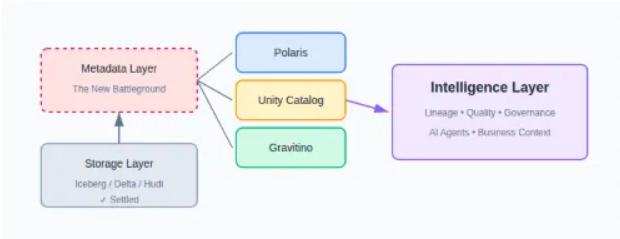
Core Insights - The infrastructure supporting artificial intelligence is undergoing a significant transformation, driven by the convergence of open formats, AI capabilities, and the unsustainable costs of integrating numerous tools [1][2]. Group 1: Importance of Fundamentals - Basic skills remain crucial as architecture changes can disrupt pipelines, and data quality issues continue to plague organizations, costing an average of $12.9 million annually due to poor data quality [2][11]. - The key challenge by 2026 will not be the existence of these issues but the speed and method of their detection and resolution [2]. Group 2: Metadata Layer as a Battleground - The storage layer competition has concluded with Iceberg, Delta Lake, and Hudi emerging as winners, while Parquet has become the common language for data storage [3][6]. - The focus is shifting upstream to the metadata layer, which is becoming the operational backbone of data management, encompassing data lineage, quality rules, access policies, and business context [6][20]. Group 3: Simplification of Data Stacks - Organizations are experiencing tool fatigue, managing an average of 15 to 30 different tools across various data functions, which is unsustainable [7][9]. - By 2026, the integration process will accelerate, with platforms like Snowflake and Databricks consolidating functionalities to streamline data operations [10]. Group 4: Data Quality as a Business Function - Data quality metrics will shift from engineering-focused indicators to business outcomes, with organizations increasingly linking data pipeline failures to revenue impacts [11][12]. - By 2026, 80% of organizations are expected to deploy AI/ML-driven data quality solutions, emphasizing the need for accountability through data contracts between producers and consumers [12]. Group 5: AI Agents Replacing Dashboards - The traditional model of data observability through dashboards is becoming obsolete, with AI agents expected to take over operational responsibilities by 2026 [13][15]. - These AI agents will be capable of understanding business context, automatically tracing issues, and applying fixes, fundamentally changing the approach to data observability [15]. Group 6: AI Reshaping Data Infrastructure - The initial design of data stacks was for dashboard services, not AI workloads, but AI is now a primary user of data [16]. - By 2026, two types of companies will emerge: AI-native architectures designed for AI workloads and traditional stacks with AI capabilities added later [16]. Group 7: The Rise of Semantic Layers - Semantic layers, previously seen as optional, are becoming essential for AI applications, providing necessary context for data interpretation and ensuring data quality [17]. - These layers serve as a bridge between technical data and business meaning, crucial for AI agents to function effectively [17]. Group 8: Common Theme - A common theme across the predictions is the shift from passive to proactive data infrastructure, where systems will not only store and visualize data but also understand, reason, and act based on interactions [18][19].

2026趋势报告:数据与人工智能
DataArt· 2025-12-26 09:18
Investment Rating - The report emphasizes that the highest return on investment in 2026 will come from modern data infrastructure rather than the latest AI models [11][14]. Core Insights - The gap between AI ambitions and actual operations is widening across industries, with organizations needing to focus on foundational work to achieve transformative wins [6][5]. - Companies are shifting from broad experimentation to specific, high-value use cases, moving AI from proof-of-concept to enterprise-level deployment [19][15]. - Successful organizations are prioritizing data lifecycle management, modernization, and human capabilities to shape their AI-driven transformation strategies [48][59]. Summary by Sections Overview - The report highlights a significant disconnect between organizational expectations of AI and the foundational work required for successful implementation [6][5]. - Many companies are still relying on outdated systems and manual processes, which hinders their ability to leverage AI effectively [6][9]. 2026 AI Trends - AI success in 2026 will be driven by data infrastructure rather than new models, with a focus on creating accessible and real-time data management systems [11][12]. - Organizations are expected to transition from broad AI experiments to targeted applications that deliver measurable business value [15][17]. Industry-Specific Trends - The report outlines predictions for various sectors, including: - Airlines will require rapid experimentation due to competitive pressures [65]. - Retail will see AI operating behind the scenes, influencing pricing and supply chain decisions [66]. - Healthcare will experience regulatory advancements that promote AI-driven innovations [69]. Preparing for 2026 - Companies need to invest in data management and governance to support AI initiatives effectively [48][51]. - A cultural shift is necessary for organizations to embrace AI as a core component of their business strategy rather than a standalone project [30][60]. Conclusion - The foundation laid in data infrastructure and governance will determine the success of AI initiatives in 2026, with companies that prioritize these areas likely to thrive [87][89].
Marvell’s (MRVL) Stock Pops After Q3 Earnings – Time to Buy?
Yahoo Finance· 2025-12-14 14:45
Core Viewpoint - Marvell Technology has shown signs of improvement in its narrative and execution, leading to a positive shift in investor perception despite ongoing challenges with major customers like Microsoft and Amazon [2][4][11]. Financial Performance - Marvell exceeded Wall Street expectations with its recent earnings guidance, resulting in a significant post-earnings stock surge [3][4][11]. - The stock initially fell after earnings but later surged by as much as 14% before closing down from that peak [5][6][9]. Strategic Moves - The acquisition of Celestial AI is viewed as a strategic move to enhance Marvell's technical capabilities, particularly in high-growth sectors like AI and data infrastructure [3][12]. - Marvell's focus on custom accelerators and interconnects positions it well within the rapidly growing tech landscape, despite being smaller than competitors like Broadcom [10][11]. Market Position and Challenges - Marvell has historically struggled with execution and narrative challenges compared to larger rivals, but recent developments indicate a potential turnaround [6][13]. - Concerns remain about the potential loss of major XPU projects from key customers, but the company’s broader interconnect opportunities are expected to mitigate these risks [2][4][11].
Why Is Eaton Stock Gaining Wednesday? - Eaton Corp (NYSE:ETN)
Benzinga· 2025-12-10 17:30
Core Insights - Eaton Corp. announced a $50 million investment to expand its manufacturing capacity in Virginia, aiming to meet the increasing demand for data centers driven by AI and cloud growth [1][4] - The company plans to construct a 350,000-square-foot facility near Richmond to produce essential power-distribution equipment for data centers [1][2] - The expansion is expected to create approximately 200 new local jobs starting in 2026 [2] Manufacturing Expansion - The new facility will more than double Eaton's footprint in the Richmond area, consolidating and upgrading production of static power infrastructure [4] - The investment is part of a broader strategy to support rising demand for electrification and data infrastructure [5] - Since 2023, Eaton has invested over $1.2 billion in North American manufacturing [4] Market Context - The expansion responds to a record number of new data-center approvals in Virginia this year [3] - Virginia's state leadership has welcomed the investment, highlighting the readiness of local companies to meet growing power requirements [5] - The project is expected to strengthen the region's manufacturing base and job market [5] Stock Performance - Eaton Corp. shares rose by 1.41% to $346.58 at the time of publication [6]