
Digital Retail

Search documents
ETFs in Focus as Walmart Loses Its Largest Retailer Title to Amazon
ZACKS· 2026-02-23 14:51
Core Insights - Amazon has surpassed Walmart to become the world's largest retailer by annual revenues, achieving $716.9 billion in 2025 compared to Walmart's $713.2 billion [1][10] - The shift highlights the importance of Amazon's technology ecosystem, particularly Amazon Web Services (AWS), which generated nearly $129 billion in sales last year [4][10] - Amazon's advertising business has also become a significant growth driver, contributing over $60 billion annually [5][10] Investment Opportunities - Investors may find potential in exchange-traded funds (ETFs) that include Amazon alongside other leading companies in retail and technology sectors [2][8] - Focusing on ETFs allows investors to mitigate company-specific risks associated with Amazon while still benefiting from its growth and market position [7][8] ETFs to Consider - Global X PureCap MSCI Consumer Discretionary ETF (GXPD) has a net asset value of $22.72 million, with Amazon holding a 33.74% weight [11] - Vanguard Consumer Discretionary ETF (VCR) has $6.3 billion in assets, with Amazon at 23.02% weight [12] - State Street Consumer Discretionary Select Sector SPDR ETF (XLY) manages $22.51 billion, with Amazon at 20.91% weight [13] - ProShares Online Retail ETF (ONLN) has an average market cap of $177.12 billion, with Amazon at 23.35% weight [15] - VanEck Retail ETF (RTH) has net assets of $264.8 million, with Amazon at 17.08% weight [16]


Can Digital Retail & E-Commerce Boost Procter & Gamble's Volume?
ZACKS· 2026-02-17 18:10
Group 1: Procter & Gamble (PG) Digital Strategy - Digital retail and e-commerce are crucial for PG as consumer purchasing shifts online, providing opportunities for volume growth through targeted content and personalized recommendations [1][2] - PG's scale, data capabilities, and brand equity position it well to leverage digital channels, enhancing visibility and conversion for core brands while supporting innovation trials [2][3] - Advanced analytics and AI-driven insights enable PG to target consumers more precisely, improving demand forecasting and facilitating faster feedback loops between innovation and execution [3] Group 2: Competitive Landscape - Church & Dwight (CHD) and Colgate-Palmolive (CL) are also utilizing digital retail and e-commerce as growth drivers, capitalizing on changing consumer behaviors to expand reach and support sustained volume growth [4][5] - CHD benefits from its focused brand portfolio and strong power brands, using online channels to efficiently reach targeted segments and support faster trials of new products [5] - Colgate leverages digital platforms to enhance consumer engagement and expand access in emerging markets, particularly in habit-driven categories like oral care [6] Group 3: Financial Performance and Valuation - PG's shares have increased by approximately 2.8% over the past six months, outperforming the industry's growth of 1.5% [7] - PG trades at a forward price-to-earnings ratio of 22.28X, higher than the industry average of 19.88X, indicating a premium valuation [9] - The Zacks Consensus Estimate for PG's fiscal 2026 and 2027 EPS indicates year-over-year growth of 2.2% and 4.7%, respectively, although recent estimates have been revised downward [10][11]


印度快速商业的演变:部门分析
印度品牌价值基金会· 2026-01-30 23:20
Investment Rating - The report indicates a bullish outlook for India's quick-commerce sector, projecting significant growth in the coming years [36][48]. Core Insights - India's retail landscape has dramatically shifted towards online shopping, particularly in quick commerce, driven by smartphone adoption and the COVID-19 pandemic [2][4]. - Quick commerce in India has evolved from a niche market to a major retail channel, with gross order value expected to reach approximately Rs. 65,645.40 crore (US$ 7.4 billion) by FY25, representing a 24-fold increase from 2022 [4][36]. - The convenience of instant delivery has led to increased overall consumption, with 6-8% of purchases being incremental demand among households using quick commerce [5][21]. Market Growth and Trends - Quick commerce services have expanded beyond metro cities into tier-2 and tier-3 towns, with urban consumers' preference for online shopping rising from 33% to 87% [5][22]. - Major players in the quick-commerce space include Blinkit, Zepto, Swiggy Instamart, Dunzo Daily, and BigBasket Daily, each employing different business models such as inventory-led, hyperlocal partner, and marketplace multi-vendor [7][10][12]. - Revenue models are diversifying, with seller commissions making up 68-74% of revenues, while delivery fees and advertising contribute an additional 9-13% [16][43]. Consumer Behavior - Quick commerce has fundamentally changed shopping habits, with consumers increasingly favoring convenience and instant gratification [17][21]. - Categories such as impulse goods and premium products are seeing higher adoption rates, indicating a trend towards premiumization in consumer purchases [21][42]. Technology and Infrastructure - Key enablers for quick commerce growth include smartphone penetration, digital payment systems, and advanced logistics networks [24][25][28]. - The integration of technology such as AI for demand forecasting and real-time inventory management is crucial for operational efficiency [41][43]. Economic Impact - Quick commerce is creating significant employment opportunities, with approximately 62-64 jobs generated for every Rs. 100 crore (US$ 11.3 million) of gross merchandise value [31][34]. - The sector is attracting substantial investments, contributing to retail market expansion and indicating rising consumer demand [35][36]. Future Outlook - Analysts project that India's quick-commerce GMV could reach about Rs. 310,485.00 crore (US$ 35 billion) by 2030, indicating sustained double- or triple-digit growth rates [36][38]. - The expansion of quick commerce is expected to include non-food categories, with companies diversifying their product offerings [42][48]. - The sector's future will depend on increasing reach into smaller cities and enhancing economic models, while sustainability and profitability remain key challenges [44][45].
Walmart Unveils McLay's Exit From International Unit: What to Know?
ZACKS· 2026-01-16 17:56
Core Insights - Walmart Inc. has announced the departure of Kathryn McLay, president and CEO of Walmart International, who will remain until January 31, 2027, to ensure a smooth transition [2][10] - Under McLay's leadership, Walmart International achieved solid revenue and profit growth, with a focus on digital initiatives and management development [3][10] - International markets, particularly India and China, are significant growth drivers for Walmart, supported by enhancements in supply chain and digital retail [5][10] Financial Performance - Walmart's International segment reported net sales of $33.7 billion in the fiscal third quarter, reflecting an 11.4% increase in constant currency [6] - Adjusted operating income for the International segment rose 16.9% to $1.4 billion, driven by improved e-commerce economics [6] - E-commerce sales in the International segment grew by 26% during the quarter, bolstered by marketplace expansion and increased store-fulfilled services [6] Market Contributions - The Big Billion Days event at Flipkart significantly contributed to e-commerce volume growth and international advertising revenues [7] - China’s sales reached $6.1 billion, marking a 21.8% increase in constant currency, with digital sales accounting for approximately half of the revenues [7] - The appointment of a new leader for Walmart International is crucial as the segment plays an increasingly important role in overall corporate growth [8] Stock Performance and Valuation - Walmart's shares have increased by 10.7% over the past three months, slightly outperforming the industry growth of 10.3% [9] - The company trades at a forward price-to-earnings ratio of 40.59X, higher than the industry average of 36.93X [11] - The Zacks Consensus Estimate for Walmart's fiscal 2026 earnings indicates a year-over-year growth of 4.8%, with a projected increase of 12.3% for fiscal 2027 [12]
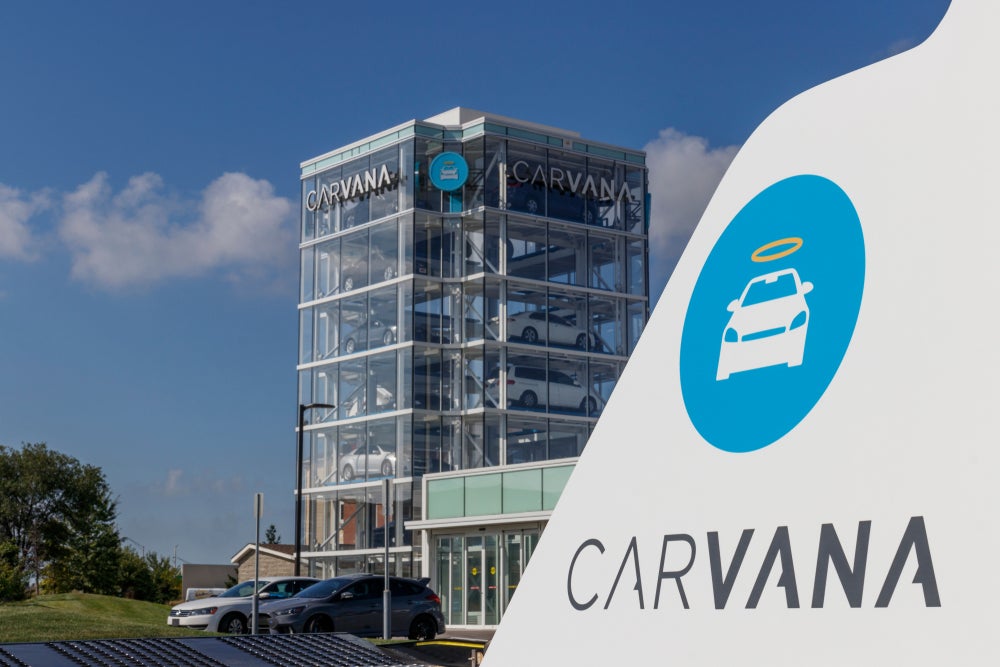
Carvana Speeds Past Dealerships With Digital Model Carvana's Digital Model Speeds Past Dealerships - Carvana (NYSE:CVNA)
Benzinga· 2025-10-24 18:13
Core Viewpoint - Carvana Co. is advancing its digital, vertically integrated model to move away from traditional dealerships as credit concerns diminish and demand remains strong [1] Group 1: Business Model and Strategy - Carvana is leading the transition from traditional auto retail through a digital-first, data-driven, and capital-efficient approach [1][2] - This model is expected to provide a cleaner and more compelling buying experience compared to traditional incumbents, creating significant long-term value [2] Group 2: Financial Projections and Market Outlook - Analyst Mackenzie Holleran has set a price target of $500 for Carvana, reflecting a 35x multiple of projected 2027 adjusted EBITDA, supported by a sustainable and profitable growth profile [3] - The company is anticipated to report 2025 revenue of $18.491 billion and EBITDA of $2.100 billion [5] Group 3: Market Conditions and Risks - Concerns regarding subprime exposure are considered over-extrapolated, with the analyst suggesting that fears are linked to Carvana's previous operational fragility [3] - The analyst expects improving supply of used vehicles and easing rates to lead to lower average selling prices and smaller monthly payments, which should help maintain unit demand despite tighter credit conditions [4]

How The Amazon-Hertz Deal Could Disrupt Dealerships
Youtube· 2025-09-29 16:01
Core Insights - Amazon is expanding into the used car market by partnering with Hertz to sell its rental cars, which could significantly benefit Hertz and enhance Amazon's emerging automotive retail business [2][20] - The partnership poses a potential threat to traditional car dealers, as Hertz can sell directly to consumers at retail prices, bypassing auctions and reducing the supply of used cars available to dealers [10][15] Group 1: Amazon's Strategy and Market Position - Amazon has seen a remarkable revenue growth of 38,000% since its inception, and its entry into the automotive sector is seen as a natural extension of its retail capabilities [1] - The company is currently acting as a listing service for dealers rather than holding inventory, which allows it to leverage its e-commerce platform without the complexities of traditional car sales [6][22] - Amazon's digital advertising revenue reached $56.2 billion in 2024, indicating a strategic focus on high-margin businesses that can utilize consumer data for targeted advertising [6][7] Group 2: Hertz's Transformation and Market Dynamics - Hertz is undergoing a critical transformation after emerging from bankruptcy in 2021, with significant investments from activist investors like Bill Ackman [4][5] - The company has approximately 560,000 vehicles in its fleet, with a strategy to sell off cars after 18 to 20 months of rental, which aligns with Amazon's retail model [7][20] - Hertz's ability to sell directly to consumers allows it to avoid auction fees and achieve better pricing, which could disrupt traditional auction markets where dealers typically source used vehicles [15][16] Group 3: Impact on Traditional Dealers - The partnership between Amazon and Hertz could lead to a reduction in the number of used cars available to dealers, as rental companies may increasingly sell directly to consumers [10][17] - Dealers currently acquire about 20% of their used vehicle stock from auctions, and a shift towards direct sales could constrain their supply [16][19] - The used car sales contribute significantly to dealership profits, and losing access to rental cars could impact their ability to retain customers for service and parts, which are crucial for profitability [28][29] Group 4: Industry Evolution and Legal Challenges - The automotive retail landscape is evolving rapidly, with companies like Amazon and Carvana gaining traction, which may have downstream implications for traditional dealers [32] - Franchise laws in the U.S. protect new car dealers from direct competition with manufacturers, but digital companies are challenging these norms, as seen with Tesla and other emerging brands [30][31] - The increasing competition from rental companies and digital platforms could reshape how used cars are sold, necessitating adaptation from traditional dealerships [25][26]
Hertz to sell used vehicles online through Amazon Autos partnership
CNBC· 2025-08-20 11:00
Core Insights - Hertz has announced a partnership with Amazon Autos to sell pre-owned vehicles online, aiming to enhance its retail operations and profitability [1][3] - The initiative allows customers to browse thousands of used Hertz vehicles on Amazon, complete purchases online, and pick up vehicles at Hertz locations [2][5] - This partnership marks a significant expansion for both Hertz's car sales business and Amazon's automotive offerings, which previously focused solely on new vehicles [3][4] Company Strategy - Hertz's strategy includes increasing its digital retail presence and making its used vehicle inventory more accessible, aligning with its broader goal to boost retail operations [5] - The company is focusing on fleet management, revenue optimization, and cost efficiency as part of its "Back-to-Basics Roadmap" turnaround plan initiated after its bankruptcy during the Covid-19 pandemic [6] Market Performance - Hertz reported its strongest-ever quarter for retail vehicle sales in Q1 of this year, indicating positive momentum in its sales operations [6] - The Rent2Buy program, allowing customers to rent a used car before purchasing, has also gained traction and is set to expand to over 100 cities [7]


Group 1 Automotive (GPI) 2022 Earnings Call Presentation
2025-07-10 11:06
Financial Performance & Growth - Group 1's 2021 revenue reached $13802 million, a significant increase from $10852 million in 2020[9] - Adjusted EPS in 2021 was $3502, compared to $1806 in 2020, demonstrating substantial earnings growth[9] - Adjusted free cash flow for 2021 was $656 million, up from $426 million in 2020, highlighting strong cash generation[9] - From 2020 through 1Q22, the company repurchased approximately 15% of its outstanding common shares, totaling $4059 million[34] Strategic Initiatives & Market Position - Group 1 completed $25 billion in acquisitions in 2021 and $550 million year-to-date in 2022, indicating a focus on growth through strategic acquisitions[10] - The company's digital platform, AcceleRide®, experienced 77% year-over-year growth in units sold in FY21, showcasing the success of its digital retail strategy[10] - Parts & Service contributes approximately 45% of total gross profit, emphasizing its importance to the business model[28] - U S same store used retail units grew by 15% on a year-over-year basis in 2021, outperforming the industry[34] Geographic Focus - Texas locations generated 40% of 4Q21 total new vehicle unit sales, highlighting the importance of the Texas market[25] - Group 1 is the 1 auto retailer in Texas, capitalizing on the state's strong economic growth and business climate[27] Real Estate Strategy - As of December 31, 2021, Group 1 owned approximately $17 billion of gross real estate, representing 64% of dealership locations[37]
