Docker

Search documents
X @𝘁𝗮𝗿𝗲𝘀𝗸𝘆
𝘁𝗮𝗿𝗲𝘀𝗸𝘆· 2026-03-16 22:40
RT Vincent Yang (@m1ssuo)重写了一下 Remodex 的 Relay 部分,并且支持了 Docker 部署。你也可以选择使用我提供的 Relay(部署在日本东京,三网优化,到江浙沪的延迟在 30ms 左右)。https://t.co/ocVK5560Eo ...
X @Avi Chawla
Avi Chawla· 2025-12-06 19:13
RT Avi Chawla (@_avichawla)Docker explained in 2 minutes!Most developers use Docker daily without understanding what happens under the hood. Here's everything you need to know.Docker has 3 main components:1️⃣ Docker Client: Where you type commands that talk to the Docker daemon via API.2️⃣ Docker Host: The daemon runs here, handling all the heavy lifting (building images, running containers, and managing resources)3️⃣ Docker Registry: Stores Docker images. Docker Hub is public, but companies run private reg ...
X @Avi Chawla
Avi Chawla· 2025-12-06 06:30
Docker explained in 2 minutes!Most developers use Docker daily without understanding what happens under the hood. Here's everything you need to know.Docker has 3 main components:1️⃣ Docker Client: Where you type commands that talk to the Docker daemon via API.2️⃣ Docker Host: The daemon runs here, handling all the heavy lifting (building images, running containers, and managing resources)3️⃣ Docker Registry: Stores Docker images. Docker Hub is public, but companies run private registries.Here's what happens ...
Orchestrating Microservices Using LlamaIndex Workflows
LlamaIndex· 2025-10-13 17:01
Architecture and Workflow - Llama Index introduces a microservices architecture demo for e-commerce, breaking down a monolith into containerized services for specific jobs like front end, authentication, payments, orders, and stock management [1][2] - The demo uses Docker Compose for easy setup, requiring cloning the repository and running `docker compose app -d` [3] - The application structure includes front end, authentication, payment processing, orders, stock management, PostgreSQL for database, Kafka for event-driven communication, and Zookeeper for Kafka management [3] - Workflows are used for payments, orders, and stock management, triggered by events in Kafka, starting with data processing and syncing [3] - The workflow extracts structured data (order, payment, stock, item) from raw JSON data and builds a query to update the database [3] - The workflow ends by restituting the operation status (success or failure) and sending details back to Kafka [4] Data Flow and Communication - The front end sends orders as JSON data to a Kafka topic, which triggers workflows for payment, order creation, and stock update [4] - Each service (payments, orders, stock) subscribes to the orders topic and publishes operation statuses to separate partitions in the Kafka topic [4] - Payments write to partition zero, orders to partition one, and stock to partition two [5] - Operation statuses are streamed back to the front end, indicating success or failure of each operation [5] Demonstration and Potential Issues - The demo can be run locally by registering a user and placing an order, which triggers the described pipeline [7][8] - Failures in updating the order, placing the order, payment, and updating the stock may occur due to disturbances in communication [10]


小米NAS定档年底,放弃极客路线,摸着华为过河?
3 6 Ke· 2025-06-12 10:05
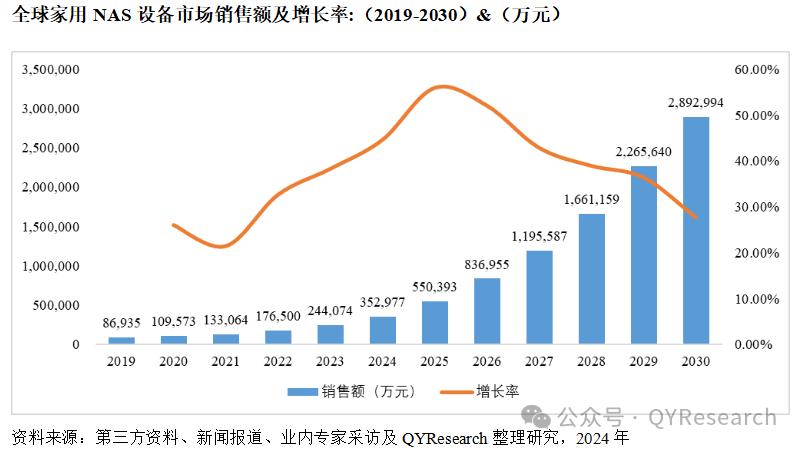
Core Insights - Xiaomi is set to launch its NAS (Network Attached Storage) product, with initial production and testing expected in October 2024, and a market release by the end of the year [1][2] - The global home NAS market is projected to grow from 2.44 billion in 2023 to 28.93 billion by 2030, with a compound annual growth rate (CAGR) of 41.99% [2] - In China, the home NAS market is expected to grow from 712 million in 2023 to 9.619 billion by 2030, capturing approximately 33.25% of the global market [4] Product Strategy - Xiaomi aims to simplify its NAS offering, focusing on user-friendly features rather than complex functionalities, targeting mainstream consumers rather than tech enthusiasts [4][9] - The product will integrate with Xiaomi's ecosystem, enhancing connectivity with mobile devices, TVs, and PCs, and will replace some of the existing cloud storage services [4][16] - Xiaomi NAS is expected to feature storage expansion, AI photo albums, and automatic media scraping for TV, while functioning similarly to a cloud storage service for PCs [4][8] Market Positioning - The pricing strategy for Xiaomi NAS is anticipated to be competitive, with estimates ranging from 1,000 to 2,000 for different configurations [8][16] - The company is not pursuing high-end features like Docker support, which is common in products aimed at tech-savvy users, instead opting for a more straightforward user experience [13][19] - Xiaomi's approach reflects a shift from its original "for enthusiasts" branding to a broader market appeal, focusing on affordability and integration with existing Xiaomi devices [17][19] Consumer Insights - There is a divide in consumer expectations, with tech enthusiasts desiring advanced features and ordinary users seeking simple, cost-effective storage solutions [13][19] - The initial reception of Xiaomi NAS may be cautious, with recommendations to wait for user feedback before making a purchase decision [17][19] - The company’s historical challenges with software bugs and system performance may impact initial consumer confidence in the new NAS product [19]