Double Carbon Goal

Search documents
2025年终观察|陈海生:我国新型储能装机破亿,如何从“规模化”迈向“高质量”?
中关村储能产业技术联盟· 2025-12-12 02:58
Core Viewpoint - The new energy storage market in China is experiencing significant growth driven by increasing demand, technological advancements, and strong policy support [3][5]. Group 1: Market Demand and Growth - The installed capacity of new energy storage in China has exceeded 100 million kilowatts, which is over 30 times that at the end of the 13th Five-Year Plan [2]. - The demand for energy storage is expected to continue increasing as the installed capacity of renewable energy sources like wind and solar power rises [5]. - By 2027, the new energy storage installed capacity is projected to reach over 180 million kilowatts, with direct investment in projects estimated at around 250 billion yuan [5]. Group 2: Technological Advancements - Significant breakthroughs in energy storage technology have occurred over the past five years, particularly in lithium-ion battery technology, leading to improved performance and reduced costs [3]. - The commercialization of alternative technologies such as compressed air and flow batteries is establishing a solid foundation for large-scale applications [3]. Group 3: Policy Support - A series of robust policies have been introduced at the national level to support the development of the energy storage industry, including guidelines from the National Development and Reform Commission and the National Energy Administration [3]. - Local governments are also implementing specific market and pricing policies that have greatly stimulated market participation [3]. Group 4: Future Outlook - The energy storage market is expected to see accelerated growth in the next 3-5 years, driven by ongoing increases in renewable energy installations and sustained policy support [4][5]. - By 2027-2028, the new energy storage capacity is anticipated to reach 200 million kilowatts, and by around 2030, it could reach 300 million kilowatts [6]. Group 5: Transition to High-Quality Operations - To transition from "scale installation" to "high-quality operation," breakthroughs are needed in market mechanisms, technology optimization, safety prevention, and lifecycle management [7]. - The development of a comprehensive safety standard and monitoring system is essential for ensuring the safety of energy storage systems [7][8]. Group 6: Industry Collaboration and Policy Recommendations - Enhancing the self-sufficiency of key materials and promoting collaborative innovation in the industry are crucial for sustainable development [8]. - Recommendations include refining market-based revenue policies, strengthening safety regulations, conducting cost research on various storage technologies, and promoting industry self-regulation [8].


打造绿色科技新优势差距在哪儿?何处着力?
Jing Ji Ri Bao· 2025-11-18 10:13
Group 1 - The core focus of the article is on the importance of implementing technology policies that promote green and low-carbon development as a key point in China's 15th Five-Year Plan [1] - Green technology is defined as emerging technologies that reduce consumption, decrease pollution, and improve ecology, covering areas such as energy conservation, clean production, and ecological agriculture [1] - Recent trends in green technology innovation show significant interdisciplinary collaboration and technological integration, driven by advancements in artificial intelligence, digital technology, and new energy [1][2] Group 2 - Developed countries, particularly the EU, have a notable advantage in green technology innovation through stringent standards and regulations aimed at achieving carbon neutrality [2] - China possesses dual advantages in green technology innovation, including top-level national strategic guidance and a vast domestic market, facilitating rapid iteration and industrial scaling [2] - China's development path emphasizes alignment with major national strategies such as energy security and industrial upgrading, showcasing strong system integration capabilities [2] Group 3 - Current green technology innovation efforts are hindered by a lack of effective collaboration among academia, industry, and research, leading to insufficient synergy [3] - Key areas of technological research face "bottleneck" risks, including high-end equipment and multi-pollutant reduction technologies, which remain underdeveloped [3] - The transformation of research outcomes into practical applications is limited by economic factors and a disconnect between research and market needs [3] Group 4 - The article emphasizes the need to break down technological barriers and focus on strategic, foundational, and forward-looking scientific issues in green technology [4] - It advocates for a supportive policy framework that encourages innovation and tolerates failure, enhancing the efficiency of technology transfer [4] - Establishing collaborative innovation organizations among enterprises, universities, and research institutions is crucial for improving resource allocation and technology transfer efficiency [4]
科技成果 | 南昌大学:生物基中链二元羧酸的创新工艺开发
合成生物学与绿色生物制造· 2025-10-19 12:37
Core Viewpoint - The article discusses the advancements in non-grain biomass utilization, highlighting innovative research outcomes and their commercial viability in the bio-based sector, particularly focusing on the development of bio-based dicarboxylic acids [2][3]. Summary by Sections Event Overview - The fifth Non-Grain Biomass High-Value Utilization Forum will be held from November 27-29 in Hangzhou, Zhejiang, focusing on innovative research results and commercial feasibility in the non-grain bio-based field, with over 1500 technology and project connections completed to date [2]. Innovation Achievements - The article presents the innovative development of bio-based medium-chain dicarboxylic acids (C5-C8), which include glutaric acid, adipic acid, heptanedioic acid, and octanedioic acid, with a global market size exceeding 20 billion and continuing to expand [5]. Technical Advantages - The project utilizes biomass-derived platform compounds (such as glycerol, furfural, and 5-hydroxymethylfurfural) to create a renewable supply chain for producing bio-based dicarboxylic acids, significantly reducing reliance on petroleum and lowering carbon emissions compared to petrochemical routes [7][8]. Production Process - The innovative one-step dicarbonylation synthesis technology achieves product selectivity of ≥85% and catalyst recovery rate of ≥99.99%, shortening production cycles and reducing overall costs, addressing high energy consumption and cost challenges [7][8]. Market Compliance - Bio-based products are certified for carbon footprint, overcoming international green barriers and filling the gap in high-end applications for domestic bio-based C5-C8 dicarboxylic acids, creating a competitive advantage through "cost reduction - green compliance - market adaptation" [8]. Intellectual Property and Collaboration - The project has published five domestic patents and is open to collaborative development, result transformation, or intellectual property transfer [9].

6.9万亿!刚刚,又一个彻底引爆中国经济的行业出现了
Qian Zhan Wang· 2025-05-13 01:41
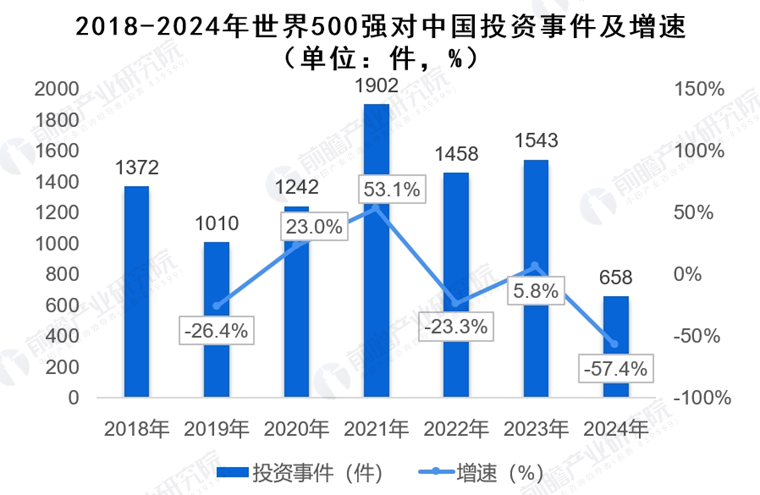
Core Insights - The global economic landscape is undergoing significant changes, with geopolitical tensions, supply chain restructuring, technological breakthroughs, and accelerated green transitions reshaping the economy. China remains a focal point for multinational capital investment [1] - The year 2025 is identified as a critical juncture for the global economic cycle and for China to achieve its "14th Five-Year Plan" goals. The investment choices of Fortune Global 500 companies reflect confidence in China's development prospects and the restructuring of global industrial value chains [1] - A forthcoming report from the Forward Industry Research Institute will analyze the investment characteristics of Fortune Global 500 companies in China, providing a framework for understanding uncertainties and identifying future opportunities [1] Group 1: Investment Trends - Fortune Global 500 companies have shown fluctuating investment patterns in China over recent years, with a notable decline in 2019 due to escalating global trade conflicts. However, confidence returned in 2021, reaching a peak, before a downturn in 2024 due to global economic decline [1][2] - The investment landscape from 2018 to 2024 indicates a shift from "factor-driven" to "innovation-driven" economic models in China, highlighting the emergence of new productive forces reshaping global supply chains [2][4] - The semiconductor industry has consistently ranked first in investment from 2020 to 2023, reflecting China's successful strategy for technological self-reliance. The renewable energy sector has also surged from fifth place in 2019 to first in 2023, demonstrating the explosive potential of green productivity under the "dual carbon" goals [3][4] Group 2: Sectoral Dynamics - The automotive industry has maintained a strong position due to the new energy revolution, while AI has remained in the top five for five consecutive years. The emergence of robotics in 2024 indicates a shift towards "intelligent manufacturing" in China [4][23] - Investment in high-tech sectors like AI shows a preference for downstream applications, with 45.8% of investments focused on general and industry-specific applications, while upstream investments in AI chips remain relatively low at 23.3% [4][6] - The semiconductor industry has seen a significant focus on design, which accounts for 34%-43% of the investment chain, while semiconductor manufacturing has increased to about 12% since 2021 [6][8] Group 3: Emerging Opportunities - The aerospace sector is experiencing rapid growth, with a 32% increase in investment events, significantly outpacing other industries. The delivery of C919 aircraft has quadrupled in 2023, indicating a ramp-up in production capacity [13][15] - The commercial aerospace industry is projected to reach a market size of 6.9 trillion RMB by 2030, with a compound annual growth rate of approximately 20% [20][22] - The report highlights four key trends: long-term strategic investments in China, concentration in semiconductor, AI, and automotive sectors, predominance of domestic enterprises in investments, and a shift towards early-stage investments with larger capital scales [22][24] Group 4: Strategic Implications - Fortune Global 500 companies are increasingly viewing the Chinese market as a strategic priority, driven by its vast consumer base, talent resources, and stable policy environment [22][24] - The investment logic of these companies has evolved from market expansion and technology acquisition to a focus on technological collaboration, green transformation, and ecosystem development [24][25] - The report emphasizes the importance of understanding industry dynamics and leveraging local insights to enhance investment attractiveness in China [28]