ESG-V

Search documents
江苏省上市公司ESG-V评级榜|上市公司观察
Sou Hu Cai Jing· 2025-12-25 08:28
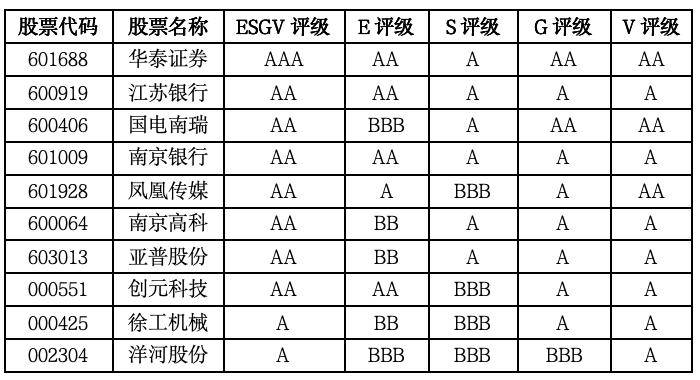
Core Viewpoint - The article discusses the importance of identifying the true responsibility and value of companies in the context of ESG (Environmental, Social, and Governance) governance, particularly through the newly released ESG-V rating list for listed companies in Jiangsu Province, which evaluates 621 companies to provide insights into their sustainable capabilities and investment values [1][2]. Group 1: ESG-V Rating System - The ESG-V rating system incorporates four dimensions: Environment (E), Social (S), Governance (G), and Value (V), aiming to provide a dual perspective of sustainability and investment potential for responsible investing [2][8]. - The top-rated companies, including Heng Rui Medicine, Huatai Securities, and Yuyue Medical, received the highest AAA rating, showcasing strong compliance and stable value characteristics [2][3]. Group 2: Industry Insights - The majority of high-rated companies share common traits such as mature governance structures, clear profit models, and stable value creation, with notable examples in the pharmaceutical and financial sectors [3][4]. - The overall distribution of ratings shows that 43% of companies are rated BBB or above, indicating a foundational balance between environmental, social, governance, and value dimensions among Jiangsu's listed companies [3][4]. Group 3: State-Owned Enterprises Performance - There is a noticeable performance divergence among state-owned enterprises, with some like Jiangsu Bank excelling in governance and value dimensions, while others lag in transparency and environmental management [4]. - The rating distribution reveals a "spindle-shaped" structure, with over 60% of companies rated between BB and A, indicating that many are still in the middle stage of establishing responsible governance [4][5]. Group 4: Future Implications - The ESG-V rating list serves as a lens to observe the ongoing journey of companies in Jiangsu towards green transformation and capital recognition, emphasizing the need for sustainable institutional foundations and rational market pricing for long-term value [8].