East - West Computing

Search documents
【公告臻选】云计算+东数西算+IDC+AIGC+算力租赁!公司拟定增募资不超15亿元加码智算中心
第一财经· 2026-03-22 14:07
Core Viewpoint - The article emphasizes the importance of efficiently filtering and interpreting key announcements in the investment landscape, providing insights into potential investment opportunities and market trends [1]. Group 1: Selected Review - On March 16, the article highlighted a company establishing a 500 million yuan joint venture in the aerospace sector, leading to a stock price increase of 4.2% on March 17, followed by a limit-up of 20% on March 18, and a further rise of 7.99% on March 19 [2]. - Another announcement on March 18 regarding a company's achievement in mass production of 100GEML in the optical communication field resulted in a stock price increase of 11.33% on March 19, with a peak rise of over 19% on March 20, ultimately closing up 11.25% [2]. Group 2: Today's Overview - A company has developed a flexible tactile sensor that has entered validation in humanoid robots and medical care fields, indicating diversification into advanced technology applications [3]. - The company has successfully integrated into the supply chains of major clients such as Huawei and CATL, showcasing a robust order reserve in robotics, artificial intelligence, and machine vision [3]. - A company plans to raise no more than 1.5 billion yuan through a private placement to enhance its intelligent computing center, reflecting a strategic move towards cloud computing and AI [3].


节前观望情绪浓厚,个股涨跌分化
Xin Lang Cai Jing· 2026-02-11 04:19
Group 1 - The three major indices opened lower, with the Shanghai Composite Index down 0.1%, the Shenzhen Component Index down 0.17%, and the ChiNext Index down 0.24%, followed by narrow fluctuations and a significant decrease in trading volume compared to the previous day [1] - In terms of real estate, January's second-hand housing transaction volume remained flat month-on-month and the year-on-year decline narrowed, with a 3% month-on-month decrease in the transaction volume index for 80 cities and a 3% year-on-year decrease [1] - The transaction price index for second-hand residential properties saw a significant narrowing of the month-on-month decline to -0.6%, indicating a potential investment opportunity in the real estate and property management sectors [1] Group 2 - The optical fiber sector is experiencing a strong growth cycle driven by AI computing infrastructure and domestic communication policies, leading to simultaneous increases in both price and demand [2] - The Ministry of Industry and Information Technology is promoting the construction of high-speed optical fibers and ultra-low loss fibers, which supports the domestic optical communication industry's upgrade and opens long-term growth potential [2] - The current optical fiber sector benefits from four major advantages: policy support, explosive demand, improved supply-demand dynamics, and technological upgrades, making it a core focus in the optical communication field [2]
硅谷算力成本飙升,中国绿电送上门,差价藏着底气
Sou Hu Cai Jing· 2025-12-16 01:17
Core Viewpoint - The article discusses the competitive landscape of AI between China and the United States, emphasizing the critical role of electricity supply and infrastructure in supporting AI development, rather than just focusing on chip technology and manufacturing capabilities. Group 1: Electricity Consumption and Infrastructure - Silicon Valley's AI data centers consume over 100 billion kilowatt-hours of electricity annually, surpassing the total electricity usage of Sweden [1] - The U.S. electrical grid is fragmented, with major regions operating independently, leading to inefficiencies and high transmission losses of over 15% on outdated high-voltage lines [3] - The construction of interstate high-voltage lines in the U.S. takes an average of ten years, which is significantly longer than in China, where the average is three years [6][18] Group 2: China's Electricity System Advantages - China has built 35 ultra-high voltage lines by 2024, enabling efficient transmission of renewable energy with losses below 5% to major AI centers [9] - The Chinese power grid can quickly adjust to fluctuating demands, providing stable electricity supply crucial for AI operations, which require consistent high loads during training [11] - China's investment in digitalizing its power grid is twice that of the U.S., allowing for better integration of renewable energy sources [13] Group 3: Coal Power as a Strategic Asset - Despite environmental concerns, China's modern coal power plants serve as a reliable backup for AI operations, capable of rapid expansion and quick deployment compared to other energy sources [15] - The ability to respond quickly to electricity demand is seen as a significant advantage for China in the AI competition, especially as global data centers are projected to consume 8% of the world's electricity by 2030 [15] Group 4: Historical Context and Future Implications - Historical patterns suggest that the benefits of technological advancements often accrue to countries that can scale applications efficiently, rather than those that invent the technology [16] - The future of AI dominance may hinge more on the efficiency of electricity supply and infrastructure than on advanced chip technology alone, positioning China's power grid as a critical asset in this competition [21]
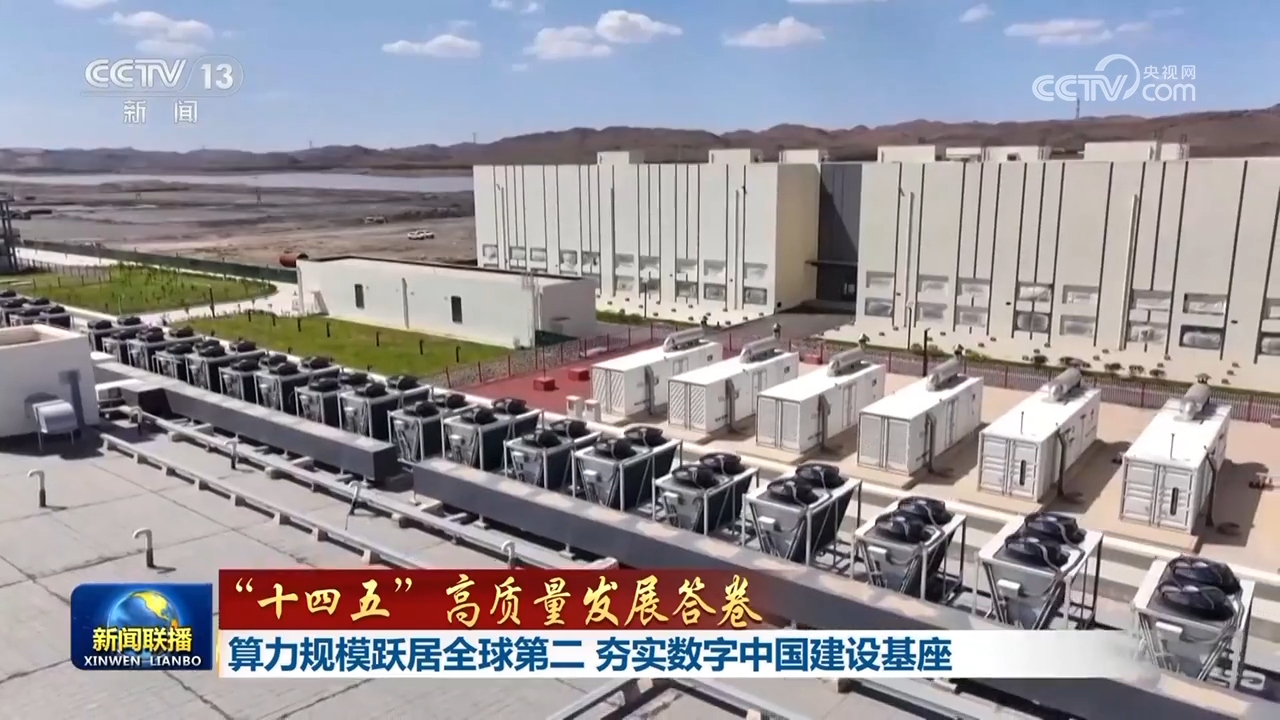
【“十四五”高质量发展答卷】算力规模跃居全球第二 夯实数字中国建设基座
Yang Shi Wang· 2025-10-18 12:05
Core Insights - Since the "14th Five-Year Plan," China has initiated a new round of digital infrastructure development, establishing a national integrated computing network that connects various regions, positioning its computing power as the second largest globally, thus fostering growth opportunities for the digital economy [1][3]. Group 1: Computing Power Growth - The average annual growth rate of China's computing power has reached 30% since the "14th Five-Year Plan," with over 70% of the new computing power originating from the western regions [3]. - The computing power generated in one second by China's entire intelligent computing system would take 4,000 years for 8 billion people using ordinary calculators to achieve [3]. Group 2: Digital Economy and Infrastructure - The "14th Five-Year Plan" explicitly aims to create new advantages in the digital economy and includes the construction of a digital China as a standalone section in the five-year plan [3]. - The establishment of eight national computing hub nodes, ten national data center clusters, and numerous new optical cable routes has led to the realization of the "East Data West Computing" mega project [3][5]. Group 3: Regional Development and Impact - In Gansu's Qingyang, the "East Data West Computing" hub has seen a significant increase in mobile signal density, with 452 new enterprises established, leading to local digital economy revenues soaring to nearly 10 billion yuan [5]. - More than 30 "computing power new cities" have emerged during the "14th Five-Year Plan," serving as critical support for the AI era, with computing power from Guizhou contributing to animation production in Beijing and from Qinghai aiding in intelligent driving model training in Jiangsu [7]. Group 4: Infrastructure and Global Position - China has built the largest and most extensive network infrastructure globally during the "14th Five-Year Plan," with its computing power ranking among the top worldwide, making it one of the countries with the richest data application scenarios [7].