
External balances

Search documents
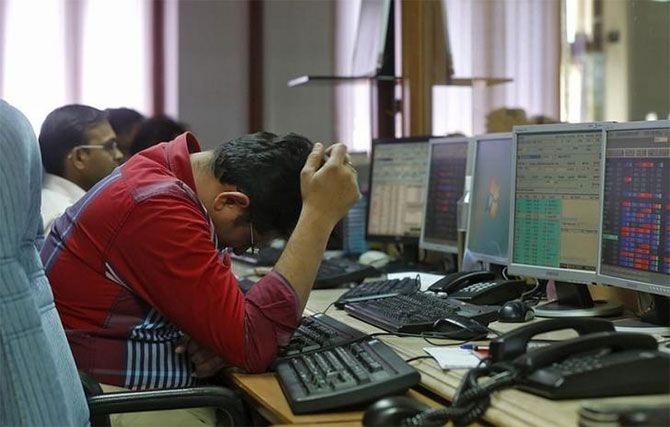
Stock Market Today March 9, 2026: Sensex tanks 1,353 points
Rediff· 2026-03-09 11:19
Market Overview - The Indian stock market experienced a significant decline, with the Sensex and Nifty dropping nearly 2 percent due to rising crude oil prices, geopolitical tensions, and foreign fund outflows impacting investor sentiment [1][3][5] - The BSE Sensex fell by 1,352.74 points (1.71 percent) to close at 77,566.16, marking its second consecutive day of decline, while the NSE Nifty decreased by 422.40 points (1.73 percent) to end at 24,028.05 [4][10] Crude Oil Impact - Brent crude oil prices surged by 12.34 percent, reaching USD 104.1 per barrel, raising concerns about inflation and external balances in India [7][8] - The escalation of geopolitical risks has pushed crude oil prices above the USD 100 per barrel mark, contributing to a weakening Indian rupee against the US dollar [8] Foreign Institutional Investors Activity - Foreign Institutional Investors (FIIs) sold equities worth ₹6,030.38 crore, exacerbating the market's downward trend [5][10] - Domestic Institutional Investors (DIIs) purchased stocks worth ₹6,971.51 crore in the previous trade, indicating some level of support in the market [10] Global Market Trends - Asian markets reflected broader global market anxieties, with South Korea's Kospi dropping 5.96 percent and Japan's Nikkei 225 falling 5.20 percent [9] - European markets were also trading significantly lower, and the US market ended sharply lower on the preceding Friday [9] Stock Performance - UltraTech Cement was the biggest loser in the Sensex pack, declining by 5.23 percent, while major laggards included Maruti, Mahindra & Mahindra, and State Bank of India [6] - Conversely, Reliance Industries, Sun Pharma, Infosys, Tech Mahindra, and HCL Tech were among the gainers [6]

摩根大通:关键货币观点-所有美好事物终会结束
摩根· 2025-06-10 07:30
Investment Rating - The report maintains a bearish outlook on the US dollar due to moderating US exceptionalism and a more growth-supportive monetary and fiscal mix overseas [6][11][14]. Core Insights - The report highlights that while tariffs remain a headwind for global growth, several currencies such as Antipodeans, NOK, EUR, and JPY are expected to turn the corner on growth [6][11]. - In developed markets (DM), the bearish USD recommendations are barbelled for either a US slowdown (long JPY) or a soft landing scenario (long Scandis, Antipodean, EUR) [6][11]. - In emerging markets (EM), there is a broadening overweight across regions with a preference for Asian creditor currencies (like KRW) and CEE euro-proxies (like CZK) [6][11]. - The report emphasizes that 2025 is different from previous years as no single factor is dominating global FX returns, necessitating a separate analysis of G10 and EM [6][11][24]. - G10 FX forecasts remain unchanged for EUR/USD at 1.22 and USD/JPY at 139, with upgrades for GBP, NZD, and CAD based on improved domestic prospects [6][11][48]. - EM forecasts include a reduction for USD/CNY to 7.15 and USD/ZAR to 17.50, reflecting a more favorable outlook for these currencies [6][11][48]. Summary by Sections Key Currency Drivers - The report identifies several macroeconomic factors influencing FX returns, including US-China trade talks and tariff adjustments [7][8]. - It notes that the reduction of tariffs from 145% to approximately 41% for a 90-day period is a significant development [7][8]. FX Models - The report discusses the performance of various currencies and highlights that the best-performing currencies are often those with current account surpluses [24][25]. - It also notes that the carry-to-value rotation is finally playing out in G10, with surplus countries outperforming [24][25]. G10 FX Short-term Fair Value - The report maintains forecasts for major currency pairs, with a bullish bias on EUR and JPY due to US moderation [56]. - It also highlights that GBP and NZD forecasts have been upgraded based on growth resilience and improved domestic conditions [56]. Technicals - The report indicates that external balances, particularly current account surpluses, have been among the best signals for global FX returns this year [24][25]. - It emphasizes that equity momentum has been a strong strategy for G10 currencies, benefiting from lower policy activity among central banks [24][25]. Trade Recommendations - The report suggests rotating AUD/USD into a long AUD and NZD basket against USD, citing improved domestic prospects for New Zealand [41][56]. - It also recommends an overweight position in EM currencies, particularly in Asia and EMEA, while remaining selective in commodity and frontier markets [23][56].