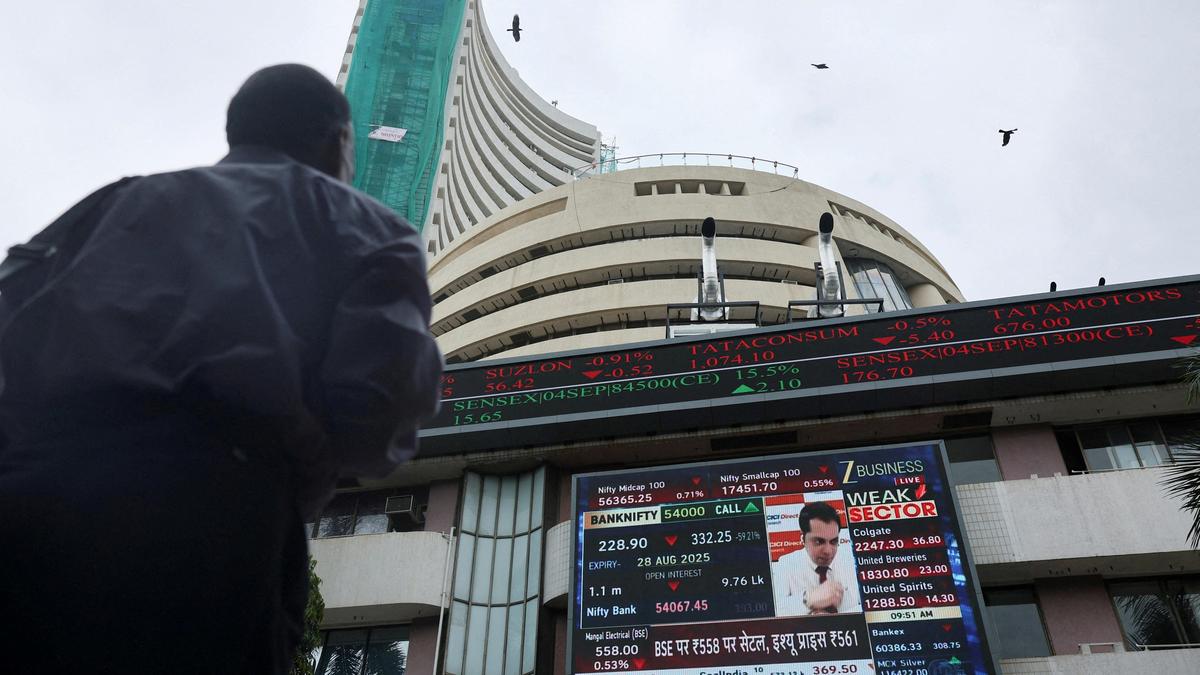
Foreign fund outflows

Search documents
Stock Market Today March 30, 2026: Sensex tanks 1,191 points, Nifty50 Fall To 22,470
Rediff· 2026-03-30 05:11
Market Overview - The Sensex and Nifty indices experienced a significant decline due to escalating geopolitical tensions in West Asia and rising crude oil prices [7][4] - The 30-share BSE Sensex fell by 1,191.24 points to 72,391.98, while the 50-share NSE Nifty dropped by 349.45 points to 22,470.15 in early trade [5] Foreign Investment Trends - Foreign Institutional Investors (FIIs) offloaded equities worth Rs 4,367.30 crore on Friday, contributing to market weakness [10] - In March, foreign investors withdrew Rs 1.14 lakh crore (approximately $12.3 billion) from domestic equities, marking the worst monthly outflow due to geopolitical tensions and concerns over crude oil prices [11] Sector Performance - Major laggards among the Sensex firms included Axis Bank, Kotak Mahindra Bank, Bajaj Finserv, Bajaj Finance, Bharti Airtel, and ICICI Bank [6] - Gainers in the market included Bharat Electronics, Reliance Industries, Power Grid, Tata Consultancy Services, and Hindustan Unilever [8] Global Market Impact - Asian markets broadly declined, with South Korea's Kospi and Japan's Nikkei 225 experiencing significant drops, reflecting the global impact of geopolitical uncertainty [12] - The US market also ended significantly lower, with the Nasdaq Composite index down by 2.15%, Dow Jones Industrial Average down by 1.73%, and S&P 500 down by 1.67% [9]

Stock markets slump in early trade as West Asia war enters fifth week
The Hindu· 2026-03-30 04:54
Market Overview - Equity benchmark indices Sensex and Nifty experienced significant declines in early trade on March 30, 2026, due to ongoing geopolitical tensions in West Asia and rising crude oil prices [1] - The BSE Sensex fell by 1,191.24 points to 72,391.98, while the NSE Nifty dropped 349.45 points to 22,470.15 [1] Sector Performance - Among the 30 firms in the Sensex, Axis Bank, Kotak Mahindra Bank, Bajaj Finserv, Bajaj Finance, Bharti Airtel, and ICICI Bank were the largest laggards [2] - Conversely, Bharat Electronics, Reliance Industries, Power Grid, Tata Consultancy Services, and Hindustan Unilever showed gains [2] Foreign Investment Trends - Foreign Institutional Investors (FIIs) sold equities worth ₹4,367.30 crore on March 27, 2026, while Domestic Institutional Investors (DIIs) purchased stocks worth ₹3,566.15 crore [3] - In March, foreign investors withdrew ₹1.14 lakh crore (approximately $12.3 billion) from domestic equities, marking the worst monthly outflow due to escalating tensions in West Asia and concerns over the impact of high crude oil prices on India's economic growth [4] Geopolitical Impact - The ongoing conflict in the Middle East, particularly the missile strikes by Yemen's Houthis on Israel, has heightened fears of prolonged instability in the region, affecting investor sentiment [5] - Asian markets, including South Korea's Kospi and Japan's Nikkei, opened significantly lower, reflecting the broad-based weakness in response to external pressures [5] Recent Market Movements - On March 27, 2026, the Sensex declined by 1,690.23 points or 2.25% to close at 73,583.22, while the Nifty fell by 486.85 points or 2.09% to end at 22,819.60 [6]

Stock Market Crash: Sensex plunges 1,690 pts, Nifty drops below 22,850
Rediff· 2026-03-27 11:13
Market Overview - Indian stock markets experienced a significant decline, with the Sensex and Nifty dropping over 2% due to escalating geopolitical tensions, a weakening rupee, and continuous foreign fund outflows [1][2][5] - The BSE Sensex fell by 1,690.23 points, or 2.25%, closing at 73,583.22, while the NSE Nifty dropped 486.85 points, or 2.09%, ending at 22,819.60 [3][5] Key Influencing Factors - The ongoing US-Iran conflict has raised concerns about market stability and the potential for de-escalation of tensions, contributing to investor uncertainty [2][8] - Crude oil prices remained above $100 per barrel, with Brent crude increasing by 1.72% to $109.9 per barrel, further dampening market sentiment [5][7] - The Indian rupee hit a record low against the US dollar, exacerbating investor concerns and indicating underlying macroeconomic stress [5][10] Institutional Activity - Foreign Institutional Investors (FIIs) sold equities worth ₹1,805.37 crore, while Domestic Institutional Investors (DIIs) purchased stocks worth ₹5,429.78 crore, indicating a mixed sentiment among institutional players [9] - The market decline was led by heavyweight energy stocks, reflecting a complex mix of policy changes and geopolitical uncertainty [9] Company Performance - Among the top losers, Reliance Industries saw a decline of 4.55%, followed by InterGlobe Aviation, Bajaj Finance, State Bank of India, and HDFC Bank [4][5] - Conversely, Tata Consultancy Services, Bharti Airtel, and Power Grid were among the gainers during this market downturn [5][7]

Stock Markets Today March 9, 2026: Sensex crashed 2346 points
Rediff· 2026-03-09 05:27
Core Viewpoint - Indian stock markets are experiencing a significant decline due to soaring crude oil prices, negative global market sentiment, and persistent foreign fund outflows, raising concerns about economic stability [1][6]. Market Performance - The benchmark indices Sensex and Nifty fell nearly 3% in early trading, with the Sensex dropping 2,345.89 points (2.97%) to 76,573.01 and the Nifty tumbling 708.75 points (2.89%) to 23,741.70 [4][5]. - All 30 firms in the Sensex index were trading lower, with notable declines in InterGlobe Aviation (down nearly 8%), Tata Steel, Maruti, State Bank of India, Eternal, Asian Paints, and ICICI Bank [5][6]. Oil Price Impact - Brent crude oil prices surged by 23.63% to USD 114.59 per barrel, delivering a significant oil shock to import-dependent economies like India [5][7]. - Analysts indicate that if the West Asian conflict continues and oil prices remain elevated, market volatility is likely to persist [6][7]. Global Market Context - Asian markets mirrored the downturn, with South Korea's Kospi falling over 7% and Japan's Nikkei 225 dropping 6.5% [8]. - The US market also ended lower, contributing to the negative sentiment in global equities [8]. Foreign Fund Activity - Foreign Institutional Investors (FIIs) sold equities worth Rs 6,030.38 crore on Friday, while Domestic Institutional Investors (DIIs) purchased stocks worth Rs 6,971.51 crore in the previous trade [8].
Stock markets decline in early trade tracking weak global peers, fresh foreign fund outflows
The Hindu· 2026-02-27 05:12
Market Overview - Benchmark indices Sensex and Nifty experienced a decline in early trade on February 27, 2026, influenced by a weak trend in global markets and fresh foreign fund outflows [1] - The 30-share BSE Sensex fell by 364.62 points to 81,883.99, while the 50-share NSE Nifty decreased by 117.15 points to 25,379.40 [1] Sector Performance - Major laggards in the Sensex pack included Maruti, Bharti Airtel, Hindustan Unilever, Mahindra & Mahindra, Kotak Mahindra Bank, and UltraTech Cement [1] - Conversely, Infosys, Tech Mahindra, HCL Tech, and Eternal were among the gainers [2] Foreign and Domestic Investment - Foreign Institutional Investors (FIIs) sold equities worth ₹3,465.99 crore on February 16, while Domestic Institutional Investors (DIIs) purchased stocks worth ₹5,031.57 crore [2] Global Market Influence - Asian markets showed a downward trend with South Korea's Kospi, Japan's Nikkei 225, and Shanghai's SSE Composite index declining, while Hong Kong's Hang Seng index was in positive territory [2] - The U.S. market also ended mostly lower on February 26, amid concerns over U.S.-Iran negotiations regarding Iran's nuclear program [3] Oil Prices - Brent Crude, the global oil benchmark, saw a slight decrease of 0.07% to $70.70 per barrel [4]
Dragged by metal, IT stocks Sensex ends down 297 points
Rediff· 2026-01-30 11:35
Market Performance - Benchmark equity indices Sensex and Nifty ended lower, with Sensex declining by 296.59 points or 0.36% to settle at 82,269.78 and Nifty dropping by 98.25 points or 0.39% to end at 25,320.65 [3][5] - The decline was attributed to weakness in metal and IT stocks, as well as caution ahead of the upcoming Budget presentation on February 1 [5][6] Sector Performance - Tata Steel experienced the largest decline among Sensex firms, falling by 4.57%, while other laggards included ICICI Bank, Power Grid, HCL Tech, Tech Mahindra, Infosys, and Kotak Mahindra Bank [4] - Conversely, Mahindra & Mahindra, State Bank of India, ITC, and Bharat Electronics were among the gainers [4] Foreign and Domestic Investment - Foreign institutional investors sold equities worth Rs 393.97 crore, while domestic institutional investors purchased stocks worth Rs 2,638.76 crore [4][5] Economic Outlook - India's economy is projected to grow by 6.8-7.2% in the upcoming fiscal year, maintaining its status as the world's fastest-growing major economy despite global trade risks [7]
Stock markets snap 3-day rally dragged by metal, IT stocks
The Hindu· 2026-01-30 10:53
Market Performance - Benchmark equity indices Sensex and Nifty ended lower, with Sensex declining by 296.59 points or 0.36% to settle at 82,269.78, and Nifty dropping by 98.25 points or 0.39% to end at 25,320.65, snapping a three-day rally [1][2] - The decline was influenced by selling pressure in metal and IT stocks, with Tata Steel experiencing the largest drop of 4.57% among Sensex firms [2] Foreign Investment Activity - Foreign institutional investors sold equities worth ₹393.97 crore on January 29, 2026, while domestic institutional investors purchased stocks worth ₹2,638.76 crore [3] Economic Outlook - India's economy is projected to grow by 6.8-7.2% in the upcoming fiscal year, maintaining its status as the fastest-growing major economy despite global trade risks and volatility [5] Market Sentiment - The Indian equity markets exhibited volatility ahead of the Union Budget, with cautious sentiment due to persistent foreign fund outflows and rupee depreciation [4][7] - Analysts noted that market participants are balancing pre-Budget positioning against external headwinds, contributing to a cautious market environment [7]
Sensex sinks below 82K; Nifty ended down 75 points
Rediff· 2026-01-21 11:50
Market Overview - Indian equity markets experienced losses for the third consecutive session due to heightened geopolitical tensions, weak global peers, and persistent foreign fund outflows [3][9] - The 30-share BSE Sensex closed at 81,909.63, down 270.84 points or 0.33 percent, while the NSE Nifty declined 75 points or 0.30 percent to 25,157.50 [4][5] Stock Performance - Major laggards included ICICI Bank, Trent, Bharat Electronics, Axis Bank, HDFC Bank, Larsen & Toubro, State Bank of India, and Maruti [6][7] - Gainers in the market were Eternal, UltraTech Cement, InterGlobe Aviation, and Reliance Industries [7][8] Investor Activity - Foreign institutional investors sold equities worth ₹2,938.33 crore, while domestic institutional investors purchased stocks worth ₹3,665.69 crore [8] Market Sentiment - Analysts noted that domestic markets were affected by global risk factors, leading to volatility, although some value buying helped recover early losses [10] - The weakening rupee and uncertainties regarding trade ties are expected to prolong market volatility [10]
Sensex cracks over 750 points, Nifty below 25,350 for first time since November. 5 factors dragging the stock market lower
The Economic Times· 2026-01-20 09:09
Market Overview - Indian equities experienced a significant decline, with the BSE Sensex dropping 1,065.7 points or 1.28% to close at 82,180.47, and the NSE Nifty 50 falling by 353 points or 1.38% to settle at 25,232.50, marking the lowest levels in three months [22][23] - The market capitalization of all listed companies on the BSE decreased by Rs 9.46 lakh crore to Rs 455.7 lakh crore [22][23] Sector Performance - Information technology (IT) stocks were the primary contributors to the market downturn, with the Nifty IT index declining by 2.1%, making it the worst-performing sector of the day [22][23] - Wipro's shares fell nearly 3% due to a weaker-than-expected outlook for the fourth quarter, while LTIMindtree's stock tumbled 7% after reporting a drop in quarterly profit attributed to new labor codes [23] Earnings Season Concerns - The slow start to the earnings season has raised concerns regarding the recovery of corporate profits, particularly in export-oriented sectors like IT [6][23] - Analysts noted that early Q3 results do not indicate a recovery in earnings growth, although expectations are higher for the auto sector, which has shown positive momentum [7][23] Global Sentiment and Trade Tensions - Global market sentiment remains fragile due to renewed trade tensions, particularly after U.S. President Donald Trump threatened new tariffs on European Union member states, impacting risk appetite [8][23] - The MSCI Asia-Pacific index outside Japan fell by 0.3%, reflecting the broader market unease [8][23] Foreign Investment Trends - Foreign institutional investors (FIIs) continued to sell off equities, extending their net selling streak to ten consecutive sessions, offloading nearly Rs 3,263 crore on January 19 [11][23] - Domestic institutional investors (DIIs) were net buyers of equities worth about Rs 4,234 crore, providing limited support to the market [12][23] Precious Metals Rally - A significant rally in precious metals, particularly gold and silver, indicated rising risk aversion among investors amid escalating trade tensions [13][23] - Gold prices surged past $4,700 per ounce, while silver prices also reached near record highs, reflecting a flight to safe-haven assets [14][23] Technical Market Indicators - Technical analysis suggests that while benchmarks found near-term support, the broader market structure remains vulnerable, with key levels identified for potential stabilization or further decline [17][19][20] - Analysts indicated that a fresh selloff could occur if certain support levels are breached, while a pullback could extend if the market surpasses specific resistance levels [20][19] Currency Impact - The Indian rupee weakened for the fifth consecutive session, settling at 90.9750 per dollar, close to its all-time low, influenced by strong dollar demand and geopolitical tensions [21][22] - Traders anticipate that ongoing tensions between the U.S. and the European Union could keep the rupee under pressure in the near term [22]


Stock markets decline in early trade dragged by blue-chips Reliance, ICICI Bank
The Hindu· 2026-01-19 04:54
Market Overview - Equity benchmark indices Sensex and Nifty declined in early trade, with Sensex down 320.69 points to 83,249.66 and Nifty down 124.60 points to 25,573.40, influenced by blue-chip stocks like Reliance Industries and ICICI Bank, along with foreign fund outflows and global tariff uncertainties [1] Company Performance - ICICI Bank's consolidated profit for the December quarter fell by 2.68% to ₹12,537.98 crore, impacted by a ₹1,283-crore provision for misclassified agricultural loans, with standalone profit also declining over 4% to ₹12,883 crore [2] - Reliance Industries reported a nearly flat net profit of ₹18,645 crore for the third quarter, as declines in gas production and retail business offset gains in other segments, leading to a drop of over 2% in its stock [3] Institutional Investment - Foreign institutional investors sold equities worth ₹4,346.13 crore, while domestic institutional investors purchased stocks worth ₹3,935.31 crore, indicating a mixed sentiment in the market [4] Global Market Influence - Asian markets showed mixed performance, with South Korea's Kospi and Shanghai's SSE Composite indices trading higher, while Japan's Nikkei 225 and Hong Kong's Hang Seng indices were lower. U.S. markets ended marginally lower, influenced by President Trump's announcement of increased tariffs on several European nations [5] Commodity Prices - Brent crude oil prices increased by 0.16% to $64.23 per barrel, reflecting ongoing fluctuations in global oil markets [6]