Free Trade Agreement

Search documents
X @Bloomberg
Bloomberg· 2026-02-05 11:51
The UK’s trade minister said a free-trade agreement with the Gulf Cooperation Council was “imminent” https://t.co/H49QlgoaX7 ...
X @Bloomberg
Bloomberg· 2026-02-05 02:38
Australia’s trade minister is set to travel to Brussels for talks with European Union officials to try and secure a free trade accord. If signed, it would be the bloc’s third major agreement this year. https://t.co/dk6ljvcuZC ...
US-India Trade Deal 'A Long Time Coming,' Nisha Biswal Says
Bloomberg Television· 2026-02-03 22:40
For a look at the wider implications of the US India trade deal, we bring in Nisha Biswal, former US Assistant Secretary of State for South and Central Asian Affairs. She oversaw the US India Strategic Partnership, including the launch of an annual Strategic and Commercial Dialogue. Nisha, good to have you with us.We heard Shruti saying it is a win win. Are you confident. It is.I mean, the skeptic in me says perhaps it's just smoke and mirrors. Well, Haslinda, I think this is a moment that we have been wait ...


Inside India’s new playbook on free trade deals
The Economic Times· 2026-01-29 11:36
Core Insights - India has evolved its approach to free trade agreements (FTAs), moving from a cautious stance to a more flexible and confident negotiation strategy, particularly in sensitive sectors like agriculture and manufacturing [1][7][10] Trade Agreements and Concessions - The initial duty concessions under early FTAs led to increased imports by companies like Honda and Sony, raising concerns about the impact on domestic manufacturing [1] - The government has been careful in its tariff policies, particularly avoiding cuts in sensitive sectors such as wine, spirits, and automobiles to protect local industries [2][12] - A notable shift occurred with the interim trade agreement with Australia in 2022, where India showed willingness to lower tariffs on wine above a certain price threshold while providing technical support to domestic producers [3][12] - Subsequent agreements expanded the scope of concessions, including products like chocolates and watches in the pact with the European Free Trade Association (EFTA), which also included a commitment of $100 billion in foreign direct investment [6][12] - By the time of the agreement with the European Union, the list of protected items had significantly decreased, with negotiators more open to trade-offs, reflecting increased confidence [7][12] Specific Trade Conditions - Tariff cuts on French and Spanish wines were exchanged for limited access to European markets for Indian grapes, with strict conditions on imports of pears and apples, including volume caps and a minimum import price [8][12] - The government tailored concessions based on market opportunities, declining duty concessions for British electric vehicles but allowing limited imports under the EU deal [9][12] Engagement on New Issues - India's evolving approach includes engagement on "new issues" in modern FTAs, such as intellectual property rights, digital trade, and environmental concerns, while ensuring these do not exceed existing international obligations [10][12]


CNBC's Inside India newsletter: EU edges out U.S. in getting India to slash auto tariffs, but can European carmakers win big?
CNBC· 2026-01-29 08:07
Core Insights - India and the European Union have finalized a significant free trade agreement that will gradually reduce import duties on European cars from 70%-110% to 10%, applicable to a quota of 250,000 vehicles priced above €15,000 ($17,952) per year [2][23]. Industry Impact - The deal provides European automobile manufacturers with access to India's third-largest car market, which is projected to reach 6 million units by 2030, driven by a young population with increasing disposable incomes [5]. - Despite the tariff reductions, the majority of cars sold in India are priced below ₹2 million ($21,756), indicating that the market for European luxury cars may remain limited due to additional local taxes [6][8]. - The Indian auto market is currently dominated by local manufacturers such as Maruti Suzuki, Hyundai, Tata, and Mahindra, which have established a strong presence over the past two decades [7]. Competitive Landscape - The European luxury brands, including Mercedes-Benz, BMW, JLR, Audi, and Volvo, sold 49,000 cars in India in the financial year ending March 2025, compared to total passenger car sales of 4.3 million [8]. - Indian and Korean manufacturers are rapidly expanding their market presence through capacity growth and frequent product launches, putting pressure on European brands [9]. - The free trade agreement may prompt European companies to reassess their business strategies in India, potentially leading to the introduction of new products and deeper localization [10][11]. Market Reactions - Following the announcement of the trade deal, shares of major Indian auto companies, including Mahindra & Mahindra, Hyundai Motor India, Maruti Suzuki, and Tata Motors, fell between 1.5% and 4% [14]. - Industry leaders view the trade deal positively, as it allows Indian manufacturers duty-free access to European markets while still protecting the majority of local sales volumes [15]. Consumer Preferences - The evolving consumer preferences in India may lead to increased competition in the premium SUV segment, which is priced above ₹2.3 million, as European brands can now offer competitive pricing [13]. - There is a growing demand for cars with better amenities, and consumers hope that European manufacturers will introduce their latest models in India at reasonable prices following the trade deal [16].
X @Bloomberg
Bloomberg· 2026-01-29 06:51
Prime Minister Narendra Modi says India’s free trade deal with the EU offers the nation’s manufacturers duty-free access to a large market, helping them establish the country’s brand globally https://t.co/GmaapEAetn ...
The Winners & Losers From the India-EU FTA | Insight with Haslinda Amin 01/28/2026
Bloomberg Television· 2026-01-28 07:50
With the current value of the dollar. You think it's declined too much. No, I think it's great.I mean, the value of the dollar, look at the business world, no doubt is doing great. But as you know, it's very interesting. If you look at China and Japan, I used to fight like hell with them because they always wanted to devalue their yen, you know, the yen and the yuan, and they'd always want to devalue it.They devalue, devalue, devalue. And is it not fair that you devalue because it's hard to compete when the ...

Sensex bounces back on buying in metal, bank stocks
Rediff· 2026-01-27 11:55
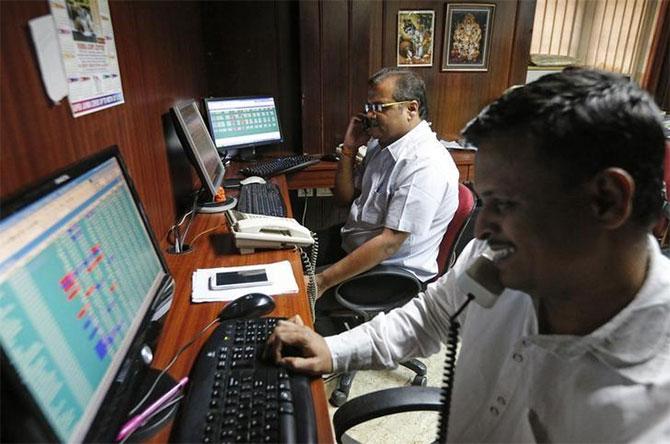
Market Performance - The 30-share BSE Sensex increased by 319.78 points, or 0.39%, closing at 81,857.48, with a daily high of 82,084.92 and a low of 81,088.59 [3] - The 50-share NSE Nifty rose by 126.75 points, or 0.51%, ending at 25,175.40 [3] - Key gainers included Adani Ports, Axis Bank, Tata Steel, Tech Mahindra, NTPC, State Bank of India, UltraTech Cement, and Bharat Electronics [3][6] Company Highlights - Axis Bank's net profit for the December quarter grew by 4% to Rs 7,010.65 crore, compared to Rs 6,742.99 crore in the same period last year, leading to a stock price increase of over 4% [4][6] - In contrast, companies such as Mahindra & Mahindra, Kotak Mahindra Bank, Asian Paints, Eternal, and ITC experienced declines [4][6] Trade Agreement Impact - India and the European Union finalized a significant free trade agreement, described as the "mother of all deals," which is expected to positively influence investor sentiment amid global trade disruptions [5][7] - The finalization of the India-EU bilateral trade agreement provided some support to Indian equities, despite a broader risk-off environment due to US tariff policies [7] Investor Activity - Foreign portfolio investors sold equities worth Rs 4,113.38 crore, while domestic institutional investors purchased stocks worth Rs 4,102.56 crore, indicating mixed investor sentiment [8]
India-EU Trade Agreement: What We Know
Bloomberg Television· 2026-01-27 09:48
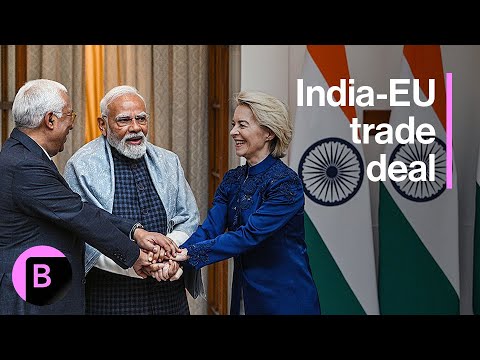
The European Union and India concluded a free trade agreement after nearly two decades of negotiations. The deal is expected to double EU goods exports to India by 2032 by eliminating or reducing tariffs on 96.6% of EU goods exports to India. The conclusion of negotiations after years of halting talks reflects the rapidly shifting global alignment under US President Donald Trump. Bloomberg's Oliver Crook reports. -------- More on Bloomberg Television and Markets Like this video? Subscribe and turn on notifi ...
Trump 25% South Korea Tariff Threat & India-EU Deal | Daybreak Europe 01/27/2026
Bloomberg Television· 2026-01-27 08:33
Bloomberg Daybreak Europe is your essential morning viewing to stay ahead. Live from London, we set the agenda for your day, catching you up with overnight markets news from the US and Asia. And we'll tell you what matters for investors in Europe, giving you insight before trading begins. On today's show, President Donald Trump has threatened to hike tariffs on goods imported from South Korea to 25%, citing what he said was the failure of the country's legislature to codify the trade deal the two nations re ...