GPU计算生态

Search documents
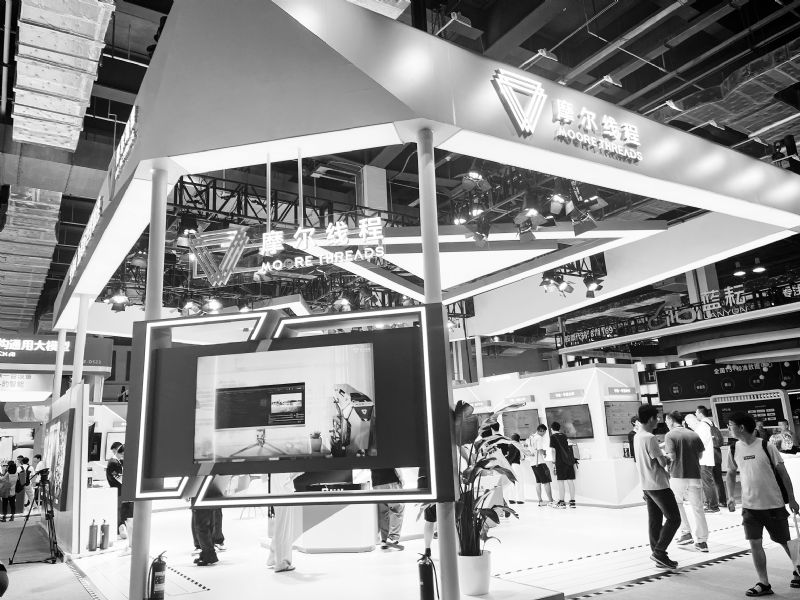
摩尔线程IPO倒计时一股东浮盈千倍 累亏超59亿预计最快2027年盈利
Chang Jiang Shang Bao· 2025-11-16 23:40
Core Viewpoint - Moer Technology has achieved the fastest IPO record on the Sci-Tech Innovation Board, with a total of 122 days from registration to approval, and is set to become the first domestic GPU stock in the A-share market [2][4][5]. Group 1: IPO Details - The company plans to raise 8 billion yuan through its IPO, with the public offering date set for November 24, 2025 [3]. - Moer Technology will issue 70 million new shares, with 11.2 million shares for online initial issuance and 44.8 million shares for offline initial issuance [3]. - The funds raised will be allocated to various AI and GPU chip development projects, with 1.006 billion yuan earmarked for working capital [3]. Group 2: Financial Performance - Moer Technology has not yet achieved profitability, reporting a cumulative loss of 5.939 billion yuan since 2022, with a loss of 724 million yuan in the first three quarters of 2025 [2][9]. - The company’s revenue has shown significant growth, with 2022 revenue at 46 million yuan, increasing to 1.24 billion yuan in 2023 and 4.38 billion yuan in 2024, representing year-on-year growth rates of 169.01% and 253.65% respectively [9]. - The company anticipates reaching profitability by 2027, projecting revenues of 5.983 billion yuan and a gross margin of 61% [10]. Group 3: Investment and Valuation - Moer Technology's valuation has reached approximately 30 billion yuan prior to its IPO, with early investors seeing returns of up to 1020 times their initial investment [7][8]. - The company has undergone seven rounds of financing, raising over 10 billion yuan in total [6]. - The shareholder base includes notable investors such as China Mobile, Sequoia Capital, and Tencent Investment, with a total of 82 shareholders [7]. Group 4: Market Position and Technology - Moer Technology is often referred to as the "Chinese version of NVIDIA," leveraging the expertise of its founder, who previously held a senior position at NVIDIA [8]. - The company has developed a full-stack technology approach, covering AI computing, professional graphics acceleration, and desktop graphics acceleration [9]. - Moer Technology has successfully mass-produced five generations of full-function GPU chips, positioning itself as a key innovator in the domestic GPU sector [9].

中信建投:国产算力板块迎来密集催化 算力芯片迎来国产替代窗口期
智通财经网· 2025-08-24 00:08
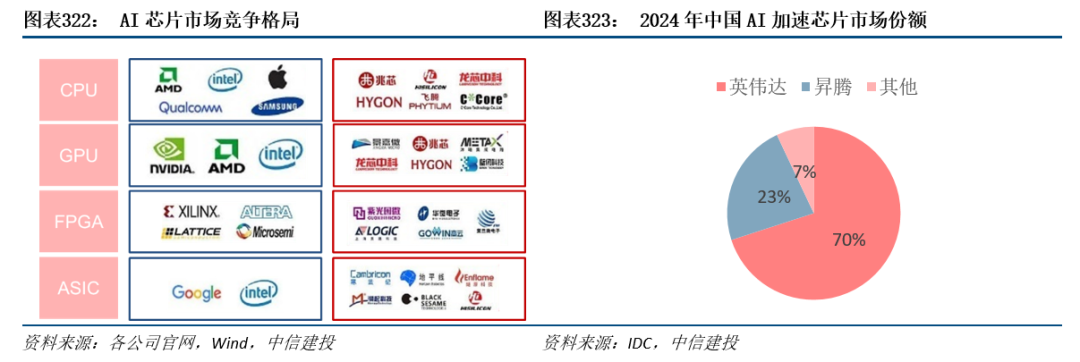
Group 1: Market Overview - The A-share index rose by 1.45% on August 22, surpassing 3800 points, with significant growth in computing power and chip stocks [1] - The domestic computing power sector is experiencing a surge in activity, with multiple catalysts emerging [1] - Domestic AI chip manufacturers are gradually gaining market share, with Huawei's Ascend chips and Cambricon's AI chips making notable advancements [2][12] Group 2: Competitive Landscape - Nvidia dominates the AI acceleration chip market with a 70% share, while Huawei's Ascend holds 23% in 2024 [2] - The GPU market is primarily led by Nvidia, AMD, and Intel, with Nvidia expected to hold a 92% market share in independent graphics cards by Q1 2025 [5] - Domestic manufacturers are closing the gap in graphics rendering GPUs, with companies like Chipone and Jingjia Micro making significant progress [9][11] Group 3: Technological Advancements - Nvidia's GPU architecture has been updated approximately every two years since 2006, with the latest GeForce RTX 40 series showcasing significant performance improvements [8] - Domestic firms are innovating in ASIC technology, with companies like Cambrian and Horizon achieving notable advancements in performance and efficiency [12] - The CUDA software ecosystem developed by Nvidia is a key factor in its market leadership, providing a robust platform for AI training and deep learning applications [13][14] Group 4: Regulatory Environment - The U.S. has intensified export controls on AI chips to China, affecting high-end products from Nvidia and AMD [15] - New regulations have expanded the scope of restricted products, impacting several Nvidia models, including the H20, which was also placed under export control [15]