Income Distribution

Search documents
Why WALL-E is 'The Good Scenario' from AI Disruption
Bloomberg Television· 2026-02-15 15:00
Almost all the conflicts in the AI era are between competing groups of people, not between machines versus people. >> David Otter is professor of economics at MIT and the co-director of the labor studies program at the National Bureau of Economics Research. He's also emerged as one of the world's leading experts on the impacts of AI on the American worker.He spoke to us from MIT's campus in Cambridge, Massachusetts. The interests of the creators may very well not be the interests of the end users. We see th ...

US Consumer Confidence Rises, Inflation Still a Worry
Youtube· 2025-12-05 16:40
Economic Sentiment and Consumer Confidence - Consumer confidence is showing slight improvement, with inflation expectations decreasing compared to previous readings [1][2] - Although overall sentiment has increased, it remains at historically low levels [2] - Consumers are feeling some relief regarding inflation but are still cautious about the economy [3] Spending Behavior and Economic Conditions - Historically, consumer confidence correlates with spending; when confidence is low, spending tends to decrease [5] - In 2022, despite low confidence, consumers were willing to spend due to strong labor markets and income stability [5] - Currently, consumers report weakening labor markets, leading to less willingness to spend, particularly among middle and lower-income groups [6][8] Income Distribution and Spending Patterns - High-income consumers with stable incomes and significant stock portfolios are more likely to continue spending [8] - Consumers with smaller portfolios or job insecurity are more cautious and focused on value when making spending decisions [8] - The distribution of income and wealth is highly skewed, with high-income individuals contributing significantly to aggregate spending [9][10]

华泰证券:AI的快速渗透将对就业市场、宏观走势、产业格局、收入分配等产生深远的影响
Sou Hu Cai Jing· 2025-08-25 00:06
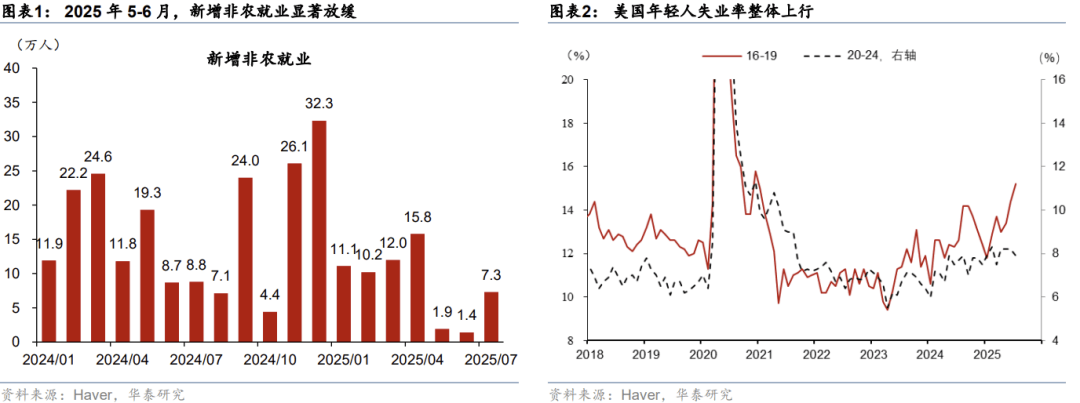
Group 1 - The U.S. job market is weakening rapidly in the first half of 2025, with AI penetration accelerating, but AI is not the primary driver of this slowdown. Other factors such as tariffs, immigration policies, and the DOGE initiative are more significant contributors [1][4][11] - Since April 2025, employment in the U.S. has noticeably slowed, particularly affecting younger demographics and those with graduate degrees. The unemployment rate for ages 16-19 reached 15.2% in July, while for ages 20-24 it was 7.9% [2][11] - AI's impact on employment is currently limited, with some industries experiencing job losses, but overall, sectors with high AI exposure have shown better employment trends compared to others. For instance, non-farm employment in AI-exposed industries has not declined as sharply as in other sectors [3][12] Group 2 - Tariffs, immigration, and the DOGE initiative are identified as primary factors contributing to the slowdown in job growth since 2025. Tariffs have increased significantly, with the weighted tariff rate rising by 6.6 percentage points to 8.9%, the highest since the 1930s [4][27] - Immigration inflow is expected to decrease significantly, potentially dropping to near zero in 2025, which will further constrain labor supply and negatively impact non-farm employment [34][38] - The DOGE initiative has led to a reduction in federal government employment, with a cumulative loss of 84,000 jobs from January to July 2025, affecting overall job growth [43][51] Group 3 - The job market is expected to remain weak in the third quarter of 2025, with a gradual increase in the unemployment rate. Factors such as rising tariffs and limited improvements in hiring intentions are likely to continue impacting the job market [55][60] - There is an expectation of a marginal rebound in non-farm employment in the fourth quarter, driven by improved corporate investment and hiring intentions, although this will be constrained by declining labor supply [60][68] - AI's penetration in U.S. industries is currently at about 9%, with significant potential for growth, which could have profound implications for employment, industry structure, and income distribution in the future [24][11]