Industrial Embodied Intelligence

Search documents
坤吾x龙虾:开启工业具身智能的Agentic时代!
机器人大讲堂· 2026-03-23 10:48
Core Viewpoint - The article discusses the challenges and opportunities in the field of embodied intelligence in industrial manufacturing, emphasizing the need for a balance between precision and flexibility, as well as the integration of general and specialized skills in AI systems [1][2]. Group 1: Challenges in Embodied Intelligence - Industrial manufacturing faces two main challenges: achieving "rigid-flexible" capabilities to meet precision and flexibility demands in "small-batch, multi-variety" production [1]. - There is a need for AI systems to not only perform general tasks but also to deeply understand and master specific manufacturing processes and skills [1]. Group 2: Development Paradigm - Instead of having AI learn complex manufacturing knowledge from scratch, it is proposed to create a smart "brain" that interprets human manufacturing intentions and optimizes processes using existing industrial software and expertise [2]. Group 3: Integration of Technologies - The integration of the Kunwu platform with OpenClaw allows for a comprehensive skill ecosystem, enabling the intelligent agent to automatically build production lines or robotic workstations based on customer specifications [3]. - The intelligent agent can perform tasks such as virtual debugging and on-site deployment, significantly enhancing operational efficiency [3]. Group 4: Transformation of Industrial AI - The OpenClaw intelligent agent is positioned to become a powerful industrial AI, capable of driving autonomous and precise operations in manufacturing environments, thus facilitating the large-scale implementation of embodied intelligence [4]. Group 5: Practical Examples of Enhanced Capabilities - Traditional methods of configuring robotic actions are labor-intensive and error-prone, but with the new system, engineers can simply instruct the intelligent agent to perform tasks, freeing them for more creative work [6]. - Building simulation scenarios has been simplified from a complex manual process to a straightforward verbal instruction, allowing for rapid scene creation [7][8]. - The development of production line control software has been transformed, enabling non-programmers to generate operational software through natural language descriptions, significantly reducing development time and complexity [9][12]. Group 6: Future of Industrial Software - The article suggests that future industrial software should be designed to support intelligent agents, encapsulating complex functions into easily callable interfaces, thus enhancing the capabilities of AI in industrial settings [12].


400亿杭州自动化龙头发力工业智能
2 1 Shi Ji Jing Ji Bao Dao· 2026-01-09 01:27
Core Insights - The article highlights the strategic shift of Zhongkong Technology, led by Chu Jian, towards industrial AI, aiming to integrate AI technology deeply into key industrial scenarios [2][3][4]. Group 1: Company Overview - Zhongkong Technology, based in Hangzhou, is a leader in the domestic industrial automation sector with a market capitalization exceeding 40 billion [3]. - Chu Jian, the founder and a key figure in the company, is focusing on transforming Zhongkong into an industrial AI company, leveraging his extensive experience in the field [7][12]. Group 2: AI Business Development - The management plans to achieve annual revenue of 20 billion from AI and 5 billion from robotics within the next 4-5 years, with an investment of 20 billion in AI [5][26]. - The core product for their AI business is the TPT model, which is set to be released in June 2024, designed to enhance productivity by analyzing time-series data [8][10]. Group 3: Technological Innovations - TPT aims to automate the analysis of industrial data, significantly reducing the time required for process optimization from 1-2 months to just a few minutes, improving efficiency by over 90% [10][11]. - The introduction of UCS (Universal Control System) is expected to revolutionize the traditional DCS architecture, reducing cabinet space by 90% and cable costs by 80% [18][19]. Group 4: Market Position and Goals - Zhongkong aims to become a professional AI service provider in the industrial process sector, with a target of reaching a market value of 1 trillion [6][25]. - The company has over 35,000 industrial clients and is transitioning to a subscription-based model, having signed 938 subscription clients by mid-2025 [14][26]. Group 5: Financial Performance and Challenges - Despite ambitious growth plans, Zhongkong reported a double-digit decline in revenue and net profit for the first nine months of 2025, with the robotics segment generating only 120 million in revenue [28][29]. - The company faces pressure to prove its capabilities as it transitions from traditional software to AI-driven solutions [32].

400亿杭州自动化龙头,发力工业智能
2 1 Shi Ji Jing Ji Bao Dao· 2026-01-09 01:11
Core Insights - The article highlights the strategic shift of Zhongkong Technology towards industrial AI, with a focus on integrating AI technology into key industrial scenarios [2][4][20] - The company aims to achieve a market capitalization of one trillion yuan by investing 20 billion yuan in AI and robotics over the next 4-5 years [5][20] Company Overview - Zhongkong Technology, based in Hangzhou, is a leading player in the domestic industrial automation sector with a market value exceeding 40 billion yuan [3] - The company is led by Chu Jian, who has a background in academia and has been pivotal in breaking the monopoly of international giants in the DCS (Distributed Control System) market [6][3] AI Business Development - Zhongkong plans to generate annual revenues of 20 billion yuan from its AI business and 5 billion yuan from its robotics business within the next 4-5 years [4] - The company is developing a core product called TPT, a time-series model for industrial processes, which is expected to enhance productivity significantly by predicting equipment failures [7][9] Technological Innovations - TPT leverages over 30 years of industry expertise and aims to automate the analysis of time-series data, drastically reducing the time required for process optimization from months to minutes [10][9] - The introduction of TPT 2.0 is expected to facilitate a shift towards online services, expanding the customer base with 518 pre-orders and 112 contracts on the launch day [13] Strategic Goals - Zhongkong's vision includes becoming a specialized AI service provider in the industrial process sector, with a goal of reaching 50,000 customers [19][20] - The company is transitioning from a project-based model to a subscription-based model, aiming to redefine industrial software configuration and pricing [20] Market Position and Challenges - The DCS market in China is projected to grow, with Zhongkong expected to capture a 40.4% market share by 2024, but the overall market size is limited to approximately 12 billion yuan [23] - Despite ambitious growth plans, the company has faced challenges, including a double-digit decline in revenue and net profit in the first nine months of 2025 [20][21]
机器人产业商业化落地进程不断加快,机器人ETF嘉实(159526)盘中涨近2%
Sou Hu Cai Jing· 2025-08-19 06:24
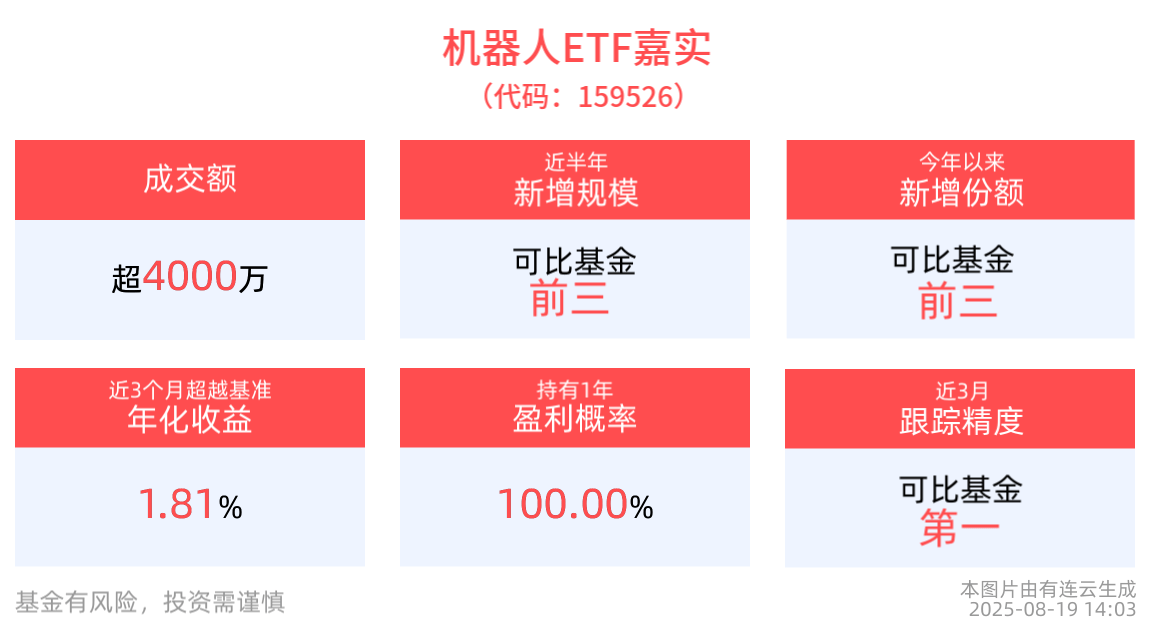
Group 1: ETF Performance and Liquidity - The liquidity of the Robot ETF managed by Jiashi has a turnover rate of 8.09%, with a transaction volume of 44.39 million yuan [3] - Over the past week, the average daily transaction volume of the Robot ETF reached 44.26 million yuan [3] - The ETF's scale has increased by 200 million yuan in the past six months, with a share growth of 23.7 million shares this year [3] Group 2: Financial Performance - As of August 18, 2025, the net value of the Robot ETF has risen by 8.92% over the past six months, ranking in the top two among comparable funds [3] - The highest monthly return since inception was 25.78%, with the longest consecutive monthly gains being three months and a maximum increase of 37.12% [3] - The average return during the rising months is 8.93% [3] Group 3: Key Holdings - As of July 31, 2025, the top ten weighted stocks in the CSI Robot Index include Keda Xunfei, Huichuan Technology, Stone Technology, Dahua Technology, Zhongkong Technology, Dazhu Laser, Shuanghuan Transmission, Robot, Ecovacs, and Julun Intelligent, collectively accounting for 48.86% of the index [3] Group 4: Industry Developments - Zhiyuan Innovation (Shanghai) Technology Co., Ltd. has partnered with Fulian Precision Engineering Co., Ltd. for a project worth several million yuan, marking the first large-scale commercial contract for embodied robots in the industrial sector in China [5] - The current phase of humanoid robots is likened to the "iPhone era," indicating significant industry potential, with dexterous hands expected to account for over 30% of the robot's value [5] Group 5: Technological Advancements - The robot industry is entering a rapid development phase, with the commercialization process accelerating [6] - Sensors are identified as the core hardware for the intelligence level of humanoid robots, with technological iterations driving significant advancements [6] - The value and technical requirements of sensors may undergo substantial changes due to the accelerated product iterations by main manufacturers [6]