International Emergency Economic Powers Act

Search documents
Trump's other tariff options are "much more narrow."
Yahoo Finance· 2026-02-21 20:30
There are a number of tariff authorities that Trump could rely on to replicate these indirectly. There's there's some authorities that could allow him to reimpose some of these tariffs immediately on a short-term duration and there's kind of a longer term process that could allow these type of tariffs, these kind of blanket tariffs that have been are such the issue here using other laws. This is a 1977 law called the International Emergency Economic Powers Act.There's a bunch of other ways that Congress has ...

Trump Tariffs Will Clear The Supreme Court Hurdle? Crypto Bettors Say: No
Yahoo Finance· 2026-01-15 16:01
Core Insights - The Supreme Court is expected to make a decision regarding President Trump's tariffs, with low odds favoring his position according to cryptocurrency prediction markets [1][2] Group 1: Odds and Predictions - Polymarket indicates a 28% chance that the Supreme Court will overturn the previous ruling on Trump's tariffs, an increase from 22% a week prior, but still below the all-time highs of September 2025 [2] - Kalshi bettors estimate a 32% chance that the Supreme Court will rule in favor of Trump, with a 53% likelihood that an opinion will be released before January 16 [3] Group 2: Economic Implications - Trade tariffs are a significant focus for market observers, with potential implications for market direction in early 2026 [4] - Trump warned of severe economic consequences if the Supreme Court rules against the federal government regarding tariffs [4] - Treasury Secretary Scott Bessent stated that the Treasury has sufficient funds to cover potential tariff refunds if the ruling is unfavorable [5] Group 3: Legal Context - Since January 2025, Trump has utilized the International Emergency Economic Powers Act to impose tariffs aimed at correcting trade imbalances, although a U.S. appeals court previously ruled that he overstepped his authority [6] - Economist Mark Zandi noted that the labor market is struggling due to tariffs, suggesting that a Supreme Court ruling could be crucial for job growth recovery [7]
Trump seeks to stop courts, creditors from seizing Venezuelan oil revenue in the U.S.
CNBC· 2026-01-10 20:32
Group 1 - The executive order signed by U.S. President Donald Trump aims to block the seizure of Venezuelan oil revenue held in U.S. Treasury accounts, declaring it as sovereign property of Venezuela [2][3] - The order states that any judicial attempts to seize these funds would harm U.S. national security and foreign policy, and interfere with efforts to stabilize Venezuela economically and politically [2][3] - Trump indicated that U.S. oil companies are expected to invest at least $100 billion in Venezuela's oil and gas infrastructure following the military operation that captured Venezuelan leader Nicolás Maduro [4] Group 2 - Major oil executives, including ExxonMobil's CEO, expressed concerns about Venezuela being "uninvestable" due to past nationalization of the oil sector and ongoing legal disputes for compensation [5] - Chevron remains the only major U.S. oil company currently operating in Venezuela, facilitated by a special license from the Trump administration [6] - The legal basis for the executive order includes the 1977 International Emergency Economic Powers Act and the 1976 National Emergencies Act [6]


What do markets expect from US Supreme Court's ruling on Trump's tariffs
Invezz· 2026-01-09 12:21
Core Viewpoint - The US Supreme Court is poised to deliver a significant ruling on President Trump's global tariffs, which could have far-reaching implications for trade policy and the economy [1][2]. Legal Authority and Refunds - The case examines whether the Trump administration lawfully imposed tariffs under the International Emergency Economic Powers Act (IEEPA) and whether importers are entitled to refunds if the tariffs are deemed unlawful [3][4][5]. - Legal experts suggest that if the court finds the use of IEEPA improper, it could lead to refunds estimated at up to $150 billion, creating a complex situation for the federal government [6]. Market Reactions and Predictions - Investors are anxious due to the uncertainty surrounding the ruling, with prediction markets indicating only a 28% chance that the Supreme Court will fully uphold the tariffs [7]. - Analysts from Morgan Stanley highlight that the court's decision could vary, potentially narrowing the president's authority or allowing some tariffs to remain while striking down others [9]. Economic Implications - A ruling against the tariffs could boost S&P 500 earnings before interest and taxes by approximately 2.4% in 2026, prompting a potential rally in equities, especially for companies reliant on imported goods [12]. - Consumer-facing businesses and retailers are expected to benefit the most from a favorable ruling, while sectors like materials and domestic producers may lag [13]. Bond Market Impact - A decision against the tariffs could negatively affect US government revenues, leading to higher Treasury yields and increased volatility in bond markets [15][16]. Broader Economic Context - Despite initial fears, the economic impact of the tariffs has been limited, with inflation effects being muted and the US trade deficit narrowing significantly [17]. - The administration argues that tariffs are reshaping trade flows without hindering economic growth, with Morgan Stanley projecting only modest economic effects if tariff rates remain unchanged [18]. Long-term Trade Policy Implications - The ruling is expected to set a precedent for how future presidents utilize emergency powers in trade matters, with significant stakes for companies across various sectors [19][20].



Costco sues Trump administration for full refund of tariffs paid on imported goods
NBC News· 2025-12-02 23:53
Legal & Financial Dispute - Costco is suing the Trump administration for a full refund of tariffs paid on imported goods under Trump's tariff plan [1] - The lawsuit challenges the legality of tariffs imposed under the International Emergency Economic Powers Act (IEEPA) [2][3] - The White House estimates that upholding President Trump's tariffs has brought in nearly $90 billion through September [4] - Costco seeks millions in refunds, arguing IEEPA doesn't authorize the president to set tariffs [3] Potential Impact & Industry Response - A Supreme Court ruling against the administration could open the door for other businesses to sue for tariff refunds [5] - Revlon, Kawasaki, and Bumblebee have filed similar suits [5] - Experts suggest that success for other companies may be difficult, as Costco's claim is specific to its business model [5][6] Costco's Business Strategy & Stance - Costco claims it has not raised prices due to tariffs, absorbing the costs to avoid passing them on to customers [6] - Costco has maintained its DEI policies despite pressure from the White House, unlike some other large US businesses [6][7] - Costco has a large customer base of 145 million worldwide, with about half in the United States, giving it significant consumer power [7] Alternative Tariff Implementation - There are at least six other ways President Trump could impose tariffs, involving Congress, the International Trade Commission, or the US Trade Representative [9] - The current tariffs were implemented via executive order by President Trump [10]


Supreme Court appears skeptical of Trump's use of an emergency law to impose sweeping tariffs
NBC News· 2025-11-06 00:23
The Supreme Court is deciding one of the biggest issues on President Trump's policy agenda, his tariffs. The court is deciding whether President Trump had the authority to issue sweeping tariffs under an emergency law called AIPA, which stands for the International Emergency Economic Powers Act. Based on the oral arguments, the justice did seem skeptical that President Trump has the power to do this.And while we don't know what the ruling is going to be yet, it looks like it's going to be an uphill battle f ...
Trump Tariffs Face Huge Test in US Supreme Court
Bloomberg Television· 2025-11-05 22:56
Case Overview - The Supreme Court is hearing a major case concerning President Trump's authority to impose tariffs under the International Emergency Economic Powers Act (IEEPA) [1] - The central question is whether the President can use IEEPA to impose tariffs, given that the act doesn't explicitly mention tariffs or duties [1][2] - Lower courts, including the International Court of Trade, have ruled against the President's use of IEEPA for tariffs [3] Legal Arguments - The President argues that the fentanyl crisis and trade deficit constitute "unusual and extraordinary circumstances," justifying the use of emergency powers [2] - Opponents argue that imposing tariffs is a power that belongs to Congress, not the President [2] - Amicus briefs overwhelmingly oppose the tariffs, with 40 briefs against and 10 in favor, including submissions from the Chamber of Commerce, small businesses, and law professors [4] Key Players - The plaintiffs are small businesses, including a wine exporter and a toy goods company [5] - Neal Katyal, a former acting solicitor general with an hourly rate of $3,000, is arguing for the plaintiffs [5] - The solicitor general is arguing on the other side, representing the government [6] Potential Outcomes and Implications - A ruling against the President would limit the use of IEEPA for imposing tariffs [10] - Even if the President loses the case, the administration may seek other ways to implement tariffs [11] - Bloomberg Economics estimates the U S is collecting $556 million daily in IEEPA tariffs, projecting over $140 billion by the end of 2025, raising questions about potential reimbursements [13]
Arguments Over Trump Tariffs Hit Supreme Court
Bloomberg Television· 2025-11-05 17:46
Legal & Policy Analysis - The Supreme Court justices are questioning the Trump administration's legal authority to impose tariffs under the International Emergency Economic Powers Act (IEEPA) [1][2] - A key point of contention is whether President Trump can impose tariffs without congressional approval, particularly concerning the power of the purse [2][3] - The administration is attempting to justify the tariffs by framing them as responses to foreign actors and national emergencies, rather than revenue raising measures [4] - The justices are questioning whether trade imbalances meet the legal standard for declaring a national emergency to invoke IEEPA tariffs [4][5] Trade & Economic Impact - Approximately 60% of the tariffs implemented this term are tied to IEEPA, indicating potentially broad implications [6] - The administration is reportedly preparing to use other authorities, such as Section 232 national security tariffs, suggesting that tariffs are likely to persist [6] - The plaintiffs in the case argue that the administration could have utilized other tariff powers [5] Supreme Court's Role - This case marks the first time the Supreme Court is hearing a case related to President Trump's actual policy with potentially long-standing impact, rather than an emergency ruling [8] - The court has previously ruled on an emergency basis regarding President Trump's policies [8]
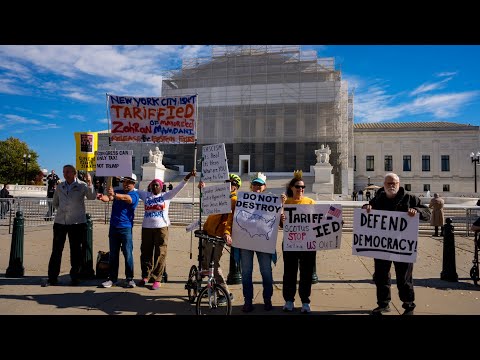
Supreme Court hears challenge to President Trump's fentanyl & 'liberation day' tariffs
CNBC Television· 2025-11-05 16:07
Tariffs & Legal Challenges - The Supreme Court is hearing arguments on the legality of President Trump's tariffs, a decision with significant implications [1][2][3] - The Trump administration is asking the Supreme Court to reverse a lower court ruling that deemed most of the tariffs an illegal use of the International Emergency Economic Powers Act (IEEPA) [3] - An estimated $90 billion in tariff revenue is at stake, which the Treasury might have to refund if the administration loses the case [4][16] - Businesses argue that the power to regulate imports is not the same as the power to tax, challenging the legality of the tariffs [5] - The companies suing the administration are primarily small firms, including toy manufacturers, a wine importer, and an apparel company [6] Potential Economic Impact & Alternative Measures - If the Supreme Court strikes down the tariffs, it could significantly limit the president's maneuvering room on tariffs [12] - The Treasury has contingency plans and could potentially reimpose tariffs using alternative measures like Section 301 or Section 232, although these are more cumbersome [10][13] - The introduction of alternative measures could reintroduce tariff volatility and policy uncertainties [14] - If the administration loses the case, the Treasury would have to return approximately $90 billion in revenue collected under IEEPA tariffs, potentially impacting the deficit [4][16] Timeline & Market Reaction - A decision from the Supreme Court is expected by the end of the year, but could come at any time [9] - Uncertainty surrounding the Supreme Court's decision and potential alternative tariff measures contributed to market selloffs [14]
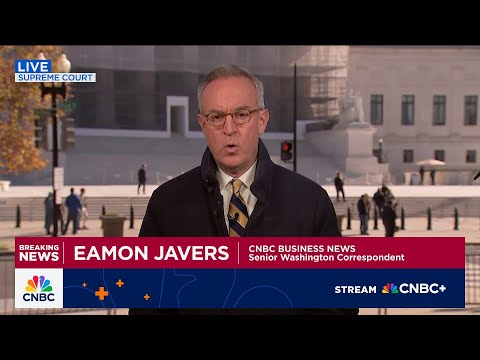
Supreme Court hears challenge to President Trump's fentanyl & 'liberation day' tariffs
Youtube· 2025-11-05 16:07
Core Points - The Supreme Court is hearing arguments regarding the legality of President Trump's tariffs, which could have significant implications for tariff revenue and presidential authority [1][2][3] - The Trump administration is seeking to reverse a lower court ruling that deemed most tariffs illegal under the International Emergency Economic Powers Act, which has never been used for such purposes before [3][5] - An estimated $90 billion in tariff revenue is at stake, which the Treasury may have to return if the administration loses the case [4][16] Legal Context - The power to impose tariffs is constitutionally granted to Congress, and the administration's use of the 1977 law to impose tariffs is being challenged [4][5] - The distinction between "regulating" and "taxing" is central to the arguments, with businesses contending that the administration's actions exceed its legal authority [5] Stakeholders - The cases are brought by small firms, including toy manufacturers and a wine importer, rather than large corporations [6] - Treasury Secretary Scott Bessant is present at the Supreme Court, indicating the administration's high stakes in the outcome [2] Potential Outcomes - The Supreme Court's decision could be expedited, with expectations of a ruling by the end of the year [8][9] - If the tariffs are struck down, the administration may resort to alternative measures, though these would be more cumbersome and less direct [10][11][12] Market Implications - The potential for tariff refunds could negatively impact the bond market, as the Treasury would face challenges in managing its revenue and deficit [16]