
LNG供应过剩

Search documents
伍德赛德(WDS.US)预警LNG价格下行压力 坚称需求增长具备韧性
智通财经网· 2026-02-24 08:03
Core Viewpoint - Woodside, Australia's largest LNG producer, acknowledges a potential oversupply in the global LNG market that may pressure prices, but emphasizes strong demand growth and the uncertainty of new supply [1][3] Group 1: Market Dynamics - The International Energy Agency (IEA) and BloombergNEF predict that the global LNG market may enter a state of oversupply as early as this year due to new LNG plants coming online in North America and the Middle East [1] - Over 50 countries currently have LNG import capabilities, enhancing market liquidity, while some high-cost projects have been shelved, including a Louisiana LNG export project halted by Energy Transfer LP [3] Group 2: Company Performance - Woodside's annual net profit decreased by 24% to $2.7 billion, although this was above market expectations of $2.54 billion, primarily due to falling oil and gas prices [3][4] - Total oil and gas production increased by over 6% year-on-year, reaching a record 198.8 million barrels of oil equivalent, partially offsetting the impact of a 5% decline in average realized prices to $60 per barrel of oil equivalent [3] Group 3: Future Projects - Production growth is attributed to the commissioning of a synthetic ammonia plant in Beaumont, Texas, and a final investment decision on the Louisiana LNG project, expected to deliver its first shipment by 2029 [4] - The Scarborough project in Australia is 94% complete and is scheduled to deliver its first LNG shipment in the fourth quarter, while the Trion oil field project in Mexico is expected to commence production in 2028 [4] Group 4: Shareholder Returns - Woodside announced a final dividend of $0.59 per share, up from $0.53 per share in the same period last year, reflecting positive performance news that boosted the company's stock price by over 2%, reaching an 18-month high [4]


Rystad Energy:尽管存在供应过剩的担忧,美国LNG仍保持盈利
Sou Hu Cai Jing· 2026-02-10 12:06
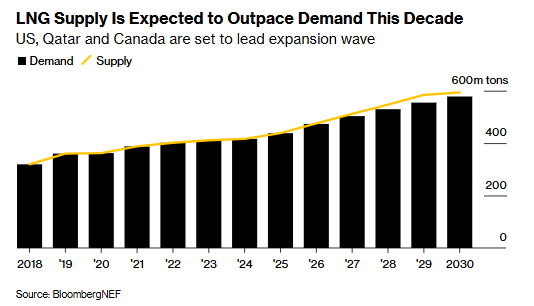
Core Viewpoint - The average profit margin for U.S. Gulf Coast (USGC) LNG shipments to Europe from 2023 to 2025 is projected to be $4.56 per MMBtu, equating to $17.5 million per LNG vessel, contrasting sharply with negative margins seen in 2019 and 2020 during the pandemic [1] Group 1: Profit Margins and Investment Decisions - The attractive profit margins have led national oil companies, large corporations, sovereign wealth funds, private equity, and Asian utilities to invest heavily in U.S. LNG projects, resulting in several final investment decisions (FID) for both greenfield and brownfield projects [1] - Despite rising risks of low prices, the impending oversupply of LNG has not deterred investors, although skepticism began to surface when the TTF-Henry Hub spread plummeted to $4 per MMBtu, the lowest since April 2021 [1] Group 2: Historical Context and Market Mechanisms - The only significant cancellation of LNG shipments in the U.S. occurred during the COVID-19 pandemic in 2020, where despite TTF prices being below the full cost of U.S. LNG deliveries to Europe, facility utilization did not decline due to fixed costs being viewed as sunk [2] - LNG cargo cancellations only occur when the price spread falls below variable costs within a one to two-month timeframe, rather than during short-term market tightness [4] Group 3: Future Demand and Economic Factors - Future demand for LNG, particularly from China and emerging Asian markets, is driven by economic factors rather than emissions reduction, with LNG prices remaining competitive against other fuels [12] - Analysts predict that unless a global recession occurs, the demand for LNG will absorb any oversupply, particularly as coal and oil alternatives remain viable [4][11] Group 4: Price Dynamics and Risks - The long-term risk to U.S. LNG profit margins is primarily driven by fluctuations in Henry Hub prices, which are expected to rise significantly due to increasing demand and declining production rates in shale regions [16] - The relationship between Henry Hub and global LNG prices is expected to strengthen, meaning that increases in Henry Hub prices will likely lead to higher global LNG prices, as seen in recent trends [17]
供应过剩预警拉满!为何卡塔尔、阿联酋仍坚信 LNG 需求强劲?
Zhong Guo Neng Yuan Wang· 2026-02-06 08:04
Core Viewpoint - The global liquefied natural gas (LNG) market is expected to transition from a tight supply to a relatively loose supply by 2026, leading to a new "buyer’s market" as new capacities come online, despite a slowdown in demand growth overall [1][2]. Supply and Capacity - At least 35 million tons per year of new LNG capacity is projected to come online globally by 2026, primarily from the U.S. and Qatar, with total global LNG supply expected to reach between 460 million and 484 million tons, reflecting a potential annual growth rate of up to 10% [2][3]. - Significant projects contributing to this capacity increase include the Golden Pass LNG project and the expansion of Qatar's North Field, with the former expected to start operations in mid-2026 and the latter to be completed by 2028 [2][3]. - U.S. LNG exports are forecasted to grow by 26% in 2025, continuing to rise until 2027, although at a slower pace [2]. Price Trends - The supply growth is anticipated to exert downward pressure on prices, with average spot LNG prices in Asia expected to range between $9.90 and $12.45 per million British thermal units (MMBtu) in 2026, and European benchmark prices projected to fall to between $9.50 and $9.74 per MMBtu [3]. - Goldman Sachs has revised its 2026 Henry Hub natural gas price forecast down to $3.75 per MMBtu, maintaining a forecast of $3.80 per MMBtu for 2027 [3]. Demand Dynamics - Asia is expected to remain a robust LNG demand market, with 64% of global LNG exports directed to the region in 2025. Demand in Asia is projected to grow by 4% to 7% in 2026, driven by price declines and increased purchases, particularly from India [4]. - Europe is also set to absorb additional supplies, with LNG imports expected to increase by 22 million tons in 2026, driven by winter stock replenishment and lower natural gas prices stimulating consumption [4][6]. Emerging Markets - Sub-Saharan Africa is emerging as a significant player in the LNG supply landscape, with exports projected to surge from 35.7 billion cubic meters in 2024 to 98 billion cubic meters by 2034, marking an increase of nearly 175% [7][8]. - Key projects in this region include the Greater Tortue Ahmeyim (GTA) project and the Rovuma LNG project, with the former expected to start production in 2025 and the latter aiming for a final investment decision in 2026 [7][8]. Market Challenges - Despite the optimistic outlook for supply growth, challenges such as regional instability and infrastructure weaknesses in parts of Africa may hinder progress [8]. - The LNG market is transitioning towards structural oversupply, necessitating a reevaluation of sourcing and downstream facilities to ensure reliable market access [8].
全球LNG供应行将过剩
Zhong Guo Hua Gong Bao· 2025-11-25 03:11
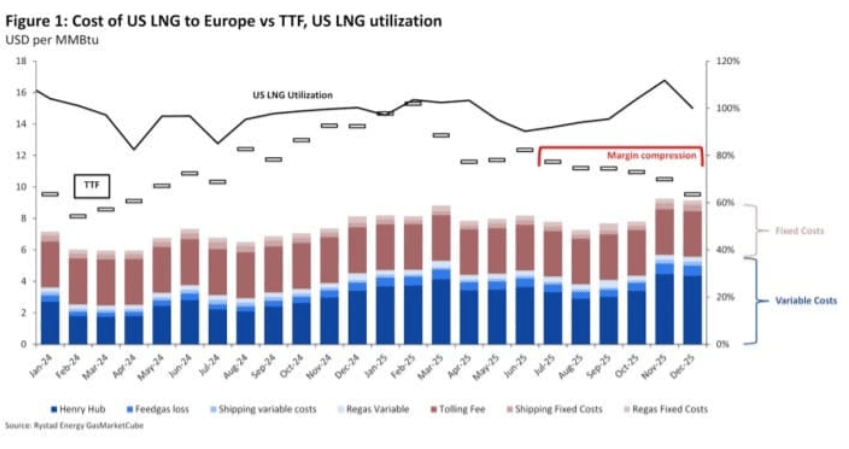
Group 1 - The global liquefied natural gas (LNG) supply is expected to expand significantly over the next two years, driven by major projects in the US and Qatar, leading to a supply surplus by the end of 2026 [1][2] - Global LNG supply is projected to increase by 10.2% this year and next, reaching 475 million tons, equivalent to the annual demand of South Korea, the world's third-largest LNG importer [1] - The primary source of LNG supply growth will shift to the US until 2027, after which Qatar's capacity expansions and newly approved US projects will further increase supply [1] Group 2 - Industry leaders and authoritative bodies are warning of potential LNG oversupply risks, with Chevron's CEO indicating that supply may exceed market absorption capacity, likely leading to a decline in spot prices [2] - The International Energy Agency (IEA) forecasts a 50% increase in global LNG supply by 2030, with half of the new capacity coming from the US and 20% from Qatar, although the path for absorbing this new supply remains uncertain [2] - Short-term LNG spot prices are expected to rise due to peak winter demand in the Northern Hemisphere, but if European gas reserves are not depleted and Russian LNG exits the market in 2027 without significant replenishment needs, prices may drop significantly in the second half of 2026 [2]