LNG进口

Search documents
E-Gas系统:2月16日-2月22日当周中国LNG进口量约53万吨
Xin Hua Cai Jing· 2026-02-24 06:56
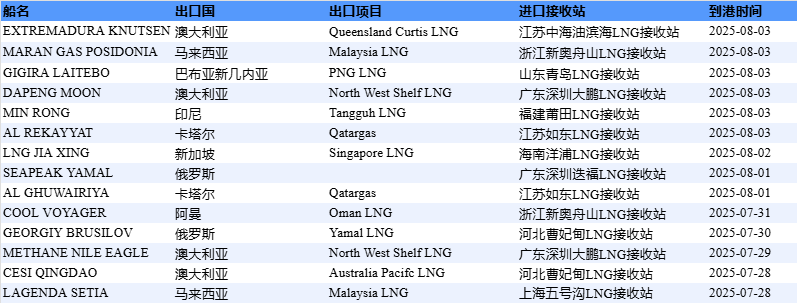
Core Viewpoint - China's LNG imports saw a significant decrease in the week from February 16 to February 22, with only 8 vessels bringing in approximately 530,000 tons, down from 1,190,000 tons in the previous week [1]. Group 1: Import Analysis - During the week of February 16 to February 22, China imported LNG from four countries, with Australia supplying 3 vessels and approximately 210,000 tons, accounting for about 41% of the total imports [3]. - The LNG receiving stations in China during this period included 2 vessels in South China, 4 in the Yangtze River Delta, and 2 in the Bohai Rim region, with the Jiangsu CNOOC Binhai LNG receiving station handling the most at 2 vessels totaling around 170,000 tons [3]. Group 2: Future Projections - For the upcoming week from February 23 to March 1, it is projected that China will import 19 vessels of LNG, with an estimated total volume of approximately 1,380,000 tons [3].

E-Gas系统:12月8日-12月14日当周中国LNG进口量约135万吨
Xin Hua Cai Jing· 2025-12-15 07:25
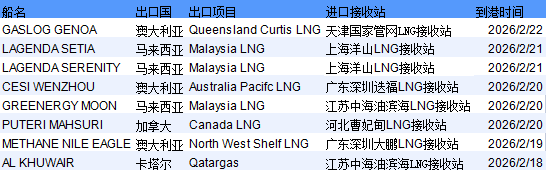
Core Insights - The article reports that China imported a total of approximately 1.35 million tons of LNG over the week from December 8 to December 14, 2023, which is a decrease from the previous week's import of 1.59 million tons [1] LNG Import Analysis - During the week of December 8 to December 14, China received 19 LNG vessels, with 7 vessels coming from Australia, accounting for about 37% of the total imports [4] - The South China region received 9 vessels, the Yangtze River Delta received 5 vessels, and the Bohai Rim region also received 5 vessels. The Yudong LNG receiving station had the highest number of arrivals with 3 vessels totaling approximately 290,000 tons [4] Future Projections - For the upcoming week from December 15 to December 21, it is projected that China will import 21 LNG vessels, with an estimated total volume of about 1.51 million tons [4][5] Data Source - The data is sourced from the China Natural Gas Information Terminal (E-Gas System), which provides real-time statistics on LNG international trade and other energy industry data [7]
E-Gas系统:10月13日-10月19日当周中国LNG进口量约125万吨
Xin Hua Cai Jing· 2025-10-20 03:21
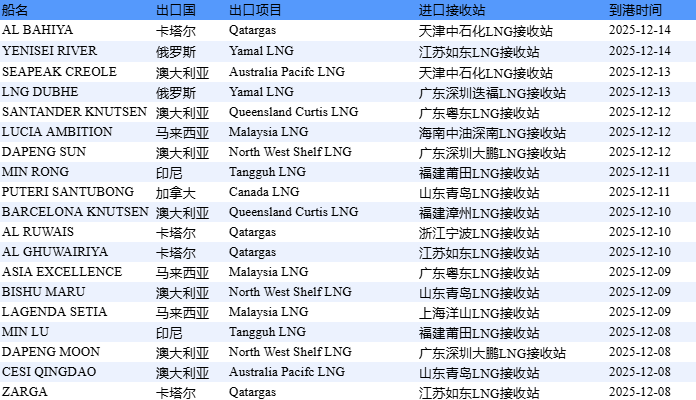
Core Insights - During the week of October 13 to October 19, China imported approximately 1.25 million tons of LNG, significantly up from the previous week's 740,000 tons, indicating a strong increase in LNG imports [1][3]. Import Analysis - A total of 16 LNG vessels were imported during the specified week, with Qatar being the largest supplier, providing 5 vessels and approximately 450,000 tons, accounting for 36% of the total imports [3]. - The South China region received 9 vessels, while the Bohai Rim region received 7 vessels. Tianjin's receiving station had the highest volume, with 3 vessels totaling around 230,000 tons [3]. Future Projections - For the upcoming week of October 20 to October 26, it is predicted that China will import 10 LNG vessels, with an estimated volume of 610,000 tons [3][5].
E-Gas系统:9月29日-10月5日当周中国LNG进口量约90万吨
Xin Hua Cai Jing· 2025-10-09 02:42
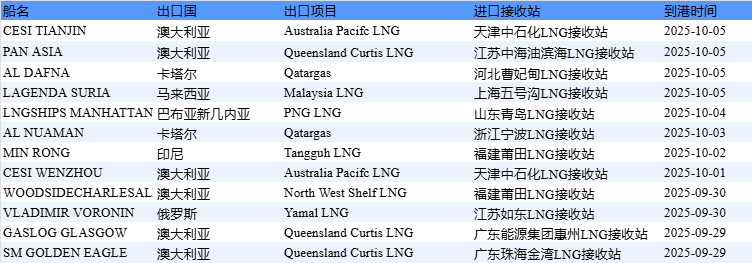
Core Insights - During the week of September 29 to October 5, China imported a total of approximately 900,000 tons of LNG, a decrease from the previous week's import of 1,100,000 tons [1] LNG Import Analysis - A total of 12 LNG vessels were imported during the specified week [1] - The breakdown of imports by country shows that Australia accounted for 6 vessels, totaling about 450,000 tons, which represents 50% of the total imports for that week [4] - The distribution of LNG receiving stations included 4 vessels in South China, 4 in the Yangtze River Delta, and 4 in the Bohai Rim region, with the Tianjin Sinopec LNG receiving station receiving the highest volume of 2 vessels, approximately 150,000 tons [4] Future Projections - For the upcoming week of October 6 to October 12, it is predicted that China will import 20 LNG vessels, with an estimated total volume of 1,390,000 tons [4][6] Data Sources - The data is sourced from the China Natural Gas Information Terminal (E-Gas system), which provides comprehensive information services for the energy sector [8]
E-Gas系统:8月18日-8月24日当周中国LNG进口量约152万吨
Xin Hua Cai Jing· 2025-08-25 06:21
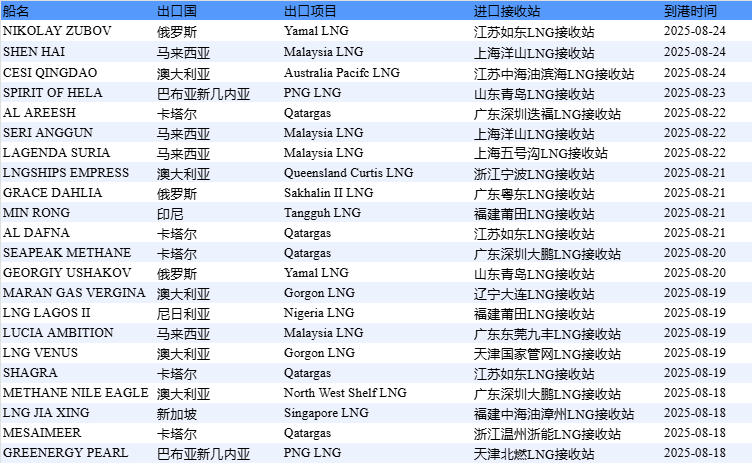
Core Insights - During the week of August 18-24, China imported a total of approximately 1.52 million tons of LNG, an increase from the previous week's 1.28 million tons, with 22 vessels arriving at coastal LNG receiving stations [1][3] Import Analysis - The LNG imports during the specified week came from eight different countries, with Qatar supplying five vessels and approximately 460,000 tons, accounting for about 30% of the total imports [3] - The distribution of LNG arrivals showed that the South China region received eight vessels, the Yangtze River Delta received nine vessels, and the Bohai Rim region received five vessels, with the Rudong LNG receiving station handling the most at three vessels totaling around 300,000 tons [3] Future Projections - For the upcoming week of August 25-31, it is projected that China will import 23 vessels of LNG, with an estimated total volume of approximately 1.56 million tons [3] Vessel Details - A detailed list of vessels arriving during the week includes various LNG projects from countries such as Australia, Qatar, and Russia, with specific receiving stations and arrival dates provided [2][4] Industry Information Service - The E-Gas system, developed by the China Economic Information Service in collaboration with the Shanghai Petroleum and Natural Gas Exchange Center, offers comprehensive information services focused on the energy sector, including LNG import cost estimation and real-time statistics on international trade [5]
E-Gas系统:7月28日-8月3日当周中国LNG进口量约96万吨
Xin Hua Cai Jing· 2025-08-04 09:18
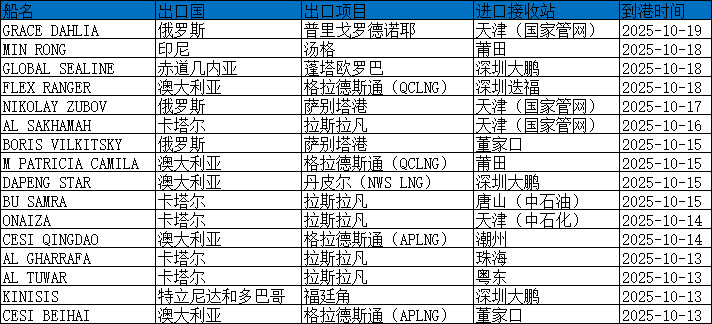
Core Viewpoint - During the week of July 28 to August 3, China imported approximately 960,000 tons of LNG through coastal receiving stations, a significant decrease from the previous week's import of 1,660,000 tons [1]. Group 1: LNG Import Data - A total of 14 LNG vessels were imported during the specified week [1]. - The primary source of LNG imports was Australia, with 4 vessels and an import volume of about 280,000 tons, accounting for approximately 29% of the total imports [4]. - The highest volume of LNG was received at the Rudong LNG receiving station, with 2 vessels totaling around 200,000 tons [4]. Group 2: Future Import Predictions - For the upcoming week of August 4 to August 10, it is predicted that China will import 28 LNG vessels, with an estimated total volume of 1,930,000 tons [4]. Group 3: LNG Vessel Details - A detailed list of LNG vessels, their exporting countries, projects, receiving stations, and arrival times was provided, indicating a diverse range of sources including Australia, Qatar, and Malaysia [3][6]. Group 4: E-Gas System Overview - The E-Gas system is a specialized information service product developed by the China Economic Information Service in collaboration with the Shanghai Petroleum and Natural Gas Exchange Center, focusing on the energy sector and providing comprehensive information services [8].