MCP (Model Context Protocol)

Search documents
提升Agent的可信度后,企业会多一批好用的“数字员工”吗?
3 6 Ke· 2025-12-19 00:11
Core Insights - The article discusses the evolution of AI technology from "tool-based" to "autonomous" systems, emphasizing the importance of optimizing agents to enhance their reliability and usability as digital employees in enterprises [1] Group 1: Definition and Technical Boundaries of Agents - Agents are seen as an evolution beyond traditional chatbots, focusing on action rather than just conversation, which requires a more complex technical architecture [2] - The transition from chatbots to agents involves a significant change in the technology stack, where agents can autonomously plan, execute tasks, and manage context, unlike previous systems that relied heavily on human input [3] Group 2: Future of Software Interfaces - There is a belief that traditional software interfaces may eventually disappear, replaced by direct interactions between agents and systems, emphasizing the need for standardized communication protocols among agents [4][8] - The importance of protocols is highlighted, as they allow different roles within the ecosystem to communicate effectively, focusing on their areas of expertise without extensive adaptation efforts [7] Group 3: Data Quality and Context Management - The quality of data and context is crucial for the effective functioning of agents, as low-quality data can lead to suboptimal task planning and results [6][14] - Knowledge graphs are proposed as a more effective long-term memory solution for agents compared to long text inputs, as they provide structured, high-density information that enhances the agent's performance [12][15] Group 4: Cost and Performance Considerations - The cost of maintaining long contexts for agents is a significant concern, with various optimization strategies being discussed, including context compression and the use of external storage for high-value information [10][11] - Balancing cost and performance is essential, as different business scenarios may require different levels of precision and resource allocation [12][19] Group 5: Agent Governance and Future Developments - The establishment of a multi-agent governance system is seen as necessary for the successful deployment of agents in enterprise environments, addressing the complexities that arise from multiple agents interacting [38][39] - The article anticipates that by 2026, agents will become integral to enterprise infrastructure, with a focus on enhancing the credibility of agent outputs through reliable data sources and controlled execution processes [40][41]
X @Avi Chawla
Avi Chawla· 2025-11-14 19:15
Agent Protocol Landscape - The industry is moving towards interoperability through three open protocols for agentic frameworks [1] - These protocols create a universal language for agents, enabling different frameworks to work together [3] Key Protocols - AG-UI (Agent-User Interaction) facilitates bidirectional communication between agent backends and frontends, enabling interactive agent experiences within applications [1][2] - A2A (Agent-to-Agent) is a protocol for multi-agent coordination, task delegation, and intent sharing across systems [3][5] - MCP (Model Context Protocol) is the standard for agents connecting to tools, data, and workflows [5] Interoperability and Integration - Protocols eliminate the need for point-to-point integrations, allowing developers to build to protocols instead [3] - Frameworks like LangGraph, CrewAI, and Agno can be integrated into the same frontend without rewriting UI logic [3] - CopilotKit unifies the entire stack into one framework, simplifying the implementation of these protocols [4] Example Workflow - A LangGraph agent retrieves data via MCP, delegates analysis to a CrewAI agent via A2A, and streams results to a React app via AG-UI [6]
X @Avi Chawla
Avi Chawla· 2025-11-14 07:06
Agent Protocol Landscape - The industry is converging on three open protocols for agent interoperability: AG-UI (Agent-User Interaction), MCP (Model Context Protocol), and A2A (Agent-to-Agent) [1][2] - These protocols are complementary layers of a stack, not competing standards, facilitating a universal language for agents [2] - Protocols enable integration of frameworks like LangGraph, CrewAI, and Agno into the same frontend without rewriting UI logic [3] Protocol Functionality - AG-UI enables bidirectional connection between agentic backends and frontends, creating interactive agents within applications [1][2] - MCP standardizes how agents connect to tools, data, and workflows [2] - A2A facilitates multi-agent coordination, enabling task delegation and intent sharing across systems [2][5] Framework Integration - CopilotKit unifies the entire protocol stack into one framework, providing generative UI support and production-ready infrastructure [3][4] - An example workflow involves a LangGraph agent pulling data via MCP, delegating analysis to a CrewAI agent via A2A, and streaming results to a React app via AG-UI [6] Development Focus - Protocols allow developers to focus on building agent capabilities instead of integration mechanics, as interoperability is handled automatically [3]
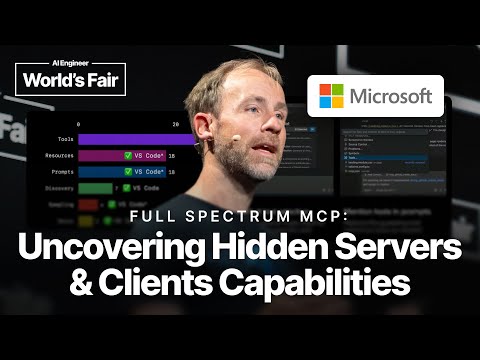
Full Spec MCP: Hidden Capibilities — Harald Kirschner, Microsoft/VSCode
AI Engineer· 2025-07-18 18:42
MCP Ecosystem & Specification - The Model Context Protocol (MCP) ecosystem is still in its early stages, with significant room for growth and development [2][3] - The industry emphasizes the importance of adopting the full MCP specification to unlock rich, stateful interactions between agents [9] - The industry acknowledges a gap in MCP implementation, with a tendency to treat it as just another API wrapper [5] - Technical barriers, including missing support in clients, SDKs, documentation, and references, contribute to the limited adoption of the full MCP spec [6] - The industry highlights the need for developers to stay updated with the latest MCP specification and provide feedback on draft features [29] Tools & Dynamic Discovery - Tools are the most immediately successful aspect of MCP, but overuse can lead to quality problems and AI confusion [7][11][12] - Dynamic tool discovery allows servers to provide context-aware tools, enhancing the user experience [16][17][18] - VS Code offers user controls like per-chat tool selection and user-defined tool sets to manage tool complexity [13][15] Resources & Sampling - Resources provide a semantic layer for exposing files and data to both the LLM and the user, enabling more dynamic and stateful interactions [19][20] - Sampling allows servers to request LLM completions from the client, enabling progressive enhancement and interesting functionalities [22][23][24] Developer Experience & Community - The industry recognizes the need for improved developer experience when working on MCP servers, including debugging and logging [26] - VS Code offers a dev mode with debugging capabilities for MCP servers, simplifying the development process [26][27][28] - A community registry is being developed to facilitate the discovery of MCP servers [32]