Magnificent Seven
Search documents
SpaceX's listing stirs up social media hype, ticker bets
Reuters· 2026-03-27 11:25
SpaceX's listing stirs up social media hype, ticker bets | Reuters Exclusive news, data and analytics for financial market professionalsLearn more aboutRefinitiv Traders are betting thousands of dollars on the company's ticker and speculating over its entry into the most elite club of U.S. companies, giving the world's most valuable startup a level of social media buzz that only a few companies enjoy, especially when they are yet to file their IPO paperwork. Sign up here. On Polymarket, users were betting ...
SpaceX's listing stirs up social media frenzy, ticker bets
Yahoo Finance· 2026-03-27 11:24
By Niket Nishant and Shashwat Chauhan March 27 (Reuters) - From rocket launches drawing millions of YouTube views to social media frenzy over its potential listing, SpaceX's debut is shaping up to be a landmark moment for Wall Street. Traders are betting thousands of dollars on the company's ticker and speculating over its entry into the most elite club of U.S. companies, giving the world's most valuable startup a level of social media buzz that only a few companies enjoy, especially when they are yet ...
Warren Buffett, Markwayne Mullin Bet On The Same 10 Stocks – Some Might Surprise You
Benzinga· 2026-03-19 16:06
So which seven stocks are common to both Berkshire Hathaway and Mullin's portfolio? Here's the full list, based on the Benzinga Government Trades page for Mullin.The 10 Shared StocksBerkshire Hathaway maintains a large portfolio of stock holdings that includes holdings that date back decades and holdings that were added as recently as the fourth quarter of 2025.The conglomerate shares 10 stocks in common with the stocks that have been bought and are still owned by Mullin since 2023.Here are the 10 stocks:Di ...
For the First Time in 13 Quarters, Billionaire Chase Coleman's No. 1 Holding Isn't Meta Platforms or Microsoft -- but It Is a "Magnificent" Stock
The Motley Fool· 2026-03-09 09:06
Core Insights - The quarterly filing of Form 13Fs is crucial for investors as it reveals the stock purchases and sales of prominent fund managers [1] Group 1: Institutional Investor Activity - The deadline for institutional investors with at least $100 million in assets under management to file a 13F was February 17 [2] - Chase Coleman, managing nearly $30 billion at Tiger Global Management, reduced his holdings in Meta Platforms and Microsoft for the first time in 13 quarters [2][5] - Coleman sold 1,073,621 shares of Microsoft, representing a 16% reduction, and 68,386 shares of Meta, a 2% cut [5] Group 2: Investment Strategy and Market Conditions - Coleman is focusing on the AI revolution and the "Magnificent Seven" stocks, with many of Tiger Global's 54 holdings influenced by AI [4] - Concerns about the stock market's high valuations, with the S&P 500's Shiller P/E Ratio at its second-highest level in history, may have influenced Coleman's decision to reduce exposure to top holdings [8] - Tiger Global's new top holding is Alphabet, with no shares sold during the fourth quarter [9] Group 3: Alphabet's Market Position and Growth - Alphabet benefits from a virtual monopoly in internet search-based advertising, holding 89% to 93% of the global search market share over the past decade [10] - Google Cloud, Alphabet's cloud infrastructure service, is a significant growth driver, with sales increasing by 48% year-over-year in the fourth quarter [11] - Alphabet's forward P/E ratio is below 23, indicating potential for future growth, particularly from its high-margin operating segment [12]
The ‘Magnificent Seven' is now the ‘Lag 7.' How Big Tech's slump is dragging down the S&P 500.
MarketWatch· 2026-02-23 12:57
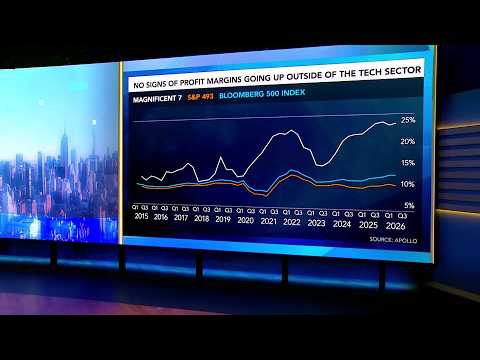
Group 1 - The article discusses the performance and implications of the "Magnificent Seven" tech stocks, which include major players like Apple, Microsoft, and Amazon, highlighting their significant influence on the stock market and the broader economy [1] - Concerns are raised regarding the concentration of market power among these companies, as they account for a substantial portion of the S&P 500's market capitalization, leading to potential volatility in the stock market [1] - The article notes that the growth of AI hyperscalers is contributing to the market dynamics, with these companies rapidly expanding their capabilities and market reach, which may further impact traditional sectors [1] Group 2 - The performance of the "Magnificent Seven" has been characterized by impressive revenue growth, with some companies reporting year-over-year increases exceeding 20%, indicating strong demand for their products and services [1] - The article highlights the potential risks associated with the over-reliance on these tech giants, suggesting that any downturn in their performance could have widespread repercussions for investors and the economy [1] - It is mentioned that the market's focus on these leading companies may overshadow other sectors, potentially leading to an imbalance in investment strategies and economic growth [1]
The Mag 7 Hit A Critical Level
Seeking Alpha· 2026-02-19 01:00
Core Insights - The current market rotation has led to a sell-off in big tech stocks, resulting in a decline in the ratio of the Magnificent Seven stocks to the broader market [1] - The average stock in the S&P 500 has been affected by this market shift, indicating a broader trend impacting technology stocks [1] Company and Industry Analysis - The article emphasizes the importance of risk management and position sizing over mere security selection in investment strategies [1] - It highlights the author's long positions in major tech companies such as Microsoft (MSFT), Google (GOOGL), and Amazon (AMZN), suggesting confidence in these stocks despite current market conditions [1]
Amazon Joins Microsoft in Bear Market. Why Mag 7 Stocks Are Struggling.
Barrons· 2026-02-13 12:42
Amazon and Microsoft stocks have entered 'bear market' territory and the rest of the Magnificent Seven isn't that far behind. ...
Jim Cramer Shared His Opinion on These 14 Stocks
Insider Monkey· 2026-02-04 06:42
Core Viewpoint - The "Magnificent Seven" stocks are no longer considered top performers in the market, as they have shown poor performance over the past year and do not align with each other in terms of direction and growth [1][2][3][4]. Group 1: Performance Analysis - The Magnificent Seven, once regarded as a group of high-performing large-cap stocks, have failed to deliver significant returns, leading to the conclusion that they are "finished" [2][4]. - The grouping of these stocks lacks coherence, with each stock moving in different directions and not contributing to overall market performance [2][3]. Group 2: Individual Stock Insights - Microsoft Corporation (NASDAQ:MSFT) is described as the "least Magnificent of the Seven," with concerns about its recent performance and strategic direction, particularly regarding its AI initiatives [9]. - Meta Platforms, Inc. (NASDAQ:META) has shown a remarkable recovery, with significant growth attributed to its AI capabilities, which have enhanced its advertising effectiveness and user engagement [11][12][14].
Is Now the Time to Move Away From the "Magnificent Seven" and Into Small-Cap Stocks?
Yahoo Finance· 2026-01-23 03:20
Group 1 - The "Magnificent Seven" stocks, including Alphabet, Amazon, Apple, Meta Platforms, Microsoft, Nvidia, and Tesla, have a combined market cap exceeding $1 trillion and have generated significant returns over the past decade, with Meta Platforms showing a 10-year return of approximately 540% compared to the S&P 500's 265% [1][2][8] - In the past 12 months, the S&P 500 has outperformed all but two of the Magnificent Seven stocks, raising concerns about rising valuations and potential corrections in the tech sector [2][4] - The Roundhill Magnificent Seven ETF offers an easy way to invest in these stocks collectively, with an expense ratio of 0.29% and a 15% increase over the past year [5][6] Group 2 - Small-cap stocks present higher risks but can be mitigated through diversified ETFs like the iShares Russell 2000 ETF, which contains nearly 2,000 stocks, reducing overall risk significantly [6][9] - The financial strength of the Magnificent Seven allows them to adapt to changing market conditions, making them a more stable investment compared to small-cap stocks that may require cash infusions [4][6]
This Value Stock ETF Is Crushing the S&P 500. Here's Its Secret Weapon.
Barrons· 2026-01-22 20:03
Core Insights - The value fund's primary return drivers are technology stocks, but notably, they do not include the so-called Magnificent Seven [1] Group 1 - The fund has achieved significant returns primarily through investments in technology companies [1] - The focus on tech stocks indicates a strategic shift away from the most popular large-cap tech firms [1] - This approach may highlight opportunities in lesser-known or undervalued tech companies [1]