
Margin debt

Search documents
‘Barron's Roundtable': Jobs report rattles Wall Street
Youtube· 2026-03-08 05:01
Economic Overview - The US economy shed 92,000 jobs in February, with the unemployment rate rising slightly to 4.4% [1] - Despite the weak jobs report, the market did not interpret it as bad news, indicating underlying resilience in the economy [2][3] Labor Market Insights - Factors contributing to the negative job numbers include weather issues, strikes, and complications in the net birth-death model for new businesses [3] - Leading economic indicators suggest potential signs of improvement in the labor market, with immigration levels significantly reduced from approximately 3 million per year (2014-2022) to around 500,000 per year currently [4][5] Economic Growth Drivers - The economy is expected to benefit from several tailwinds, including a significant bill projected to add 0.9% to GDP growth this year, advancements in AI and data center spending, and a resurgence in domestic production across various sectors [5][6] - Current economic indicators, such as ISM for services and manufacturing, suggest continued growth in the economy over the coming months [7] Inflation and Interest Rates - Current inflation stands at 3.0%, above the Federal Reserve's target of 2%, complicating the possibility of interest rate cuts [8][9] - The expectation is that if the recent job data is an anomaly, growth will persist, making it challenging for the Federal Reserve to lower interest rates [9][10] Market Dynamics - The "Magnificent 7" stocks have begun to underperform, while margin debt remains high, creating a unique market situation where overall index volatility is low, but individual stock volatility is high [11][12] - The market is experiencing significant fluctuations as it assesses which sectors will benefit from AI advancements, leading to increased volatility among individual components of the S&P 500 [12][13] Credit Market Analysis - Default rates for high-yield loans and other lower-rated assets have been declining over the past nine months, indicating a strengthening economy rather than a credit cycle downturn [17][18] - Current issues in the private credit market are viewed as idiosyncratic rather than systemic, aligning with the overall positive economic outlook [18][19]


Panic Sweeps Korean Stocks in Biggest One-Day Crash on Record
Yahoo Finance· 2026-03-04 07:51
Market Overview - The Kospi Index experienced a significant decline, plunging 12% after a 7.2% drop on the previous day, marking the largest selloff in South Korea's stock market history [2] - Major companies such as Samsung Electronics, SK Hynix, and Hyundai Motor faced substantial losses, leading to a 20-minute trading halt [2] - Out of over 800 stocks on the benchmark, only 10 managed to close in positive territory, while a key volatility gauge reached its highest level since 2008 [2] Investor Sentiment - The market's downturn caught many investors off guard, as there was previously strong optimism regarding artificial intelligence and demand for memory chips, leading to increased retail investment [3] - Retail investors had been heavily leveraging their positions, which magnified both gains and losses, resulting in forced liquidations as stock prices fell [4][6] Margin Debt and Market Dynamics - The selloff highlighted the risks associated with a record build-up of margin debt, which had surged alongside investor deposits at brokerages [6] - Investors were reportedly putting down only 30%-40% in margin deposits for heavyweight stocks, increasing vulnerability to market fluctuations [7] - Analysts noted that the extreme market moves made forecasting difficult, with retail investors becoming hesitant and bids fading [5] Future Outlook - The current market conditions suggest that if further declines occur, investors may be reluctant to buy into falling stocks, indicating a cautious sentiment moving forward [8]
The Phantom Debt Trap: How $1.2 Trillion in Hidden Consumer Debt Triggered Thursday's Market Crash - Nasdaq (NASDAQ:NDAQ), iShares S&P 500 Index Fund (ARCA:IVV)
Benzinga· 2025-11-21 13:37
Core Viewpoint - The current AI valuation system is underpinned by excessive leverage and weakening consumer sentiment, leading to potential market instability [1][12][23] Group 1: Wall Street Leverage - Margin debt reached $1.18 trillion in October 2025, increasing by $58 billion in one month, marking a 39% rise since April, the fastest increase since October 2021 [4][20] - The rapid increase in margin debt raises concerns about forced selling during market downturns, particularly when stocks like Nvidia experience intraday reversals [5][19] - The relationship between high margin debt and declining consumer sentiment creates systemic fragility, as both depend on assumptions that are deteriorating [12][20] Group 2: Main Street Consumer Sentiment - The University of Michigan Consumer Sentiment Index fell to 50.3 in November, nearly 30% lower than a year ago, with 71% of households expecting rising unemployment [7][14] - U.S. credit card debt reached $1.233 trillion in Q3 2025, with the average household carrying $9,326 in credit card balances at an interest rate of approximately 22.25% [8][20] - Rising delinquencies are evident across income levels, with the 90-day delinquency rate in the poorest ZIP codes climbing to 22.8% [9][10] Group 3: Implications for AI and Corporate Spending - Consumer spending, which constitutes about 69% of U.S. GDP, is weakening, posing risks to the AI capital expenditure narrative that relies on sustained demand for AI services [3][14] - Hyperscalers supporting Nvidia's growth are projected to spend over $300 billion on capital expenditures in 2025, but this is contingent on the profitability of AI services [15][22] - The decline in consumer sentiment and spending plans, particularly among Generation Z, signals potential challenges for corporate revenue assumptions tied to AI products [13][14] Group 4: Federal Reserve's Position - The Federal Reserve faces a complex situation with inflation around 3% and rising year-ahead inflation expectations, complicating decisions on interest rate cuts [16][20] - Disagreements among Fed policymakers highlight the tension between supporting employment and managing inflation, leaving both consumers and investors vulnerable [17][18] Group 5: Market Reaction - Nvidia's strong earnings report was overshadowed by market reactions to the broader economic context, leading to a significant drop in major indices and increased volatility [2][21] - The market's interpretation of Nvidia's performance reflects a growing concern over the sustainability of AI valuations amid deteriorating consumer conditions [19][23]


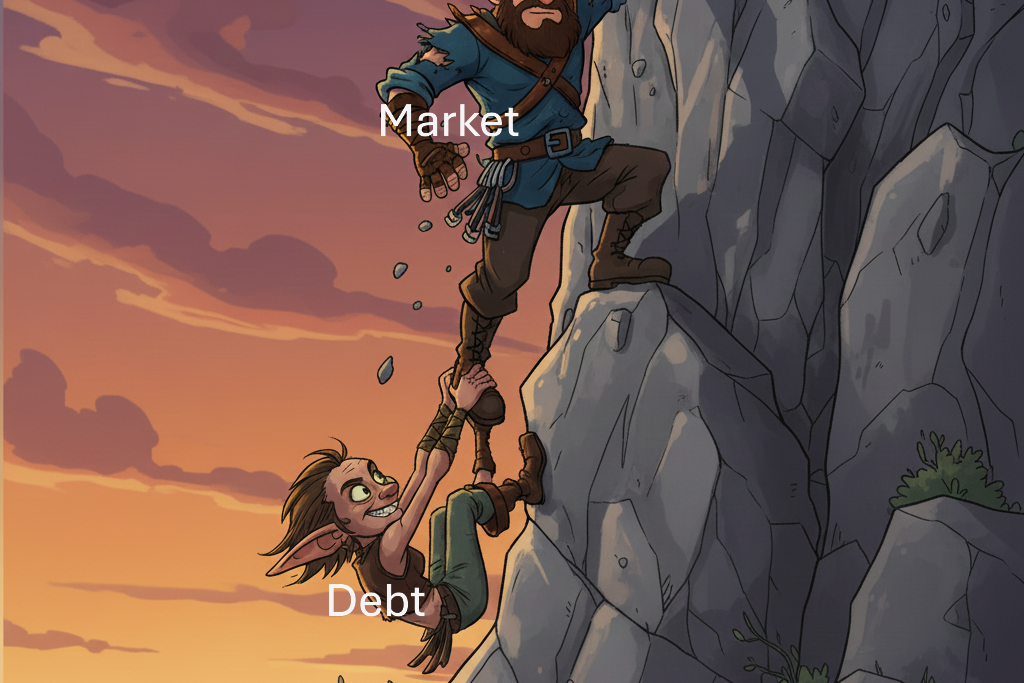
The Phantom Debt Trap: How $1.2 Trillion in Hidden Consumer Debt Triggered Thursday's Market Crash
Benzinga· 2025-11-21 13:37
Core Insights - The current AI valuation system is underpinned by excessive leverage and weakening consumer sentiment, leading to potential market instability [1][12][23] Wall Street's Leverage Problem - Margin debt reached $1.18 trillion in October 2025, increasing by $58 billion in one month, with a 39% rise since April, marking the fastest increase since October 2021 [4] - Historical patterns suggest that such rapid increases in margin debt can lead to significant market declines, as seen in the past [4][19] Main Street's Breaking Point - The University of Michigan Consumer Sentiment Index fell to 50.3 in November, nearly 30% lower than a year ago, indicating a significant decline in consumer confidence [7] - U.S. credit card debt hit $1.233 trillion in Q3 2025, with the average household carrying $9,326 in credit card balances at an interest rate of approximately 22.25% [8] - Rising delinquencies are evident across income levels, with the 90-day delinquency rate in the poorest ZIP codes increasing to 22.8% [9] Consumer Spending Outlook - PwC's 2025 Holiday Outlook survey indicates consumers expect to spend an average of $1,552, down 5% from 2024, with gift spending projected to fall by 11% [13] - Generation Z is expected to cut holiday spending by 23%, reflecting a broader trend of declining consumer expenditure [13] Implications for AI Investments - The AI capital expenditure narrative relies on sustained demand for AI services, which is threatened by weakening consumer spending and rising unemployment expectations [14][15] - Hyperscalers supporting Nvidia's growth are projected to spend over $300 billion on capital expenditures in 2025, but profitability of AI projects remains uncertain [15] Federal Reserve's Dilemma - The Federal Reserve faces a complex situation with inflation around 3% and rising delinquencies, complicating decisions on interest rate adjustments [16][20] - Disagreements among policymakers highlight the challenges in balancing support for employment while managing inflation concerns [17] Market Reaction - Nvidia's strong earnings report was overshadowed by market reactions to the broader economic context, leading to a significant drop in major indices [2][19] - The VIX spike indicates increasing market volatility and sensitivity to economic shocks, reflecting concerns over the sustainability of current valuations [21][22]

Margin debt is at a record high. Here's what that means for the stock market.
MarketWatch· 2025-10-24 16:20
Core Viewpoint - Investors are showing confidence in the market by purchasing stocks with borrowed money, indicating a belief that the market will continue to rise, although this optimism may not be justified [1] Group 1 - The trend of buying stocks on margin suggests a bullish sentiment among investors [1] - There is a concern that this confidence may not align with actual market conditions [1]
17 Charts To Consider As Stocks Rally And Economy Cools
Benzinga· 2025-09-16 17:16
Group 1 - The U.S. stock market and the economy are closely intertwined, but the composition of earnings per share (EPS) differs significantly from GDP, with services making up over 70% of GDP while S&P 500 earnings are nearly evenly split between services and goods/manufacturing [2][3] - The S&P 500 accounts for 80% of the total value of U.S. stocks, making it a key indicator of the U.S. stock market [8] - U.S. companies have shown strong earnings growth prospects compared to global markets, with analysts expecting this trend to continue [9][10] Group 2 - The S&P 500 has experienced consistent earnings growth over a long period, which is a primary driver of stock prices [12] - There has been a notable increase in spin-offs among S&P 500 companies, with 11 announced spin-offs as of early September, the highest since 2016 [15] - Companies are delaying their initial public offerings (IPOs), with the median age of IPOs rising from five years in 1999 to 14 years today, reflecting a trend of firms wanting to remain private longer [16] Group 3 - Discussions around tariffs have increased, with many companies citing pricing power as the most frequently mentioned strategy for mitigating tariff impacts [24] - The stock market has seen significant rallies, with the S&P 500 up more than 30% since April, and historical data suggests that such rallies often lead to further gains [27][28] - The Federal Reserve is expected to announce a rate cut, which historically has led to positive returns for the S&P 500 in the following year, although the macroeconomic context is crucial for performance [32][33]