Monetary easing cycle

Search documents
South Korea November exports beat forecasts, led by chips and autos
Yahoo Finance· 2025-12-01 00:47
Core Insights - South Korea's exports increased by 8.4% in November, reaching $61.04 billion, surpassing market expectations of a 5.7% rise [1][2] - This marks the sixth consecutive month of export growth, driven by record semiconductor sales and a significant increase in auto exports following a U.S. trade deal [1][2] Export Performance - Semiconductor exports surged by 38.5% to a record $17.26 billion, fueled by strong demand for advanced chips used in data centers [2] - Auto exports rose by 13.7% due to the resolution of uncertainties regarding U.S. tariffs after a trade deal was finalized [2] - Shipments to China increased by 6.9%, while exports to Southeast Asian countries rose by 6.3%. However, shipments to the European Union declined by 1.9% [3] Economic Context - The Bank of Korea indicated it is nearing the end of its monetary easing cycle, raising its economic growth forecast for the next year due to strong semiconductor exports [3] - The South Korean economy grew at its fastest pace in a year and a half during the third quarter, supported by robust export performance despite challenges from U.S. tariffs [3] Import and Trade Balance - Imports rose by 1.2% to $51.30 billion in November, which was below the expected 3.4% increase [4] - The trade balance recorded a surplus of $9.7 billion, the largest since September 2017, compared to a surplus of $6.0 billion in the previous month [4]
【笔记20251016— “老登股”,债市的老朋友】
债券笔记· 2025-10-16 11:31
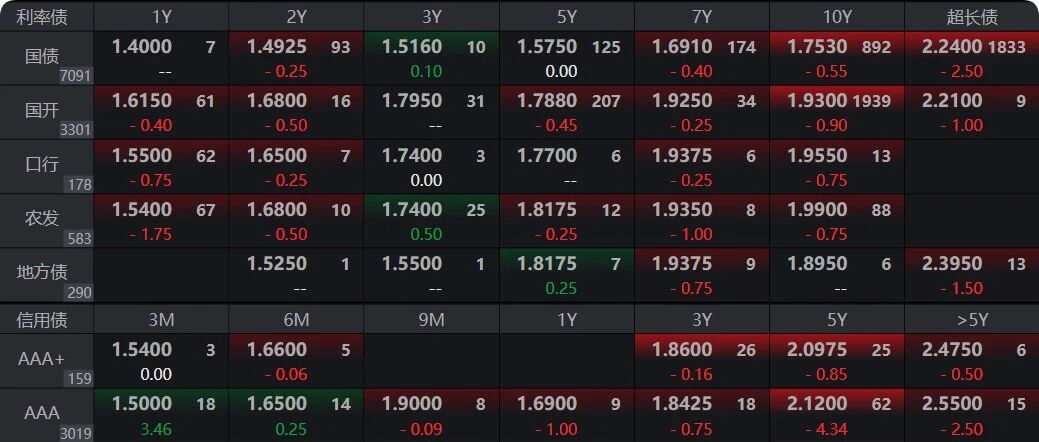
Core Viewpoint - The article discusses the behavioral patterns of investors, highlighting a tendency to be overly tolerant of losses while being quick to take profits, leading to a cycle of small gains and significant losses [1]. Group 1: Market Overview - The funding environment is balanced and slightly loose, with the central bank conducting a 2,360 billion yuan reverse repurchase operation, resulting in a net withdrawal of 3,760 billion yuan [3]. - The interbank funding rates remain stable, with DR001 around 1.31% and DR007 around 1.42% [4]. - The stock market experienced a pullback after reaching near previous highs, influenced by ongoing US-China trade tensions and a slight decline in interest rates [6]. Group 2: Bond Market Dynamics - The bond market showed stability, with the 10-year government bond yield fluctuating around 1.7575%, reflecting a slight downward trend [6]. - The "old friends" in the bond market, referred to as "old Deng stocks," have been performing well, indicating a potential shift in investor sentiment towards bonds [7]. - The yield on long-term bonds has shown a stronger performance, with the 10-year bond yield decreasing to approximately 1.753% [6][7]. Group 3: Interest Rate Trends - The weighted rates for various repurchase agreements indicate a slight increase in R007 to 1.48%, while R001 remains stable at 1.35% [5]. - The interest rates for government bonds across different maturities show a mixed trend, with some rates experiencing slight declines [9].