Multimodal Intelligence

Search documents
我国科研机构主导的大模型成果首次登上Nature
Guan Cha Zhe Wang· 2026-02-07 01:15
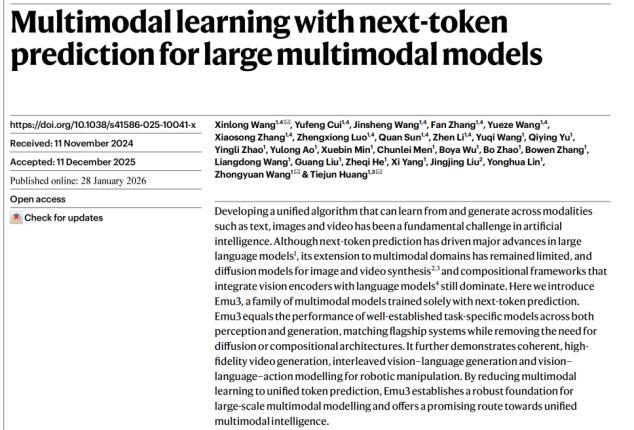
Core Insights - The article discusses the groundbreaking AI research paper published in *Nature* by the Beijing Academy of Artificial Intelligence, introducing a multimodal model named "Emu3" that aims to unify various AI capabilities such as vision, language, and action through a single task of "next token prediction" [1][4][21]. Group 1: Emu3's Technical Innovations - Emu3 utilizes a unique "Vision Tokenizer" that compresses a 512x512 image into just 4,096 discrete symbols, achieving a compression ratio of 64:1, and further compresses video data in a time-efficient manner [8][9]. - The model architecture of Emu3 is a standard language model enhanced with 32,768 visual symbols, diverging from the complex encoder-decoder architectures used by other models [10][11]. - Emu3 demonstrates superior performance in various tasks, scoring 70.0 in human preference evaluations for image generation, 62.1 in visual language understanding, and 81.0 in video generation, surpassing established models [11]. Group 2: Scaling Laws and Multimodal Learning - Emu3's research confirms that multimodal learning adheres to predictable scaling laws, indicating that performance improves uniformly across different modalities when training data is increased [12][13]. - The findings suggest that future multimodal intelligence may not require separate training strategies for each capability, simplifying the development process [13]. Group 3: Comparison with Global Peers - Emu3 is positioned against models like Meta's Chameleon and OpenAI's Sora, showcasing its ability to bridge the performance gap between unified architectures and specialized models [17][18]. - Unlike OpenAI's approach, which requires additional models for understanding, Emu3 integrates generation and comprehension within a single framework [18]. Group 4: Commercialization Potential - Emu3's architecture allows for efficient deployment, leveraging existing infrastructure for large language models, which can reduce operational complexity and costs [19]. - The model's unified capabilities enable diverse applications, from generating instructional content to real-time video analysis, enhancing user interaction [20]. Group 5: Philosophical Implications - Emu3 challenges the notion of fragmented intelligence by proposing that intelligence can be unified through a single predictive framework, potentially reshaping the understanding of AI's capabilities [21][22]. - The success of Emu3 suggests a paradigm shift in AI development, emphasizing simplicity and unified approaches over complexity [22].

Google and Anthropic Drop AI Prices and Release New Models
PYMNTS.com· 2025-11-26 00:55
Core Insights - The recent launches of AI models by Google and Anthropic signify a competitive shift in the AI landscape, with both companies aiming to enhance their market positions through innovative features and cost reductions [1][3][5] Company Developments - Google launched Gemini 3 on November 18, emphasizing advancements in multimodal reasoning and visual understanding, aiming to regain leadership in the AI sector [1] - Anthropic introduced Claude Opus 4.5 six days later, claiming it outperformed human candidates in internal assessments, showcasing its capabilities in coding and long-horizon reasoning [3][7] Cost Efficiency - Both companies have significantly reduced operational costs for their new models, with Anthropic cutting the price of Claude Opus 4.5 by 67%, from $15 to $5 per million tokens, while Google set Gemini 3 Pro at $2 for reading and $12 for generation [4][5] Model Capabilities - Gemini 3 excels in processing various data types, achieving over 90% on the GPQA Diamond benchmark for scientific reasoning, which could transform workflows involving design and video feedback [6] - Claude Opus 4.5 focuses on coding and complex data analysis, outperforming Gemini 3 Pro in real engineering tasks and demonstrating strong consistency in extended sequences [7][10] Market Positioning - The pricing strategies of both models reflect a rapid shift in the economics of high-end AI, allowing for broader usage across workflows [5] - Gemini 3 is integrated into Google's broader ecosystem, enhancing its capabilities in search and development platforms, while Claude Opus 4.5 is paired with new product integrations for tools like Excel [9][8] Production-Level Execution - Both models are designed for multistep tasks rather than isolated responses, with Gemini 3 demonstrating superior decision-making in a business simulation benchmark [11][12]