Chameleon

Search documents
我国科研机构主导的大模型成果首次登上Nature
Guan Cha Zhe Wang· 2026-02-07 01:15
Core Insights - The article discusses the groundbreaking AI research paper published in *Nature* by the Beijing Academy of Artificial Intelligence, introducing a multimodal model named "Emu3" that aims to unify various AI capabilities such as vision, language, and action through a single task of "next token prediction" [1][4][21]. Group 1: Emu3's Technical Innovations - Emu3 utilizes a unique "Vision Tokenizer" that compresses a 512x512 image into just 4,096 discrete symbols, achieving a compression ratio of 64:1, and further compresses video data in a time-efficient manner [8][9]. - The model architecture of Emu3 is a standard language model enhanced with 32,768 visual symbols, diverging from the complex encoder-decoder architectures used by other models [10][11]. - Emu3 demonstrates superior performance in various tasks, scoring 70.0 in human preference evaluations for image generation, 62.1 in visual language understanding, and 81.0 in video generation, surpassing established models [11]. Group 2: Scaling Laws and Multimodal Learning - Emu3's research confirms that multimodal learning adheres to predictable scaling laws, indicating that performance improves uniformly across different modalities when training data is increased [12][13]. - The findings suggest that future multimodal intelligence may not require separate training strategies for each capability, simplifying the development process [13]. Group 3: Comparison with Global Peers - Emu3 is positioned against models like Meta's Chameleon and OpenAI's Sora, showcasing its ability to bridge the performance gap between unified architectures and specialized models [17][18]. - Unlike OpenAI's approach, which requires additional models for understanding, Emu3 integrates generation and comprehension within a single framework [18]. Group 4: Commercialization Potential - Emu3's architecture allows for efficient deployment, leveraging existing infrastructure for large language models, which can reduce operational complexity and costs [19]. - The model's unified capabilities enable diverse applications, from generating instructional content to real-time video analysis, enhancing user interaction [20]. Group 5: Philosophical Implications - Emu3 challenges the notion of fragmented intelligence by proposing that intelligence can be unified through a single predictive framework, potentially reshaping the understanding of AI's capabilities [21][22]. - The success of Emu3 suggests a paradigm shift in AI development, emphasizing simplicity and unified approaches over complexity [22].

ICCV 2025|训练太复杂?对图片语义、布局要求太高?图像morphing终于一步到位
机器之心· 2025-07-18 00:38
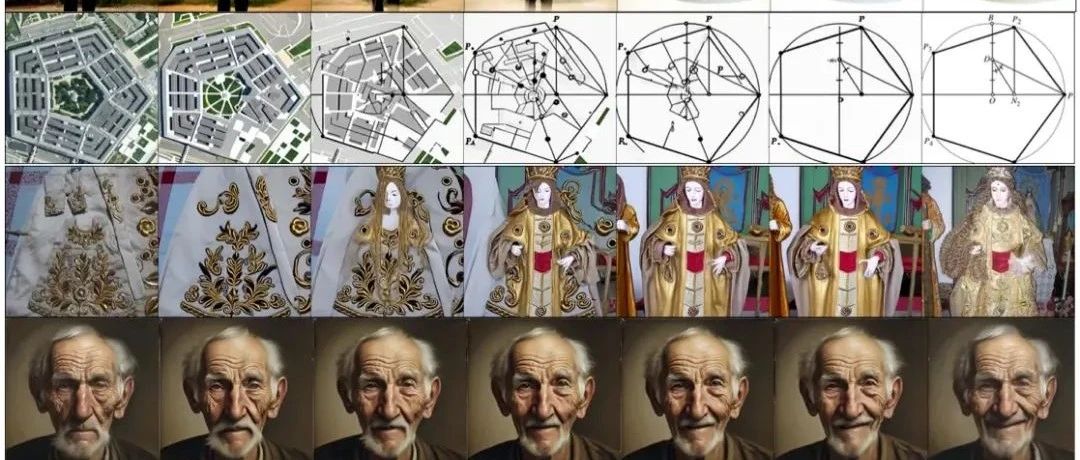
Core Viewpoint - The article introduces FreeMorph, a novel training-free image morphing method that enables high-quality and smooth transitions between two input images without the need for pre-training or additional annotations [5][32]. Group 1: Background and Challenges - Image morphing is a creative task that allows for smooth transitions between two distinct images, commonly seen in animations and photo editing [3]. - Traditional methods relied on complex algorithms and faced challenges with high training costs, data dependency, and instability in real-world applications [4]. - Recent advancements in deep learning methods like GANs and VAEs have improved image morphing but still struggle with training costs and adaptability [4][5]. Group 2: FreeMorph Methodology - FreeMorph addresses the challenges of image morphing by eliminating the need for training, achieving effective morphing with just two images [5]. - The method incorporates two key innovations: spherical feature aggregation and prior-driven self-attention mechanisms, enhancing the model's ability to maintain identity features and ensure smooth transitions [11][32]. - A step-oriented motion flow is introduced to control the transition direction, allowing for a coherent and gradual morphing process [21][32]. Group 3: Experimental Results - FreeMorph has been evaluated against existing methods, demonstrating superior performance in generating high-fidelity results across diverse scenarios, including images with varying semantics and layouts [27][30]. - The method effectively captures subtle changes, such as color variations in objects or nuanced facial expressions, showcasing its versatility [27][30]. Group 4: Limitations - Despite its advancements, FreeMorph has limitations, particularly when handling images with significant semantic or layout differences, which may result in less smooth transitions [34]. - The method inherits biases from the underlying Stable Diffusion model, affecting accuracy in specific contexts, such as human limb structures [34].
Mary Meeker:AI采纳现状如何?
Sou Hu Cai Jing· 2025-06-11 02:17
Core Insights - Mary Meeker's latest report highlights the rapid growth of ChatGPT's search volume, surpassing traditional Google search in just three years, marking a significant shift in internet usage [2][3] - The report emphasizes the unprecedented speed of technological change, particularly in AI, and its global impact, contrasting it with the slower adoption rates of previous technological revolutions [4][6] AI Growth Metrics - Since 2010, the annual growth rate of AI training model data has reached 260%, while the required computational resources have grown at 360% [2] - ChatGPT's user base, subscription numbers, and revenue growth indicate its widespread adoption among internet users [3] Developer Engagement - The number of developers in the Google ecosystem has increased from 1.4 million to 7 million, a fivefold increase since last year [5] - Companies are leveraging AI developments to enhance user interactions, with a shift towards AI management roles in customer support [5] Adoption Speed Comparison - AI adoption has occurred in approximately three years, significantly faster than personal computers (20 years), desktop internet (12 years), and mobile internet (6 years) [6] Business Investment Trends - A Morgan Stanley survey indicates that 75% of global CMOs are experimenting with AI, with significant capital expenditures in AI projects, including a 21% increase in related capital spending and a 28% rise in data spending [6][7] Cost Dynamics - The report notes a "cost deflation" phenomenon, with the purchasing power for AI inference increasing tenfold annually [7] Future AI Landscape - New users will engage with AI in a native environment, free from traditional internet constraints, suggesting a transformative impact on daily life [8] Global Usage Statistics - ChatGPT usage rates are reported at 13.5% in India, 9% in the U.S., and 5% in Indonesia and Brazil [9] U.S.-China AI Competition - The report highlights China's leading position in large language model performance, with implications for national strategy and technological innovation [10] Next-Generation AI Interfaces - The transition from text to voice interfaces, and eventually to humanoid robots, is anticipated as a significant development in AI interaction [10]