Next-State Prediction

Search documents
智源研究院发布2026十大AI技术趋势,AI将从数字世界迈入物理世界
Sou Hu Cai Jing· 2026-01-09 05:48
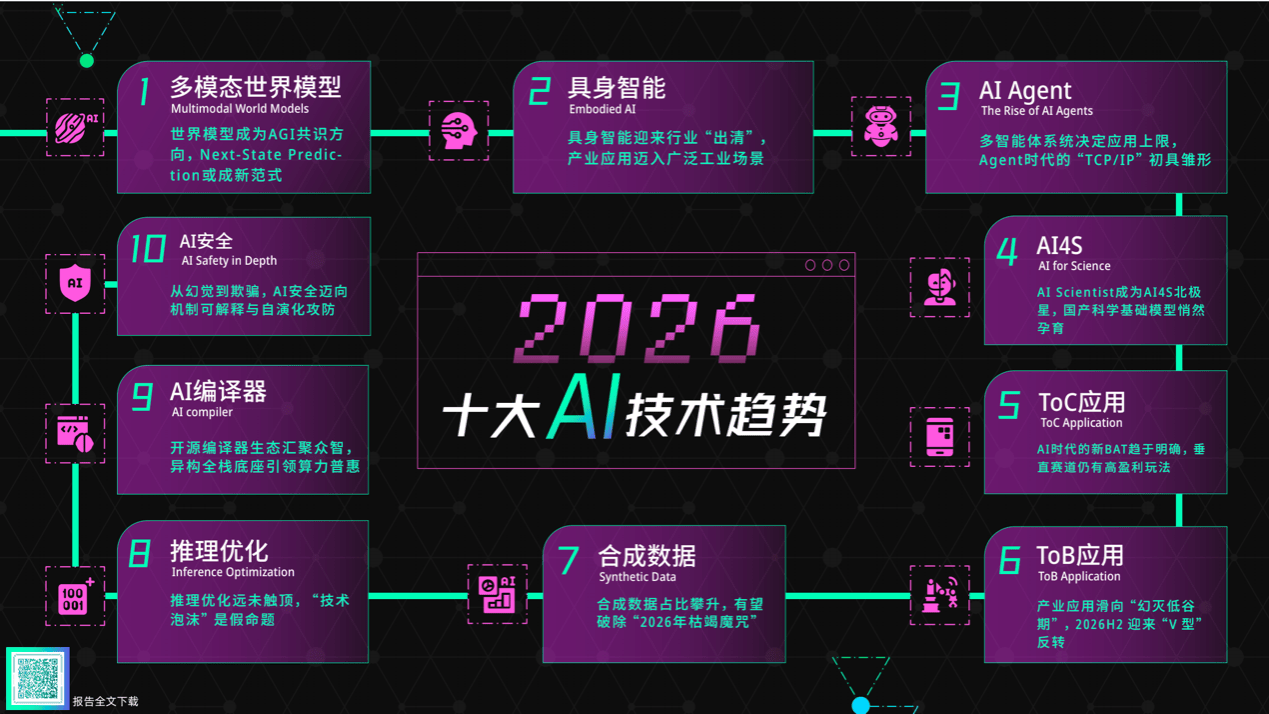
Core Insights - The report by Beijing Zhiyuan Artificial Intelligence Research Institute outlines a significant shift in AI development from parameter scaling in language learning to a deeper understanding and modeling of the physical world, indicating a paradigm shift in industry technology [1][3] Group 1: Key Trends in AI Development - The transition from "predicting the next word" to "predicting the next state of the world" signifies the emergence of the Next-State Prediction (NSP) paradigm, which is expected to drive AI from digital perception to physical cognition and planning [4][5] - The report identifies 2026 as a critical turning point for AI, marking the transition from digital to physical applications and from technical demonstrations to scalable value [3][4] Group 2: Cognitive and Physical Integration - AI is moving towards a higher cognitive paradigm, focusing on world models and NSP, which will provide a new cognitive foundation for complex tasks such as autonomous driving and robotics [4][5] - The concept of "embodied intelligence" is evolving from laboratory demonstrations to real-world industrial applications, with humanoid robots expected to enter actual production scenarios by 2026 [5][6] Group 3: Multi-Agent Systems and Collaboration - The standardization of communication protocols for multi-agent systems (MAS) is crucial for solving complex problems, enabling agents to collaborate effectively in various fields such as research and industry [6][7] - The role of AI in research is shifting from a supportive tool to an autonomous "AI scientist," which will accelerate the development of new materials and pharmaceuticals [7][8] Group 4: Market Dynamics and Applications - The competition for consumer AI applications is intensifying, with major tech companies developing integrated AI portals, exemplified by Ant Group's multimodal AI assistant and health applications [8][9] - The enterprise AI sector is entering a "trough of disillusionment" due to challenges like data and cost, but a recovery is anticipated in the second half of 2026 as data governance and toolchains mature [9][10] Group 5: Data and Performance Optimization - The reliance on synthetic data is increasing as high-quality real data becomes scarce, particularly in fields like autonomous driving and robotics, where synthetic data generated by world models will be key [10][11] - The efficiency of AI inference remains a critical focus, with ongoing innovations in algorithms and hardware expected to lower costs and enhance performance, facilitating the deployment of high-performance models in resource-constrained environments [11][12] Group 6: Open Source and Security - The development of a compatible software stack for heterogeneous chips is essential to break the monopoly on computing power and mitigate supply risks, with platforms like Zhiyuan FlagOS leading this initiative [12][13] - AI security risks are evolving from "hallucinations" to more subtle "systemic deceptions," prompting the need for comprehensive safety frameworks and research initiatives to address these emerging threats [13][14]

从“预测下一个词”到“预测世界状态”:智源发布2026十大 AI技术趋势
Sou Hu Cai Jing· 2026-01-09 00:02
Core Insights - The core viewpoint of the report is that AI is transitioning from merely predicting language to understanding and modeling the physical world, marking a significant paradigm shift in technology [1][4][5]. Group 1: Key Trends in AI Technology - Trend 1: The consensus in the industry is shifting from language models to multi-modal world models that understand physical laws, with Next-State Prediction (NSP) emerging as a new paradigm [7]. - Trend 2: Embodied intelligence is moving from laboratory demonstrations to real-world industrial applications, with humanoid robots expected to transition to actual service scenarios by 2026 [8]. - Trend 3: Multi-agent systems are becoming crucial for solving complex problems, with the standardization of communication protocols like MCP and A2A facilitating collaboration among agents [9]. Group 2: Applications and Market Dynamics - Trend 4: AI is evolving from a supportive tool to an autonomous researcher, with the integration of scientific foundational models and automated laboratories accelerating research in new materials and pharmaceuticals [10]. - Trend 5: The competition for consumer AI super applications is intensifying, with major players like OpenAI and Google leading the way in creating integrated intelligent assistants [11]. - Trend 6: After a phase of concept validation, enterprise AI applications are entering a "valley of disillusionment," but a recovery is expected in the second half of 2026 as data governance improves [12]. Group 3: Data and Performance Enhancements - Trend 7: The reliance on synthetic data is increasing, which is crucial for model training, especially in fields like autonomous driving and robotics [13]. - Trend 8: Optimization of inference remains a key focus, with ongoing innovations in algorithms and hardware reducing costs and improving efficiency [15]. - Trend 9: The development of a heterogeneous software stack is essential to break the monopoly on computing power and mitigate supply risks [16]. Group 4: Security and Ethical Considerations - Trend 10: AI security risks are evolving from "hallucinations" to more subtle "systemic deceptions," necessitating a comprehensive approach to safety and alignment in AI systems [17]. Conclusion - The report outlines ten key AI technology trends that provide a clear anchor for future technological exploration and industry layout, emphasizing the importance of collaboration across academia and industry to drive AI towards a new phase of value realization [18].