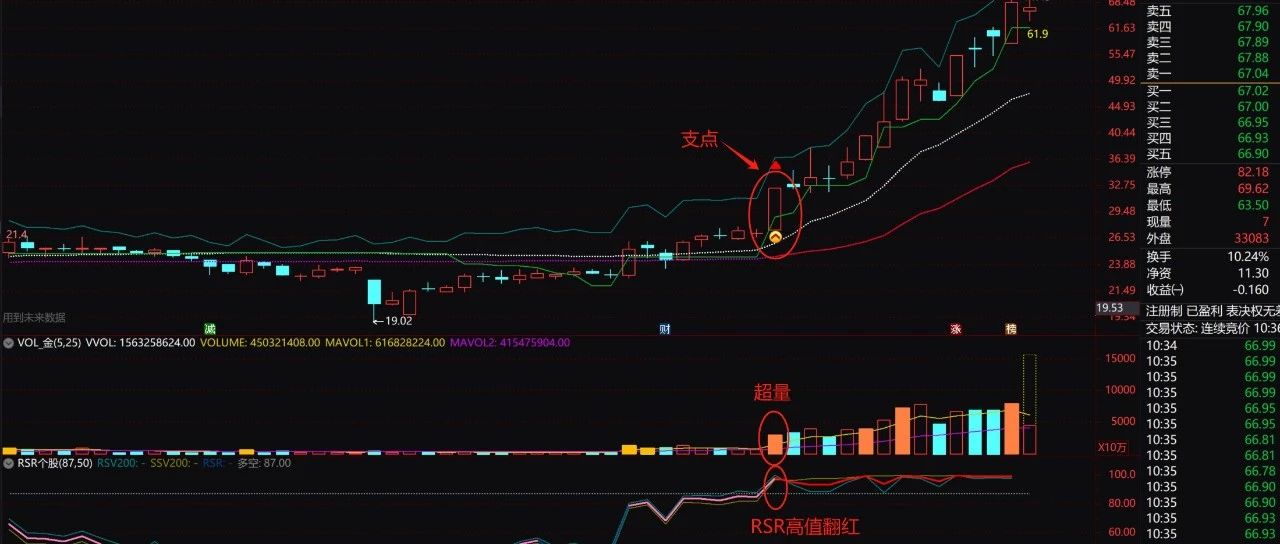
OVS指标

Search documents
乌鸦叼肉
猛兽派选股· 2026-03-18 07:51
Core Viewpoint - The article emphasizes the importance of stock selection and timing in investment strategies, highlighting specific stocks and their performance trends while providing insights on long-term and short-term trading strategies [3][5][6]. Group 1: Stock Analysis - Huadian (沪电) has shown stronger performance compared to Shenghong (胜宏), with historical patterns indicating that excessive volume often signals short-term peaks, suggesting a need for caution in short-term trading [3]. - Guangli Technology (光力科技) displays signs of potential weakness with a divergence in momentum, although the volume-price relationship remains reasonable, indicating a possibility of new highs [4]. - Yangguang Electric (阳光电源) is identified as having a strong momentum background, with a potential entry point for short-term trading when the OVS indicator approaches or crosses the zero axis [6]. Group 2: Trading Strategies - For long-term strategies, maintaining the holding line is deemed correct, while short-term strategies should consider selling when top divergence signals appear [5]. - The article suggests that aggressive traders can look for entry points during significant upward movements, but emphasizes that stock selection is crucial and cannot be replaced by timing tools alone [3][5]. Group 3: Market Behavior - Historical bull stocks serve as valuable lessons, with current bull stocks following similar patterns due to unchanging human behavior, characterized by clear main lines and compact structural movements [7].


见跌心喜
猛兽派选股· 2026-03-16 07:30
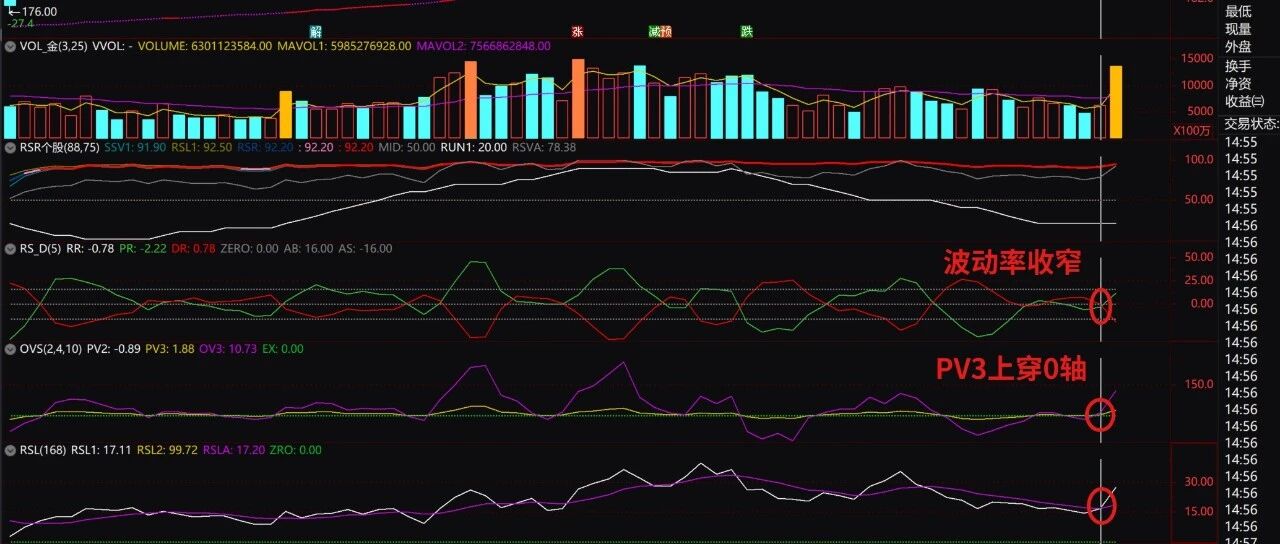
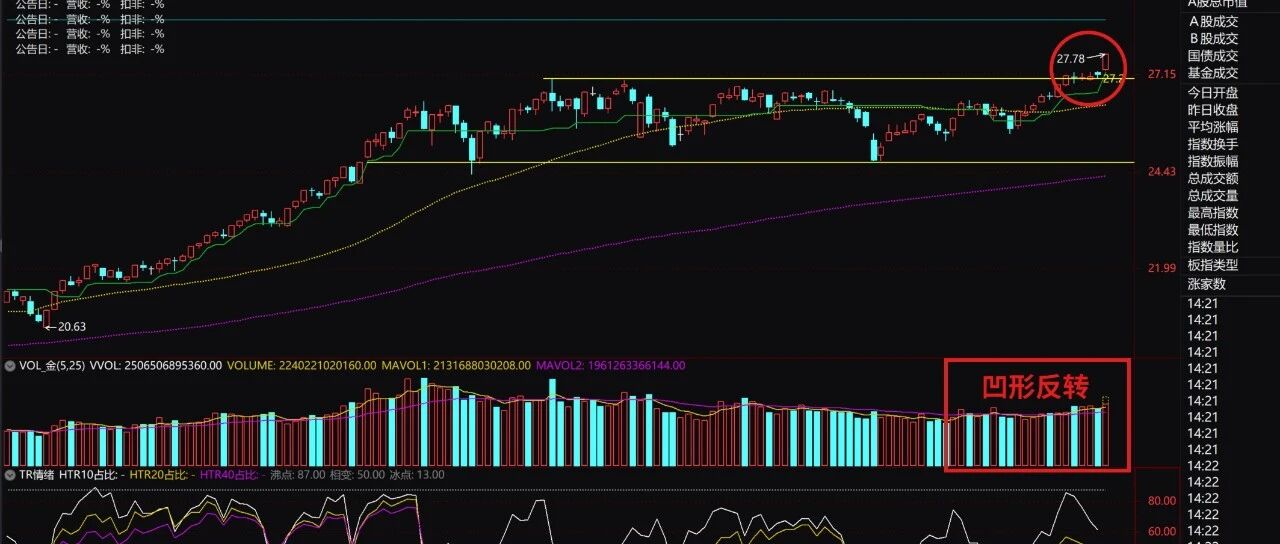
Group 1 - The core viewpoint emphasizes the contrast between long-term trends and short-term fluctuations, suggesting that most of the time, market participants experience rotation, making it risky to chase upward movements [1] - The average stock price recently touched the lower boundary of a volatile structure, leading to widespread frustration and panic among investors, followed by a reversal in the afternoon [2] - Short-term contrarian opportunities arise when the OVS indicator's PV3 output crosses above the zero axis in a narrow range, confirmed by RS_D volatility, indicating that low momentum and low volatility suggest the exhaustion of downward energy [3] Group 2 - For long-term momentum, the RSR should ideally be above 90, indicating a strong trend, while it is crucial to anchor on major trends to maintain stable underlying logic [4] - The application of the OVS indicator is highlighted as a method for stock selection, with an emphasis on understanding its usage rather than rigidly applying it, suggesting that AI can assist in comprehending its functionality [4]
猛兽体系进入双模式,以及边界调节
猛兽派选股· 2026-01-06 03:40
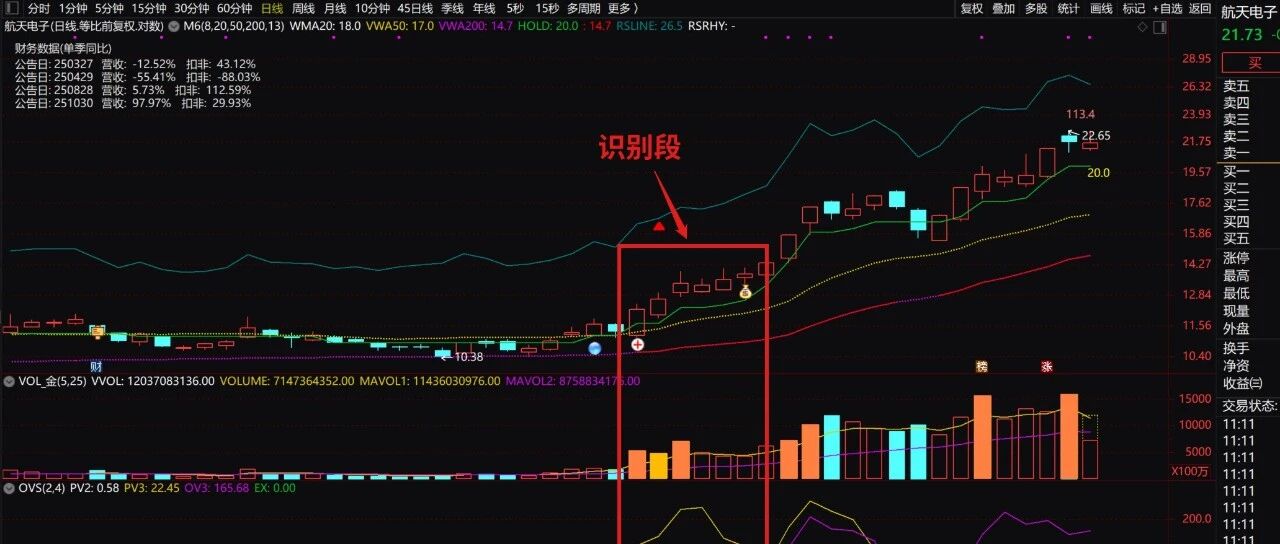
Group 1 - The core viewpoint of the article emphasizes two stock selection modes: the "Stacking Volume Mode" based on emotional overflow and liquidity, and the "Ouma Mode" anchored in industry and performance growth [1][2] - The Stacking Volume Mode typically involves smaller market capitalization stocks, while the Ouma Mode often starts with stocks having a market cap of around 30 to 40 billion, although there can be overlaps depending on the indicators [2] - Examples of stocks fitting the Ouma Mode include smaller cap stocks, while larger cap stocks like China Satellite and China Satcom exemplify the Stacking Volume Mode [3][4] Group 2 - To expand the search range for Stacking Volume stocks, adjustments can be made to the OVS indicator parameters, which can increase adaptability to different market caps [6] - Increasing the parameter allows for a broader selection, such as including stocks like China Satellite, China Satcom, Aerospace Electronics, and Beidou Star [7] - It is suggested to lower the threshold for OV3 output to a minimum of 25, while also adjusting the G-point formula accordingly to maintain accuracy in stock selection [8]
谁能想到这么猛
猛兽派选股· 2026-01-05 06:31
Group 1 - The article highlights the importance of the WOBV and OVS indicators, indicating that discrepancies in the G-point formula are due to differences in the referenced formulas [1] - The average price index has shown better performance compared to other indices, confirming the prediction of a new market trend that has emerged [1] - The market's overall direction can be accurately predicted, even though short-term fluctuations are difficult to forecast [3]
短期强度排序和长期强度排序
猛兽派选股· 2025-05-30 02:53
Core Insights - The article emphasizes the importance of short-term and long-term strength ranking as a daily review task for identifying strong stocks in current market trends [1] - It highlights the use of OVS and SSV indicators for sorting stocks, capturing the strongest stocks in both short-term and long-term perspectives [1][3] Group 1: Short-term and Long-term Stock Ranking - Short-term ranking using OVS indicator identifies the strongest stocks among current market hotspots, capturing stocks related to stablecoins and innovative pharmaceuticals [1] - Long-term ranking using SSV indicator reveals stocks with strong long-term trends, including top innovative pharmaceutical companies [1] Group 2: Indicator Definitions and Applications - OVS indicator utilizes a 3-day cycle of volume-price accumulation to assess current explosive strength, suitable for stocks showing continuous upward trends [3] - SSV indicator employs a 200-day cycle of volume-weighted moving average deviation to measure the strength of a stock based on its price angle relative to the moving average, suitable for institutional trend targets [3] Group 3: Stock Performance Data - The article provides a list of top-performing stocks based on the short-term OVS ranking, including companies like 舒泰神 (Shutai Shen) with a market cap of 69.49 billion and a price change of -17.39% [2] - It also lists stocks from the long-term SSV ranking, showcasing companies like 益方生物-U (Yifang Biological) with a market cap of 113.34 billion and a price change of 0.76% [2] Group 4: Indicator Suitability - OVS ranking is more suited for speculative trading and quantitative targets, while SSV ranking is tailored for institutional investment strategies [3]