Price increases

Search documents
Stubborn Wholesale Inflation Persisted in February
WSJ· 2026-03-18 12:56
Core Insights - Wholesale inflation reached the highest rate in a year last month, indicating persistent price increases in the economy prior to the onset of the Iran war [1] Group 1 - The increase in wholesale inflation serves as evidence of ongoing inflationary pressures within the economy [1]


X @Bloomberg
Bloomberg· 2026-03-17 18:35
Germany moved to cap how often gas stations can raise prices and tighten antitrust oversight in response to a consumer backlash over war-driven price increases https://t.co/OOThebtZjw ...
X @THE HUNTER
GEM HUNTER 💎· 2026-02-09 12:19
RT THE HUNTER (@TrueGemHunter)In 2021 Binance listings tended to cause average price increasesIn average ~41 %+ in the first day and 93 % in 30 days post-listingSHIB binance listing pump~100% in hours, around 1000% in a weekExpecting 50x just from a Binance listing and now expecting project death. ...
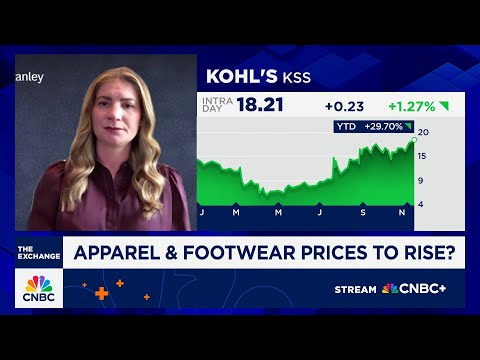
Anticipate further apparel and footwear price increases, says Morgan Stanley's Alex Straton
CNBC Television· 2025-11-12 19:03
Pricing Trends in Apparel and Footwear - A third-party data source tracking e-commerce prices indicates a slight increase in apparel prices, but it's not a huge jump from previous trends [2][3][4] - The apparel industry has seen a mix shift into higher price point categories like work wear and tailored pants, contributing to gross margin highs [6][7] - Economists believe the full impact of tariffs hasn't been seen yet due to inventory timing, with potential one-time hits later on [8][9] - Apparel retailers typically hold three months of inventory, suggesting that the real pricing impact from tariffs will likely flow through P&Ls from November onwards [9][10] - Footwear businesses, often run as wholesale models, may see price increases more clearly in the first half of next year due to forward order books locked in for six months [11][12] Company-Specific Observations - Torrid and Anthropology (within Urban Outfitters) have shown the biggest price jumps since Liberation Day, potentially due to mix shift and strategic assortment changes [14][15] - On the footwear side, Hey Dude, Macy's, and Kohl's are showing more price increases compared to pre-liberation day levels, possibly due to a mix shift dynamic [16] - Department stores are trying to fortify themselves with popular and premium brands, actively adjusting their business model [17] Data Considerations - The pricing data factors in discounting and mix shift, but it's not possible to see exactly how these are factoring into the pricing [3] - The prices reflect the final selling price, taking into account discount codes and what shoppers actually paid [5]
We inherited an affordability crisis: Treasury Secretary says Trump has slowed down price increases
MSNBC· 2025-11-11 14:39
Government Shutdown Impact - The government shutdown had a negative impact on GDP, potentially ranging from 1% to 1.5% [2][3] - The shutdown initially cost \$1 billion to \$2 billion per day, escalating to \$15 billion per week [6] - Concerns arose about potential food shortages due to unpaid food inspectors [6] - Airline executives expressed worries about their businesses due to the shutdown [8] Affordability and Inflation - Affordability remains a significant issue for voters, impacting their ability to afford home heating, food, housing, and cars [9][10] - The administration believes they inherited an affordability crisis and are working to slow price increases and increase real wages [21] - The administration argues that Democrats are using a "con job" to suggest costs are up, despite gasoline prices being down [18][20] - The Treasury Secretary believes tariffs help consumers by bringing down the budget deficit and inflation [26] Economic Outlook and Job Security - The Treasury Secretary highlights the importance of bringing back manufacturing jobs to the US to improve job security [45] - The administration is optimistic about the potential for job growth due to a capex boom [52] - Younger Americans are encouraged to become AI literate to succeed in the job market [51][52] Argentina Bailout (Swap Line) - The US government provided a line of credit to Argentina, described as a swap line, to stabilize the government during an election [35][36] - The US government claims to have already made a profit on this swap line [40][41]
Around 70 countries hit with new round of Trump tariffs
MSNBC· 2025-08-07 18:57
Tariff Impact - New tariffs impacting approximately 70 countries worldwide have taken effect [1] - Brazil and India face tariff rates of 50% and 25% respectively, with India's rate set to rise to 50% by the end of the month [1] - Other countries face tariffs ranging from 15% to 35% [1] Economic Implications - American companies will initially bear the burden of these tariffs on goods entering the US, such as through ports in Long Beach and Los Angeles [2] - Companies will decide whether to absorb the tariff costs or pass them on to American consumers through higher prices [2] - The US government has collected approximately $30 billion in tariff revenue as of July [2] - It is suggested that American companies, and potentially consumers, are paying these tariffs [3] - Price increases on goods ranging from clothing from Vietnam to coffee from Brazil are expected to become noticeable to consumers within months [3]
Procter & Gamble CEO warns of price increases due to tariffs
Yahoo Finance· 2025-07-29 16:25
Company Performance & Strategy - Procter & Gamble's (P&G) organic sales increased by 175 billion, placing it in the 84th percentile of the S&P 500 over the past seven years [2] - P&G's profit increased by 6 billion, ranking in the 92nd percentile of the S&P 500 [2] - P&G created 180 billion in incremental market capitalization over the past seven years [3] - The company strategically consolidated its portfolio into categories used daily or more, where performance drives brand choice [7] Consumer Behavior & Market Trends - P&G is observing modest trade-down within its branded portfolio, specifically within different Tide offerings and towards brands like Gain [5] - Private label shares in North America and Europe are currently down, indicating consumers still value performance [6] - The company is also seeing continued trade-up, emphasizing that stronger performance enhances consumer relevance and value [8] Financial Outlook & Challenges - P&G anticipates a 1 billion tariff hit in the new fiscal year [1][8] - The company plans to implement some price increases, combined with innovation, to offset the tariff impact [9] - Tariffs, especially on naturally sourced ingredients without US substitutes, are inherently inflationary and could potentially incentivize companies to move production out of the US [15][17] Leadership Transition - CEO John Muller will step down at the end of the year, transitioning into the executive chair role [1] - Shalesh Jajurkar, the current COO, will take over as the leader of the next phase of growth and value creation [3]


Fmr. NEC Director Gary Cohn: We're going to start seeing price increases
CNBC Television· 2025-06-12 16:15
Economic Performance - The actual economy continues to perform very well, contrasting with negative perceptions from polling data [1] - Inflation data is observed to be at or around the Federal Reserve's target of 2% [1] - The job market remains strong, supporting continued employment growth [2] Tariffs and Inflation - Concerns exist regarding tariffs potentially feeding through the system, causing inflation and disruption [2] - The effects of tariffs may take time to manifest in the economy due to existing inventory priced at old rates [3] - Price increases are anticipated as old inventory is depleted and new inventory is introduced [4]
Ralph Lauren: Demand From High-End Consumers Will Support Price Increases
PYMNTS.com· 2025-05-22 20:24
Core Viewpoint - Ralph Lauren plans to raise prices to offset tariff costs, supported by strong demand from high-end customers [1] Pricing Strategy - The company is assessing additional pricing actions for fall 2025 and spring 2026 to mitigate tariff impacts, building on proactive pricing already planned for 2025 in North America and Asia [2] - Ralph Lauren has increased its average unit retail (AUR) every quarter for the past eight years, with a high single-digit increase in AUR expected for the current quarter compared to the previous year [2] Brand and Quality Enhancement - The company has elevated its AUR by enhancing brand quality, adjusting geographic and channel mixes, reducing discounts, and selectively raising prices [3] - These strategies provide confidence in managing cost headwinds while maintaining strong pricing power [3] Consumer Resilience - Despite weakening consumer confidence in the U.S. and potential broader consumer pullback, Ralph Lauren's core consumers remain resilient [4] - The company has not observed changes in sales trajectories across its regions (APAC, EMEA, North America), with full-price sales continuing to grow [5] Market Context - The remarks from Ralph Lauren follow reports of soft demand from luxury conglomerate LVMH due to weaker consumer confidence in China and other markets [5] - In contrast, luxury group Richemont plans to limit price increases to avoid customer backlash seen by some competitors [6]