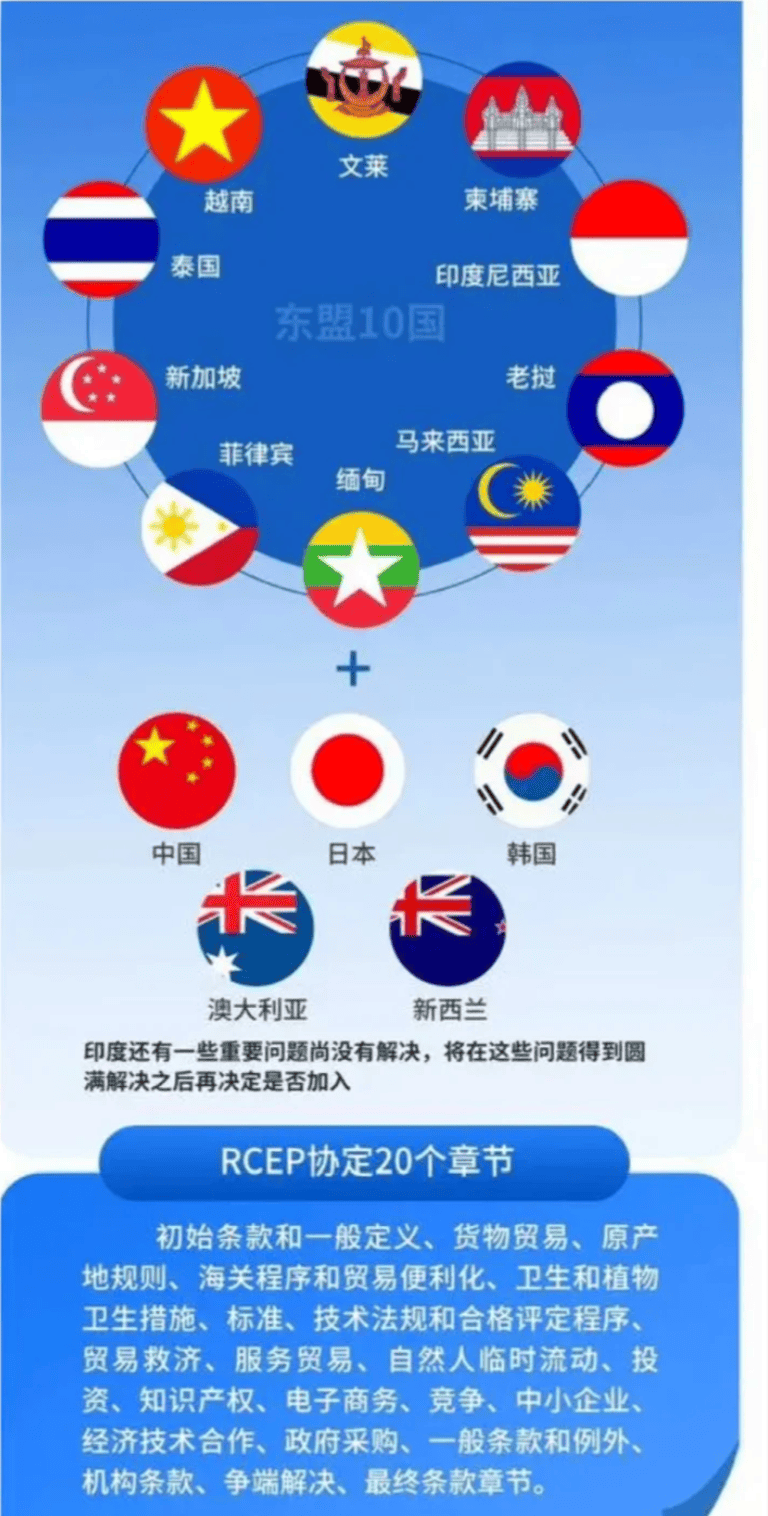
RCEP原产地规则

Search documents
RCEP转口贸易加速升温:高反倾销压力下,中国出口企业迎来降本增效的新解法
Sou Hu Cai Jing· 2025-12-19 04:41
Core Viewpoint - The rise of global trade protectionism is leading to anti-dumping and anti-subsidy measures becoming a long-term norm, prompting Chinese export companies to utilize RCEP transshipment trade as a vital tool for restructuring international channels [1]. Group 1: RCEP Institutional Benefits - The Regional Comprehensive Economic Partnership (RCEP) has simplified origin rules, expanded regional accumulation scope, and reduced tariff barriers among members, resulting in structural changes in regional trade models [4]. - According to RCEP origin rules, products with over 30% cumulative value added within member countries can be recognized as RCEP-origin products, significantly lowering the threshold for "origin transformation" [4]. - By 2025, intermediate goods trade within the RCEP region is projected to reach 68.3%, indicating the rapid formation of a regional supply chain characterized by processing, transshipment, and redistribution [4]. Group 2: Southeast Asia as a Transshipment Hub - Southeast Asian countries are emerging as crucial transshipment hubs due to their industrial capacity and advantageous tariff structures, connecting China with global markets [6]. - Average tariff levels for exports to Europe and the U.S. range from 5% to 15%, making Southeast Asia an attractive option for intermediate processing and value addition [6]. - The domestic "zero tariff" policy in Hainan Free Trade Port, covering approximately 6,600 items, further reduces costs for transshipment and regional distribution, facilitating a multi-stage export pathway of "domestic—RCEP—third market" [6]. Group 3: Back-to-Back Certificates Enhancing Feasibility - A key innovation of RCEP is the issuance of back-to-back certificates of origin, effectively addressing the challenge of maintaining origin qualifications in transshipment trade [8]. - In practice, goods transiting between RCEP member countries can have their origin certificates reissued as long as they retain their origin attributes and meet agreement conditions, allowing subsequent exports to benefit from tariff reductions [8]. - For instance, in the first seven months of 2025, enterprises in Qingdao utilized RCEP certificates to achieve an export value of 7.26 billion yuan, a year-on-year increase of 21.8% [8]. Group 4: Upgrading Transshipment Trade - Current RCEP transshipment trade is evolving from simple "logistics transshipment" or "label changes" to a more compliant, processed, and structured approach [9]. - The processing phase is increasingly focused on substantial value addition, with stricter verification of origin rules and higher compliance requirements for documentation [9]. - Transshipment pathways are becoming integrated into long-term supply chain planning for enterprises, indicating that transshipment trade is transitioning from an "emergency measure" to a systematic export solution [9]. Group 5: Future Outlook - With the long-term trend of anti-dumping measures and detailed origin reviews, the core of future export competition will hinge on the ability to establish regional supply chain layouts, familiarity with RCEP origin rules, and the capacity to achieve identity transformation under compliance [11]. - RCEP transshipment trade is expected to continue expanding in the coming years, becoming a key pathway for Chinese export companies to tackle high tariff barriers, diversify market risks, and enhance export resilience [11]. - In the context of reshaping global trade rules, RCEP serves not only as a tariff reduction agreement but also as a tool for reconstructing regional industrial chains and export pathways [11].

生产企业必看!“免抵退” 全解析:从原理到实操指南
Sou Hu Cai Jing· 2025-10-14 10:59
Group 1 - The "tax refund" policy is reshaping the competitive landscape of China's manufacturing exports, with a specific example showing a photovoltaic component company saving 120 million yuan in cash flow, equivalent to 18% of its net profit in Q3 2024 [1] - The policy reveals three underlying games: the tax refund game in technology-intensive industries, compliance challenges for cross-border e-commerce, and the regional tax refund siphoning effect [1][2] - A battery company benefits from a 13% tax refund rate, but 73% of its input tax comes from imported separator materials, highlighting the complexities of the tax refund system [1] Group 2 - The Chengdu-Chongqing region's laptop cluster utilizes a "processing trade" model, increasing tax refunds by 42 yuan per laptop, but causing a loss of 3.7 billion USD in processing trade orders from East China in the first eight months of 2024 [2] - In the first half of 2024, the national export tax refund processed reached 1.54 trillion yuan, with a 79% year-on-year increase in recovered illegal tax refunds [2] - Future compliance benefits will concentrate on multinational manufacturing leaders with AEO certification and overseas warehouse companies using blockchain verification, while small exporters using manual methods may face a 17% risk of tax refund loss [2]