REITs市场创新

Search documents
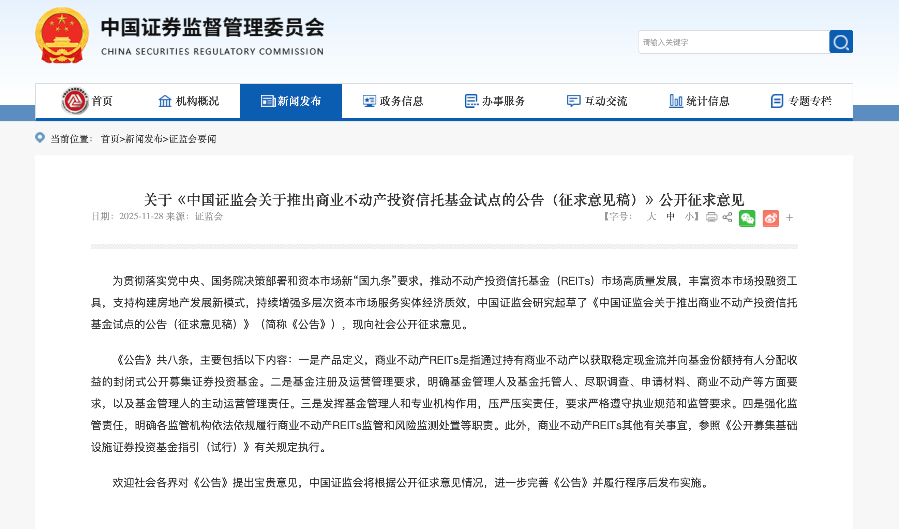
商业不动产REITs试点将启幕,资本市场服务实体经济再添利器
2 1 Shi Ji Jing Ji Bao Dao· 2025-11-29 00:17
Core Viewpoint - The announcement of the pilot program for Commercial Real Estate Investment Trusts (REITs) marks a significant breakthrough in China's capital market, transitioning from infrastructure to commercial real estate, aimed at revitalizing trillions of yuan in dormant assets and enhancing the connection between commercial real estate and capital markets [1][4]. Group 1: Institutional Design - The pilot program establishes a comprehensive market-oriented operational system, emphasizing the active management and equity attributes of REITs, which are designed to generate stable cash flows for investors [4][5]. - The announcement requires that the commercial real estate assets must have clear ownership and stable cash flow, ensuring asset quality for investors [4]. - The regulatory framework includes a multi-tiered responsibility system involving the China Securities Regulatory Commission (CSRC), exchanges, industry associations, and fund managers, ensuring market vitality while maintaining risk control [5]. Group 2: Market Impact - The introduction of commercial real estate REITs coincides with a critical turning point in the sector, providing a new financing channel for companies holding substantial commercial properties, thus transforming dormant assets into liquid capital [7][8]. - REITs are expected to change the operational logic of commercial real estate, pushing managers to enhance operational capabilities and improve property value through refined management practices [8][9]. - The REITs will inject new vitality into the capital market, appealing to long-term investors like insurance funds and pension funds, while also allowing ordinary investors to participate in quality commercial real estate investments [9]. Group 3: Future Development - The rollout of commercial real estate REITs is based on five years of experience with infrastructure REITs, aligning with international practices and market trends [11]. - The market is prepared for implementation, with exchanges revising rules and fund companies forming specialized teams to support the initiative [11]. - Successful pilot programs will require complementary policies, including tax and state-owned asset transfer regulations, to create a conducive environment for REITs market development [12].