
ROE(净资产收益率)

Search documents
太保寿险增持上海机场今年险资首例举牌出现
Zheng Quan Ri Bao Zhi Sheng· 2026-01-15 16:34
Core Viewpoint - China Pacific Life Insurance Co., Ltd. (CPIC) has increased its stake in Shanghai International Airport Co., Ltd. (Shanghai Airport) by acquiring 72.424 million shares, bringing its total holdings to approximately 124 million shares, which represents 5.00% of the company's A-share capital. This marks the first instance of insurance capital participating in a stake increase in 2024 [1][2]. Group 1: Investment Activity - CPIC's investment in Shanghai Airport is part of its equity investment management strategy, driven by its own investment needs [2]. - The frequency of insurance capital stake increases has been rising, with 20 instances in 2024 and a projected increase to 41 instances in 2025, marking a near ten-year high [2]. Group 2: Reasons for Increased Activity - The rise in stake increases is attributed to several factors: low interest rates, the implementation of new accounting standards, and low market valuations [2]. - Experts indicate that the low interest rate environment and "asset shortage" pressures have made high-dividend stocks a core choice for insurance capital to match long-term liabilities and enhance returns [2]. Group 3: Target Industries and Preferences - Insurance capital has primarily targeted industries such as banking, insurance, new energy, infrastructure logistics, and public utilities, with a significant focus on H-shares [3]. - In 2025, 44% of the stake increases were in the banking sector, and over 80% of the targets were H-shares, which often have higher dividend yields [3]. Group 4: Future Outlook - The demand for stake increases is expected to be categorized into two main types: one focused on stable dividend cash flows and the other on companies with strong return on equity (ROE) and established market positions [4]. - The active participation of insurance capital in stake increases is anticipated to continue, with a shift towards technology and green energy sectors while maintaining a focus on traditional high-dividend sectors [5].


美国全球化秩序崩坏,中国ROE上升,看好保险
2025-12-17 02:27
Summary of Key Points from Conference Call Records Industry Overview - The records discuss the insurance industry in China and its evolving dynamics within the context of global economic changes and the shifting global order [1][3][4][11]. Core Insights and Arguments - **Global Order Changes**: The shift in global order has led to a transformation in economic models, with China's return on equity (ROE) showing a cyclical decline due to its previous role in satisfying U.S. demand, resulting in long-term deflation [1][3]. - **Decoupling from U.S. Dominance**: China is actively working to detach from the dollar-dominated global system through measures such as reducing U.S. Treasury holdings, wage reforms, and adjustments in the real estate market, aiming to enhance domestic ROE and achieve sustainable economic growth [1][4]. - **Impact of New Energy Sector**: The development of the new energy sector is facilitating China's integration into the global division of labor, thereby improving profit distribution capabilities and positively impacting the overall economy [1][3][4]. - **Insurance Sector as Beneficiary**: Insurance companies are positioned to benefit from the reconstruction of national credit and asset prices, as they play a crucial role in the economic transformation [1][3][4][11]. Additional Important Insights - **China's Supply Chain Position**: China has significantly enhanced its position in the global supply chain, becoming a "black hole" for high-quality supply chain resources, despite perceptions that Southeast Asian countries are replacing it [5][6]. - **Long-term Market Trends**: The Chinese market is facing challenges such as real estate deflation, but the long-term development trend remains positive, with increasing long-duration capital in the insurance sector leading to a market pricing bias towards long-term investments [8][11]. - **A-Share Market Outlook**: The A-share market may shift from an AI-driven tech style to a value style due to the slowdown in AI technology development and the dual changes in ROE between China and the U.S., which could lead to capital flow deterioration [9][10]. - **Fiscal Policy Support**: Fiscal policies are expected to mitigate short-term risks, contributing to a more optimistic overall outlook for the market [10]. Conclusion - The insurance industry in China is poised for growth amid significant economic transformations, with long-term trends favoring stability and potential returns, making it a strategic focus for investment [11].
每日钉一下(股价到底跟公司盈利有没有关系?)
银行螺丝钉· 2025-12-03 13:57
Group 1 - Funds are suitable investment products for ordinary people, and there is a free course available to help beginners understand fund investment from scratch [2] - The course includes notes and mind maps to facilitate efficient learning [2] Group 2 - The relationship between stock prices and company earnings can be complex, with some companies showing good earnings but stagnant stock prices, while others with losses may see stock price increases [6][8] - Companies can be categorized based on their Return on Equity (ROE): loss stocks (negative ROE), marginal profit stocks (positive ROE but below market average), and quality stocks (positive ROE above market average) [6][7] - In periods of ample liquidity, stocks with poor earnings may rise more than those with good earnings, indicating a speculative market environment [9][11] - Long-term investment should focus on companies with relatively good earnings to ensure sustainable returns, rather than engaging in short-term speculation or investing in loss-making companies [11]


李蓓:龙头企业寒冬开花利润率启动回升,正是核心指数ROE能够筑底、无明显向下风险的关键原因
Xin Lang Zheng Quan· 2025-11-30 02:07
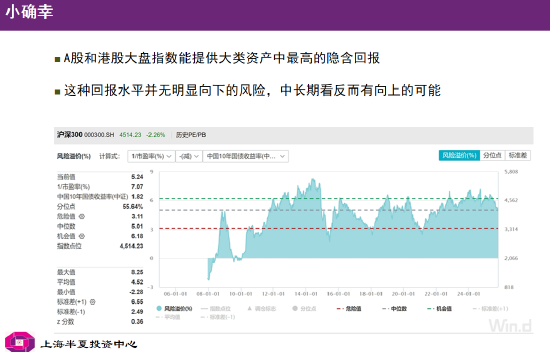
Core Viewpoint - The 2025 Analyst Conference highlighted that A-shares and Hong Kong stocks are currently among the most cost-effective high-return assets globally, with core indices' ROE stabilizing despite ongoing economic pressures and deflation [1][4]. Valuation Comparison - A-shares and Hong Kong stock indices exhibit significant return advantages compared to global assets, with the CSI 300 index's current PE ratio at approximately 13 times, implying a return of 7%, while some Hong Kong indices show even higher implied returns [1]. - Despite concerns about bubbles in certain sectors, the overall market's median valuation remains in a relatively low range, indicating that valuation risks have been largely released [1]. Profitability Concerns - The primary concern regarding profitability amidst economic decline and persistent deflation has been addressed, asserting that core indices' ROE will not significantly decline even if economic conditions do not improve [4]. - Historical data shows that during previous economic downturns, such as the 2008 financial crisis and the 2015 market adjustment, the ROE of core indices stabilized at current levels, receiving strong support [4]. Industry Dynamics - In economic downturns, many companies face losses, but leading firms maintain their ROE, reflecting the profitability gap between strong and weak companies. The index is primarily composed of leading firms, which helps stabilize the overall ROE [4]. - The construction materials industry serves as a case study, where leading companies are showing signs of profit improvement despite the sector's deep adjustment. For instance, only the top two companies in the industry remain profitable, while the third has incurred losses [4]. Investment Value of Leading Firms - Leading companies are expected to maintain their profitability levels even if industry demand continues to decline, as the exit of weaker firms will absorb downward pressure on the industry [4]. - The profit margins of leading firms have begun to recover from around 6%, while the second-ranked firm's net profit is only 1%, illustrating the resilience of core indices' ROE [4][5].
产寿险牌照价值大逆转?
Xin Lang Cai Jing· 2025-09-28 10:48
Core Viewpoint - The value of life insurance licenses has significantly declined, while the value of property insurance companies has increasingly been recognized by the industry and outside investors [1][5]. Group 1: Life Insurance Sector - In September, Minsheng Life Insurance's 705,000 shares were auctioned with a starting price of 12.7795 million yuan, which is 70% lower than the assessed value of 18.2564 million yuan, but the auction received no bids [2]. - Minsheng Life Insurance reported an insurance business income of 12.887 billion yuan and a net profit of 607 million yuan for 2024, with total assets of 140.056 billion yuan and a risk rating of BBB [3]. - The life insurance industry is facing challenges due to a decline in new premium growth and the pressure of rigid claims payments, leading to cash flow issues for companies [5][6]. Group 2: Property Insurance Sector - The approval of the share transfer for Anhua Agricultural Insurance to Rongjie Investment Holding Group, which now holds 32.719% of the company, indicates a growing recognition of property insurance value [2][9]. - The business model of property insurance is characterized by high certainty, with clear metrics for premium income and claims, making it easier to evaluate compared to life insurance [8]. - The market for property insurance is dominated by major players like PICC, Ping An, and Taikang, making it difficult for smaller companies to achieve significant breakthroughs [9].
主动优选2025年来超额表现好,因为啥呢?
银行螺丝钉· 2025-07-14 13:59
Core Viewpoint - The article discusses the performance of the "Active Selection" strategy compared to the CSI 300 index and other equity fund indices, highlighting its ability to generate excess returns in most years since its inception, particularly noting a recovery in 2025 after underperforming in 2024 [1][2][36]. Performance Summary - As of June 30, 2025, the Active Selection strategy achieved a 5.46% excess return compared to the CSI 300 index [1]. - The performance of the Active Selection strategy since its inception shows that it outperformed the CSI 300 and the equity fund index in most years, particularly excelling during the bull market from 2020 to 2021 [4][8]. - Yearly performance data indicates that in 2020, the Active Selection strategy rose by 65.78%, outperforming the CSI 300 by 24.49% and the equity fund index by 5.61% [7][4]. 2024 Underperformance Analysis - In 2024, the Active Selection strategy increased by 6.56%, but underperformed the CSI 300, which rose by 14.68%, resulting in an 8.12% shortfall [11][12]. - The underperformance in 2024 is attributed to market style shifts, particularly a surge in small-cap and loss-making stocks, which the Active Selection strategy does not engage with [14][23]. Investment Strategy Insights - The article emphasizes the importance of investing in companies with strong profitability, as measured by Return on Equity (ROE), and categorizes companies into three groups based on their ROE [15][18]. - The strategy focuses on high-quality stocks, avoiding speculative investments in loss-making companies, which led to its relative underperformance during periods of "speculative trading" in 2024 [23][34]. - Long-term investment in high-performing stocks is advocated, aligning with the principle that stock prices ultimately reflect the underlying company's value over time [37][38].

中国人保(601319):人身险增长强劲、利润贡献上升
Xin Lang Cai Jing· 2025-03-28 10:35
Core Viewpoint - The company reported a significant increase in 2024 earnings per share (EPS) to RMB0.95, a 90% year-on-year growth, primarily driven by strong investment performance, aligning with previous forecasts of 75%-95% growth [1] Group 1: Life Insurance Performance - The company's life insurance (including health insurance) new business value (NBV) increased by 127% year-on-year on a comparable basis, with agent and bancassurance channels growing by 86% and 223% respectively [2] - New single premium slightly declined by 1%, but NBV growth was driven by improved profit margins, with the NBV profit margin rising to 18% from 8% [2] - The company adjusted the long-term investment return rate to 4.0% and the discount rate to 8.5%, leading to an estimated 22% decrease in NBV due to assumption adjustments, but expects a 17% growth in NBV for 2025 [2] Group 2: Property Insurance Performance - The comprehensive cost ratio (COR) for property insurance increased by 1 percentage point to 98.8%, mainly due to natural disaster impacts [3] - The auto insurance segment maintained a stable underwriting performance with a COR of 96.8%, while the non-auto insurance COR rose by 2.8 percentage points to 101.9% due to increased loss ratios [3] - The company anticipates a return to normal disaster frequency in 2025, projecting a COR of approximately 98% for Chinese property insurance [3] Group 3: Investment Performance - Supported by strong investment performance, the company's return on equity (ROE) for 2024 is estimated at 16.5%, the highest in nearly a decade [4] - The total investment return rate improved significantly to 5.6% from 3.3% in 2023, resulting in over 100% year-on-year growth in investment income [4] - The company’s annual dividend per share (DPS) reached RMB0.18, up from RMB0.16 in 2023, with a dividend payout ratio of approximately 19% [4] Group 4: Earnings Forecast and Valuation - Based on favorable investment conditions, the company has raised its EPS forecasts for 2025, 2026, and 2027 to RMB0.93, RMB0.85, and RMB0.93 respectively, with adjustments of 21.3%, 1.5%, and -0% [5] - The target prices for A/H shares have been increased to RMB7.9 and HKD4.7, up from RMB7.2 and HKD4.4 [5]
