
Tariff exemptions

Search documents
美国经济-2025 年增速确有放缓,但幅度小于最初担忧-U.S. Economics-US growth did slow in 2025, just not by as much as we initially feared
2026-02-24 14:17
Summary of Key Points from the Conference Call Industry Overview - The conference call focuses on the **U.S. economy** and its performance in **2025** as analyzed by **Morgan Stanley** economists. Core Insights and Arguments - **U.S. Economic Growth**: The U.S. economy did experience a slowdown in 2025, but not as significantly as initially feared. Headline GDP growth remained largely unchanged at **2.2%** compared to **2.4%** in 2024, despite a federal government shutdown that subtracted **1.2 percentage points** from growth in Q4 2025 [5][18] - **Final Sales to Domestic Purchasers**: This metric, which excludes trade and inventories, showed a more pronounced slowdown from **3.0%** in 2024 to **1.9%** in 2025, indicating weaker domestic demand primarily driven by households and government spending [13][14] - **Factors Influencing Growth**: The resilience in growth was attributed to tariff exemptions and stronger-than-expected spending on artificial intelligence (AI). Households also showed a willingness to lower their saving rates to maintain consumer spending [19][20] - **Expectations for 2026**: Looking ahead, final sales to domestic purchasers are expected to rebound to **2.5%** in 2026, supported by AI-driven investment, solid household balance sheets, fiscal stimulus, and a less restrictive monetary policy [20] Additional Important Insights - **Volatility in Trade and Inventory**: The analysis highlighted extreme volatility in trade and inventory flows, particularly following "Liberation Day," which obscured the underlying economic signals in GDP data [6][12] - **Consumer Behavior**: Personal consumption growth slowed from **3.4%** in 2024 to **2.2%** in 2025, while real government spending declined from **3.6%** to **-1.0%** [14][16] - **Nonresidential Investment**: Nonresidential investment rose significantly by **5.9%** in 2025, driven by a **28.1%** increase in information processing equipment spending [17] - **Trade Dynamics**: The volatility in imports was notable, with real goods imports surging at an annualized rate of **52.9%** in Q1 2025 before declining sharply in subsequent quarters [10][12] This summary encapsulates the key points discussed in the conference call regarding the U.S. economy's performance in 2025 and expectations for 2026, highlighting both the challenges and resilience observed in various economic indicators.
Johnson & Johnson reaches deal with US government to lower drug prices
Reuters· 2026-01-09 01:43
Core Point - Johnson & Johnson has reached an agreement with the U.S. administration to reduce drug prices for Americans in exchange for exemptions from U.S. tariffs [1] Group 1 - The agreement aims to lower drug prices for American consumers [1] - The deal includes tariff exemptions for Johnson & Johnson [1]



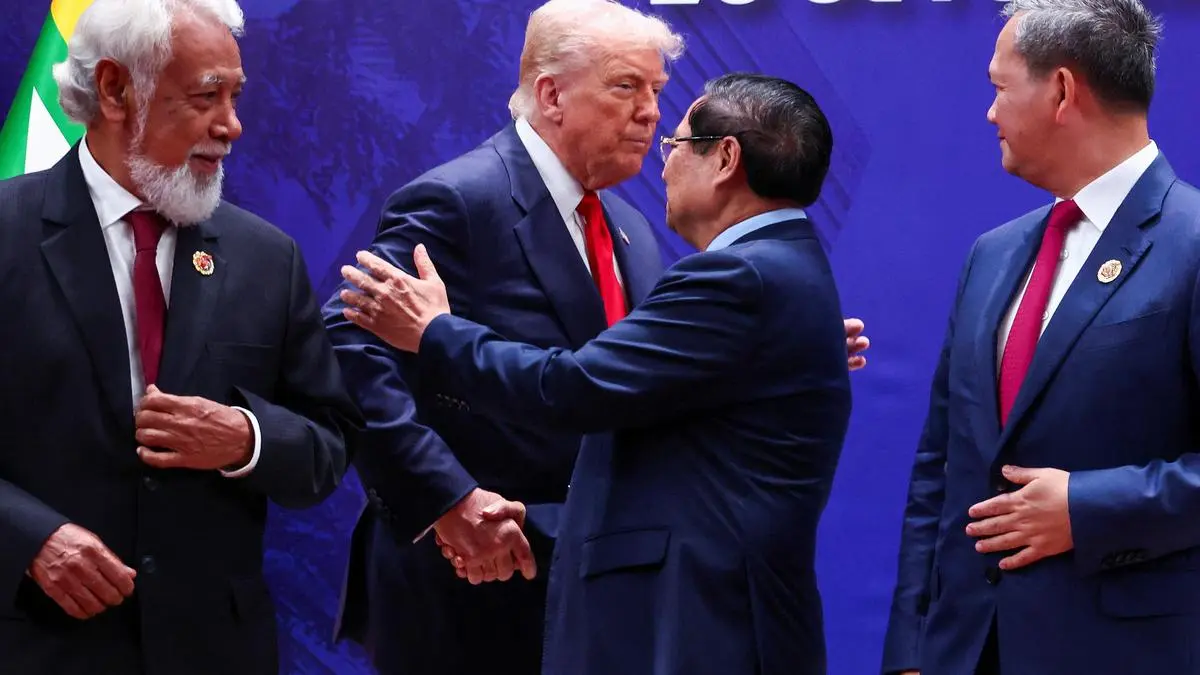
Trump’s new trade deals give US an edge over Southeast Asia
BusinessLine· 2025-10-28 03:14
Core Insights - The trade agreements announced by US President Trump in Southeast Asia are characterized as "historic" but reveal uneven benefits and numerous uncertainties for the involved countries [1][2]. Trade Agreements Overview - The agreements include the removal of many tariff and non-tariff barriers on US exports, with commitments from Southeast Asian nations to purchase nearly $150 billion worth of US goods, particularly in sectors like semiconductors and aerospace [2][6]. - The agreements are perceived as "one-sided," with Southeast Asian countries facing unclear benefits and potential costs to their domestic industries due to the rollback of tariffs on US goods [3][7]. Economic Impact on Southeast Asia - For Malaysia, the tariff exemptions are estimated to apply to about $12 billion of its exports to the US, which is approximately 2.8% of its GDP, but only about $1 billion of these exports will benefit from a zero tariff rate [3][4]. - The Malaysian stock market showed a decline following the announcement, indicating that investors may have already priced in the trade deals [5]. Specific Country Insights - Vietnam is highlighted as a significant contributor to regional exports to the US, accounting for about $18 billion of the $41 billion total in July [9]. - Cambodia expressed satisfaction with the deal but is seeking further exemptions for garments and footwear, which constitute about 50% of its exports [13]. - Malaysia's Trade Minister indicated that the deal provides better access to US markets and exemptions for specific products like palm oil and pharmaceuticals [14]. Future Negotiations and Uncertainties - The framework of the agreements is non-binding, and detailed negotiations are expected to continue, particularly for Thailand, with a goal to conclude by the end of the year [13]. - There remains uncertainty regarding how the US will classify "transshipped" goods, which could be subject to high tariffs, adding complexity for manufacturers [11][12].

Trump's tennis invite from Rolex echoes Apple, Nvidia playbook for currying favor, Warren says
CNBC· 2025-09-24 14:02
Core Viewpoint - Senator Elizabeth Warren has raised concerns regarding Rolex's relationship with President Donald Trump, suggesting that the company may be attempting to secure tariff exemptions through this association [2]. Group 1: Company Actions - Rolex hosted President Donald Trump at the U.S. Open, which has led to scrutiny over whether the company is leveraging this relationship for potential tariff benefits [2][4]. - The invitation to Trump has drawn parallels to actions taken by other companies like Apple and Nvidia, which have made domestic investments since Trump's return to the White House [3]. Group 2: Political Context - Warren's letter to Rolex's CEO, Jean-Frederic Dufour, questions the company's motives and suggests an inquiry into its practices [2]. - The presence of high-ranking officials alongside Trump at the U.S. Open, including Treasury Secretary Scott Bessent, highlights the political connections that may influence corporate strategies [4].


Stock Market Today: AMD Surges 5.7% Despite Earnings Headwinds as Chip Stocks Rally
The Motley Fool· 2025-08-07 21:10
Group 1 - AMD's stock surged 5.7% to close at $172.40, driven by renewed hopes for tariff exemptions for U.S.-based chipmakers [1][2] - Trading volume for AMD reached 94.4 million shares, nearly 80% above its three-month average of 53 million [1] - AMD's stock is currently about 5.5% below its 52-week high of $182.50 [1] Group 2 - The Nasdaq Composite rose 0.4%, supported by strong performance in the semiconductor sector, while the S&P 500 slipped 0.1% [2] - Nvidia and Broadcom also saw gains, with Nvidia rising 0.8% to $180.77 and Broadcom adding 0.7% to close at $303.76 [2] Group 3 - AMD reported a record $7.7 billion in second-quarter revenue, but margins declined due to an $800 million inventory write-down related to U.S. export restrictions [3] - The company guided for third-quarter revenue of approximately $8.7 billion, which alleviated concerns and bolstered investor confidence [3] - Analysts remain optimistic about AMD's positioning in the AI accelerator and data center markets [3]


X @Bloomberg
Bloomberg· 2025-08-07 13:54
Market Trends - US stocks experienced an increase following Trump's announcement of chip tariff exemptions [1] - Data releases have strengthened expectations for a Federal Reserve rate cut in the coming month [1]