
Tech War

Search documents
Dalio: Why Market Crises Keep Changing the Rules for Investors
Bloomberg Television· 2025-12-21 13:00
Market Events & Financial Crisis - The market peaked in early 2000 and dropped approximately 30% within months [1] - Major financial institutions faced collapse, triggered by housing market sell-offs that spread to unrelated sectors [3] - The Fed implemented quantitative easing (QE) three times, restarting after less than a decade due to the COVID-19 pandemic [4] - COVID-19 pandemic caused market plunges of 20% to 30% in about 5 and a half weeks [5] - Headline inflation rates peaked at 9%, the highest in the modern era [6] Market Dynamics & Investment Trends - Individual investors drive the majority of activity in U S public equity markets by 2025, impacting prices and valuations [7] - Discussions of bubbles are resurfacing, with concerns about an AI bubble similar to the tech bubble of 2000 [8] - The US spent approximately $8 trillion on wars on terrorism, leading to budget deficits [9] - Since 2020, large budget deficits and wealth gaps have been monetized, leading to leveraging up of assets in private equity and venture capital markets [15][14] - Geopolitical conflicts necessitate a shift from consumer-based to directed economies, emphasizing infrastructure and energy development [18] Global Economic Factors - Developed countries, including Europe, the United States, and China, face declining populations, while the Global South experiences growing populations and migration linked to climate change [22] - A successful country requires education, productivity, financial resources, and avoidance of internal and international conflicts [26]

Trump Team Floats Selling Nvidia H200 Chips to China
Youtube· 2025-11-21 20:08
Core Viewpoint - The potential licensing of Nvidia's H200 chip for sale in China could significantly impact the company's earnings and market position, despite current geopolitical tensions limiting sales opportunities [4][6][8]. Group 1: Chip Performance and Market Context - The H200 chip is positioned as a significant upgrade over the H20, with performance metrics indicating it is 1.5% to 2 times more powerful than its predecessor [1]. - Current alternatives available to China are on par with the H20, making the H200 a superior option if it becomes available [3]. - The geopolitical friction between the U.S. and China is a major factor affecting the sales of Nvidia chips, with only $50 million in sales reported for the current quarter [6][7]. Group 2: Potential Impact of Licensing - If Nvidia secures a license to sell the H200 in China, it could motivate hesitant buyers to purchase, potentially increasing sales in the Chinese market [8]. - However, the ongoing geopolitical tensions may still hinder Chinese companies from purchasing advanced chips, which could limit the expected sales boost [7][8]. Group 3: Competitive Landscape and Innovation - There is a debate regarding whether allowing Nvidia to sell advanced chips to China could inadvertently accelerate China's own chip development efforts [11]. - Historical data suggests that limiting access to advanced technology has often led to increased innovation efforts within China [13]. - Despite current limitations, Chinese companies like Huawei are still able to achieve competitive performance levels, albeit with less efficient solutions [14]. Group 4: Nvidia's Strategic Position - Nvidia's potential re-entry into the Chinese market with the H200 could represent a significant strategic advantage, as the company currently has no business in China [14][15]. - The relationship between Nvidia's leadership and U.S. officials may play a role in the company's ability to navigate these licensing discussions [9][10].


Chinese owners of UK factory move crucial chip production out of Britain
Yahoo Finance· 2025-11-03 20:01
Core Points - A UK semiconductor factory owned by China, Dynex Semiconductor, has ceased production of high-voltage microchips as China tightens control over the global electronics supply chain [1] - The Chinese owner, CRRC, is expanding domestic production facilities for the same components, raising concerns about the hollowing out of the UK's electronics industry [1][5] - The semiconductor technology sector is a focal point in the tech war between the West and China, with both sides imposing trade restrictions [3] Company Overview - Dynex Semiconductor, established in 1957, is a leading UK producer of semiconductor devices known as IGBTs, which are essential for controlling high-power loads in electric trains and vehicles [3] - The company was acquired by CRRC, a state-owned Chinese rail corporation, in 2008, which has since been blacklisted by the US government due to alleged military ties [4] - CRRC's investment in Dynex was part of a strategy to secure high-voltage chip supplies for China's high-speed rail and grid projects [4] Production Changes - Dynex has officially stopped IGBT production in Lincoln, issuing a nine-month notice to customers in October of the previous year, indicating that production was halted in the summer [5] - While Dynex will continue to package IGBT chips, the focus of production will shift to other areas, as CRRC has become a major producer of IGBTs in China, recently opening a third production line [6]

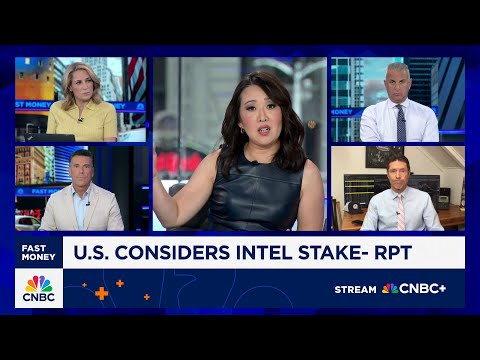
'Fast Money' traders react to the Trump admin possibly taking a stake in Intel
CNBC Television· 2025-08-14 21:52
Market Trends & Government Intervention - Intel's stock performance has seen a 19% increase this week, potentially influenced by President Trump's focus on Lip Bhutan [1] - The discussion suggests Intel could become a significant foundry business, similar to Taiwan Semiconductor Manufacturing [2] - The Trump administration's focus on national champion companies and bringing back manufacturing to the US aligns with potential government support for Intel [3][5] - Government taking a stake in a company typically doesn't lead to stock rallies, unlike the observed 8% increase [4] - The administration might have been considering investing in Intel while publicly criticizing them [4] - Concerns arise from Lip Bhutan's relationships in China, emphasizing the US versus China tech war and the need for Intel to prioritize US concerns [7] - Government ownership could provide more control over Intel, which might be necessary in the current geopolitical climate [7][8] Financial & Strategic Considerations - The idea of government taking stakes in companies outside of a crisis is unconventional, especially post-Great Financial Crisis [9] - The government's potential stake in Intel is viewed as a strategic move, similar to the 15% stake in MP Materials [11][12] - The discussion highlights the potential for the government to take stakes in other strategic companies [12]

X @Bloomberg
Bloomberg· 2025-07-18 09:04
Even as US President Donald Trump upends China’s factory floors, he seems to be laying the ground for an easing in the tech war. How far will he go?: Here is your Evening Briefing. https://t.co/UbJXgUMaLs ...