Terminal rate

Search documents
Bank of Japan is poised to raise rates to a 30-year high despite economic weakness
CNBC· 2025-12-18 09:44
Core Viewpoint - The Bank of Japan is expected to raise benchmark interest rates to their highest level in 30 years, aiming for policy normalization after a prolonged period of low rates [1][2]. Group 1: Interest Rate Hike - The anticipated rate hike could increase rates to 0.75%, the highest since 1995, with an 86.4% probability of this occurring [2]. - A rate increase is likely to strengthen the yen against the dollar and help contain inflation, which has exceeded the BOJ's target for 43 consecutive months [2][3]. Group 2: Economic Context - Japan's economy contracted by 0.6% quarter on quarter and 2.3% on an annualized basis in the third quarter, indicating a weak economic environment [3]. - Experts suggest that the market's focus will shift to the BOJ's commentary following the rate decision, as nuances in communication will influence market reactions [3]. Group 3: Neutral Rate Insights - Governor Kazuo Ueda indicated that estimating the neutral or terminal rate, which balances inflation and economic growth, is challenging, with the BOJ estimating it to be between 1% and 2.5% [4]. - Ueda emphasized the need for the BOJ to guide monetary policy despite the uncertainty surrounding the exact neutral rate [5]. - An updated estimate on the neutral rate may be provided after the upcoming meeting [5].


美国经济-12 月 FOMC 会议前瞻:进一步降息的门槛提高-US Economics Analyst_ December FOMC Preview_ Raising the Bar for Further Cuts
2025-12-08 02:30
Summary of Key Points from the December FOMC Preview Industry Overview - The report focuses on the U.S. economic outlook and the Federal Open Market Committee (FOMC) meeting scheduled for December, which is expected to address interest rate adjustments. Core Insights and Arguments - **Interest Rate Cut Expectations**: The FOMC is anticipated to implement a third consecutive 25 basis point interest rate cut, bringing the target range to 3.5-3.75% [2][5] - **Labor Market Concerns**: Job growth is insufficient to match labor supply growth, with an estimated underlying trend monthly job growth of 40,000, below the breakeven rate of 70,000. The unemployment rate has risen to 4.4%, indicating a softening labor market [2][6][10] - **Dovish vs. Hawkish Sentiment**: While many investors expect a hawkish tone from the FOMC, there is uncertainty regarding future cuts, especially if the labor market continues to weaken [2][18][39] - **Economic Projections**: The median GDP growth forecast is expected to rise to 2% for both 2025 and 2026, while core PCE inflation is projected to decline to 3% for 2025 and 2.5% for 2026 [25][26] - **Future Rate Cuts**: The FOMC is likely to signal that the bar for further cuts has been raised, with expectations of one additional cut in 2026 to 3.375% and another in 2027 to 3.125% [28][31] Additional Important Insights - **Inflation Trends**: Core PCE inflation, net of tariff effects, is currently estimated at 2.3% and is expected to reach 2% by the first half of 2026 [13][14][17] - **Impact of AI on Employment**: Companies are increasingly utilizing AI to reduce labor costs, which may lead to restrained hiring or increased layoffs, further complicating the labor market outlook [35][36] - **Economic Uncertainty**: The report highlights significant uncertainty regarding whether improved GDP growth will stabilize the labor market, given the current negative job growth outside of healthcare [35][36] Conclusion - The upcoming FOMC meeting is poised to be contentious, with a mix of hawkish and dovish sentiments among participants. The labor market's performance and inflation trends will be critical in shaping future monetary policy decisions.
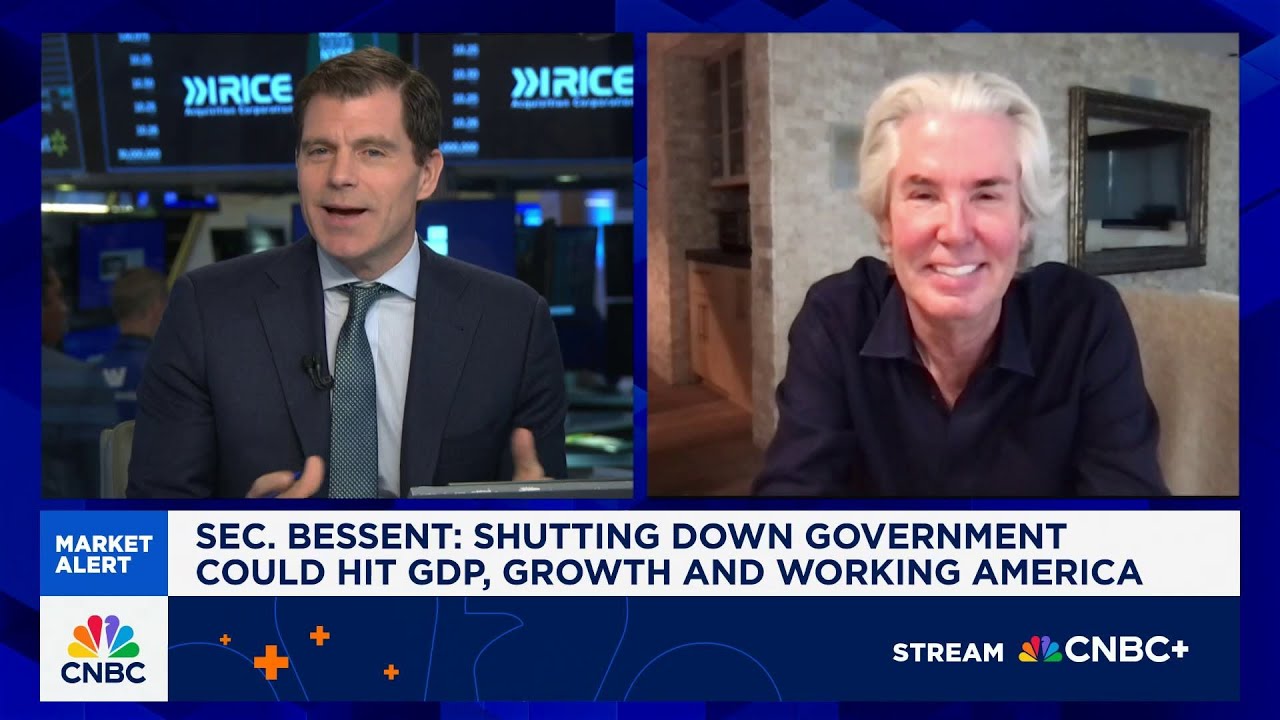
Absence of data will reduce Fed's excessive reliance on data dependence: Georgetown's Paul McCulley
Youtube· 2025-10-02 15:11
Core Viewpoint - The Federal Reserve is expected to move towards further rate cuts, potentially reducing the policy rate to a neutral zone of 3% to 3.5% in the coming meetings, despite some hawkish sentiments among committee members [3][4][8]. Group 1: Federal Reserve's Rate Policy - The absence of new data due to a potential government shutdown may lead the Fed to rely less on data dependence, allowing for a clearer path towards rate cuts [2][3]. - The Fed is anticipated to implement 25 basis point cuts in the next three to four meetings, aligning the policy rate with the current yield curve [3][4]. - There is a consensus within the Fed committee on the need to move towards a neutral policy rate, although there is disagreement regarding the terminal rate [7][8]. Group 2: Internal Dynamics of the Fed - The Federal Open Market Committee (FOMC) is cautious about committing to specific rate cuts, emphasizing that their projections are not promises [6][8]. - There is a notable division among committee members regarding the terminal rate, with some preferring it to remain above 3% [7]. - Chair Powell is expected to effectively guide the committee towards a steady approach of gradual rate cuts without making definitive promises [8].