Trade friction

Search documents
美联储会议召开在即 贵金属价格屡创新高
Qi Huo Ri Bao· 2026-01-27 01:11
Core Viewpoint - Precious metal prices have continued to rise since 2026, reaching record highs, driven by factors such as trade tensions, ongoing central bank gold purchases, and geopolitical disturbances [1] Price Movements - On January 26, the London spot gold price briefly surpassed $5,100 per ounce, with a year-to-date increase of over 18% [1] - The London spot silver price also exceeded $110 per ounce, showing a year-to-date increase of over 50% [1] Market Expectations - The Federal Reserve is set to hold its first monetary policy meeting of 2026 on January 27-28, with widespread market expectations that it will maintain its current stance [1] - A hawkish statement from the Federal Reserve could lead to increased market volatility [1]
China's trade surplus surges 20% to a record $1.2 trillion, even with Trump's tariffs
Yahoo Finance· 2026-01-14 03:35
Trade Surplus and Exports - China's trade surplus reached a record of almost $1.2 trillion in 2025, driven by strong exports to various global markets despite a decline in shipments to the U.S. due to increased tariffs [1] - Total exports for 2025 rose by 5.5% to $3.77 trillion, while imports remained flat at $2.58 trillion, resulting in a trade surplus of over $992 billion in 2024 [2] - In December, exports increased by 6.6% year-on-year, surpassing economists' expectations, while imports rose by 5.7% [2] Export Dynamics - Exports to the U.S. fell by 20% in 2025, but this decline was offset by significant increases in exports to Africa (26%), Southeast Asia (13%), the European Union (8%), and Latin America (7%) [4] - The largest export category was mechanical and electrical items, which rose by 8.4% from the previous year, while exports of labor-intensive products like furniture and clothing saw declines [6] Economic Impact - Strong global demand for computer chips and automotive exports, particularly electric vehicles, contributed to the growth in exports, with auto exports surging by 21% to over 7 million units [5] - The robust export performance has helped maintain China's economic growth close to its official target of about 5%, raising concerns in other countries about the impact of cheap imports on local industries [6] Future Outlook - Economists anticipate that exports will continue to be a significant growth driver for China's economy in 2026, despite facing a "severe and complex" external trade environment [3][7]
【债市观察】假期前后债市转暖 避险需求促利率下行
Xin Hua Cai Jing· 2025-10-13 02:30
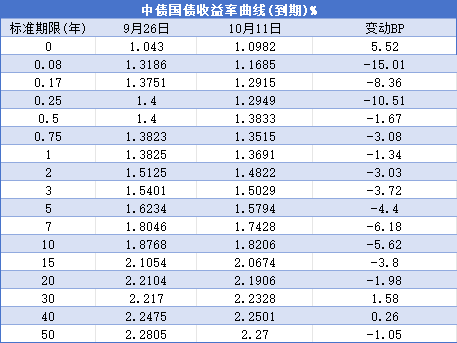
Core Viewpoint - The bond market has shown signs of recovery in the days surrounding the long holiday, with a decline in yields, particularly in the 10-year government bonds, which fell by over 5 basis points [1][4]. Market Overview - During the six working days from September 28 to October 11, bond yields experienced a downward trend, with the 10-year government bond yield decreasing by 5.62 basis points [2][3]. - The yield changes for various maturities from September 26 to October 11 include a decrease of 1.34 basis points for the 1-year bond and a decrease of 6.18 basis points for the 7-year bond [2]. Specific Events - On September 30, the market reacted positively to rumors of the central bank restarting government bond purchases, leading to a significant drop in yields [4]. - The first trading day after the holiday on October 9 saw a further decline in yields due to a large reverse repurchase operation by the central bank, totaling 1.1 trillion yuan [4][14]. - On October 11, yields fell sharply due to heightened market risk aversion following threats of increased tariffs from the U.S. [4][10]. Issuance and Market Activity - A total of 39 bonds were issued in the six working days post-holiday, amounting to 359.14 billion yuan, including 24.75 billion yuan in government bonds [8]. - Upcoming issuance plans for the week of October 13 to 17 include 32 bonds totaling 306.3 billion yuan, with a significant portion being government bonds [9]. International Context - U.S. Treasury yields also fell significantly, with the 10-year yield dropping by 7 basis points to 4.05%, influenced by trade tensions and increased demand for safe-haven assets [10]. - The Federal Reserve's recent meeting minutes indicated a strong consensus for a potential rate cut, reflecting concerns over economic uncertainty [12][13]. Institutional Perspectives - Analysts from various institutions suggest that while the bond market has stabilized, it remains susceptible to fluctuations due to equity market dynamics and policy changes [18][19][20]. - The current market sentiment is seen as having priced in negative factors adequately, but further catalysts are needed for a sustained decline in yields [19][20].

X @The Economist
The Economist· 2025-08-26 04:00
Industry Overview - Japan was once a semiconductor powerhouse [1] - Trade friction with America led to limits on Japanese chip exports [1] - This created an opportunity for rivals in the semiconductor industry [1] Future Outlook - The report questions whether Japan can rise back to the top in the semiconductor industry [1]
ETO Markets 市场洞察:中美联手按下暂停键,原油多头已偷偷布局这个价位!
Sou Hu Cai Jing· 2025-08-12 05:23
Core Viewpoint - The international oil market is experiencing a mild upward trend, supported by the extension of the tariff suspension period between China and the U.S., which alleviates concerns over trade tensions affecting the year-end consumption season [1][3] Group 1: Market Dynamics - Brent crude futures settled at $66.65 per barrel, while WTI closed at $63.89 per barrel, with narrowed intraday volatility [1] - The extension of the tariff suspension aims to provide more time for bilateral negotiations and prevent supply chain disruptions during the holiday shopping season [3] Group 2: Geopolitical Factors - Attention is shifting to the upcoming U.S.-Russia high-level talks in Alaska, focusing on de-escalating the Russia-Ukraine conflict and discussing potential easing of secondary sanctions on Russian oil buyers [4] - A substantial peace agreement between Russia and Ukraine could significantly reduce the risk of oil supply disruptions, potentially providing further upward momentum for oil prices [4] Group 3: Economic Indicators - The upcoming U.S. inflation data is viewed as a critical variable; a signal of potential interest rate cuts by the Federal Reserve could weaken the dollar, providing price support for dollar-denominated oil [5] - Conversely, if inflation remains sticky and exceeds expectations, concerns over tightening liquidity may suppress risk asset performance [5] Group 4: Technical Analysis - WTI crude oil has formed a short-term support level around $63, with short-term moving averages showing signs of stabilization and bullish momentum [6] - Key resistance is identified at $64.80 per barrel; a breakthrough could challenge the $66 per barrel mark, while $63 serves as a critical support level [6] Group 5: Market Sentiment - The market is currently benefiting from the dual expectations of eased trade tensions and reduced geopolitical conflicts, though the actual impact will depend on the substantive progress of negotiations and Federal Reserve policy direction [8] - Investors are advised to closely monitor the interplay between political and economic signals, along with key technical levels for risk management [8]

中远海控:2024 年年报业绩简报要点
2025-03-27 07:29
COSCO Shipping Holdings Ltd | 2024 Annual Results Briefing Summary Industry Overview - **Industry**: Transportation & Infrastructure - **Company**: COSCO Shipping Holdings Ltd (1919.HK, 601919.SS) Key Takeaways Market Outlook - Demand recovery post Chinese New Year (CNY) has been faster than in 2024, with improved volumes and load factors expected in 2025 [2] - Management anticipates a healthy market in 2025, with industry supply growth projected at approximately 5% year-over-year and demand growth slightly slower at 2-3% year-over-year compared to 2024 [9] Trade Dynamics - Management believes that tariffs will not eliminate US demand but may create a more segmented and potentially fragile global supply chain [2] Capital Expenditure - Total capital expenditure (capex) is projected at Rmb42.3 billion, with allocations of Rmb11 billion in 2025, Rmb9 billion in 2026, and Rmb14.8 billion in 2027, primarily focused on vessels, boxes, and supply-chain infrastructure [2] Share Repurchase Strategy - Management views the stock as undervalued when trading below book value and may consider updating the share repurchase plan based on share price performance, capital requirements, and cash liquidity [3][9] Emerging Markets Strategy - COSCO Shipping Holdings plans to increase capacity in Latin American markets, expecting fewer demand disruptions from geopolitical tensions. The company has already expanded its presence in Mexico and Southeast Asia and aims to enhance operations in Abu Dhabi, a key global hub port [3] Financial Performance - For fiscal year ending December 2024, net revenue is projected at Rmb234.36 billion, with net income expected at Rmb49.28 billion, resulting in an EPS of Rmb3.09 [6] - The company’s price-to-earnings (P/E) ratio is forecasted to be 3.9 for 2024, with a price-to-book (P/B) ratio of 0.8 [6] Risks and Considerations - Potential risks include global trade drops amid macroeconomic headwinds, significant increases in fuel prices, and failure to maintain segment capacity discipline [13][14] - Upside risks may arise from a spot market turnaround, better-than-expected earnings distribution, and prolonged disruptions in the Red Sea [13][14] Stock Rating and Valuation - Current stock rating is Underweight with a price target of HK$8.50, indicating a downside of approximately 29% from the closing price of HK$11.98 on March 21, 2025 [6] Additional Insights - Management's focus on share repurchase and capital allocation reflects a strategy to enhance shareholder value amidst market fluctuations [3][9] - The company’s expansion into emerging markets is a strategic move to mitigate risks associated with geopolitical tensions and supply chain disruptions [3] This summary encapsulates the critical insights from the COSCO Shipping Holdings Ltd annual results briefing, highlighting the company's strategic outlook, financial performance, and market dynamics.