Trade restrictions

Search documents
X @Bloomberg
Bloomberg· 2025-10-30 07:28
Trade Relations - US administration agreed to a one-year delay of a sanctions framework [1] - The sanctions framework would have significantly increased the number of Chinese companies facing US trade restrictions [1] Government Policy Impact - China's Ministry of Commerce released a readout regarding the agreement [1]
ECB President Lagarde: I would like 'some certainty' on U.S.-China trade
CNBC Television· 2025-10-14 17:45
Trade Certainty & Economic Impact - Economic actors need certainty regarding US-China trade relations to make informed decisions about investments like factories and shipping [1] - Businesses require clarity on current and future tariff realities to plan effectively [2] Trade Diversion & Inflation Concerns - Excessive trade restrictions between the US and China could divert goods to Central and Eastern Asia, and Europe [2][3] - Trade diversion may lead to inflationary consequences [3] Trade Balance & Open Trade - The hope is for sufficient open trade, even with tariff restrictions, to maintain a reasonably balanced movement of trade and goods between the two countries [2]


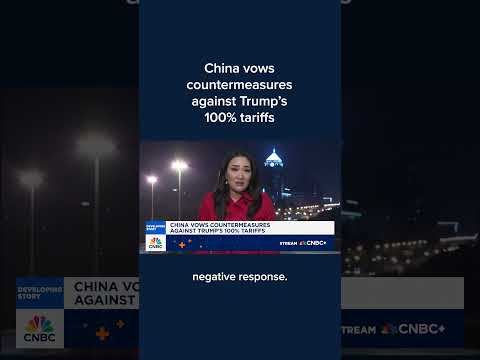
China vows countermeasures against Trump's 100% tariffs
CNBC Television· 2025-10-13 17:30
Geopolitical Response - China defends rare earth export restrictions, stating it's a response to US restrictions and sanctions that have harmed China's interests [1] - China threatens to retaliate against President Trump's 100% tariff threat with "corresponding measures" [2] Rare Earth Export Controls - China's rare earth controls have been expanded to cover foreign companies operating overseas [3] - China clarifies that the export curbs do not equate to a ban [3] Industry Impact - Chinese rare earths are used in a broad range of industries, including defense, autos, robotics, and semiconductors [3]
Synopsys Stock Falls on China Ban, But Long-Term Outlook Holds
MarketBeat· 2025-06-14 13:14
Core Viewpoint - Synopsys is a crucial player in the semiconductor industry, particularly in electronic design automation (EDA) software, despite recent challenges and a decline in share performance [1][2]. Financial Performance - Synopsys reported a 10% increase in sales and a 22% increase in adjusted earnings per share (EPS) compared to the previous year's quarter [3]. - The company's shares have decreased approximately 13% over the past 52 weeks, with a notable drop of nearly 10% on May 28 due to U.S. government restrictions on sales to China [2][3]. Impact of Trade Restrictions - Approximately 10% of Synopsys's revenue came from China last quarter, and the recent restrictions are significant but not catastrophic, as revenue from China has already declined from 15% in fiscal Q2 2024 to 10% [2][5]. - The company has faced declining sales growth in China for years due to previous trade restrictions, which has softened the impact of the latest restrictions [6]. Acquisition of ANSYS - Synopsys announced a $35 billion acquisition of ANSYS in January 2024, but is still awaiting regulatory approval, particularly from Chinese regulators [7]. - There is speculation that the acquisition could be approved soon, as Synopsys will no longer be doing business in China, but the company has pushed back against moving forward without China's approval [8][9]. Stock Forecast and Analyst Ratings - The 12-month stock price forecast for Synopsys is $607.14, indicating a potential upside of 26.79% based on 13 analyst ratings [11]. - Analysts at KeyCorp set a price target of $540, suggesting an 8% upside from the June 11 closing price, reflecting moderate upside potential [11]. Long-Term Prospects - Despite near-term uncertainties, Synopsys's long-term prospects remain strong, particularly with the anticipated approval of the ANSYS deal and recovery in non-AI end markets [12]. - The ongoing trend of developing advanced chips across various markets positions Synopsys for long-term success [12].