VLA(视觉 - 语言 - 动作)

Search documents
对话优理奇CEO杨丰瑜:00后创业不押注VLA,把机器人先送进酒店干活
3 6 Ke· 2025-08-28 07:13
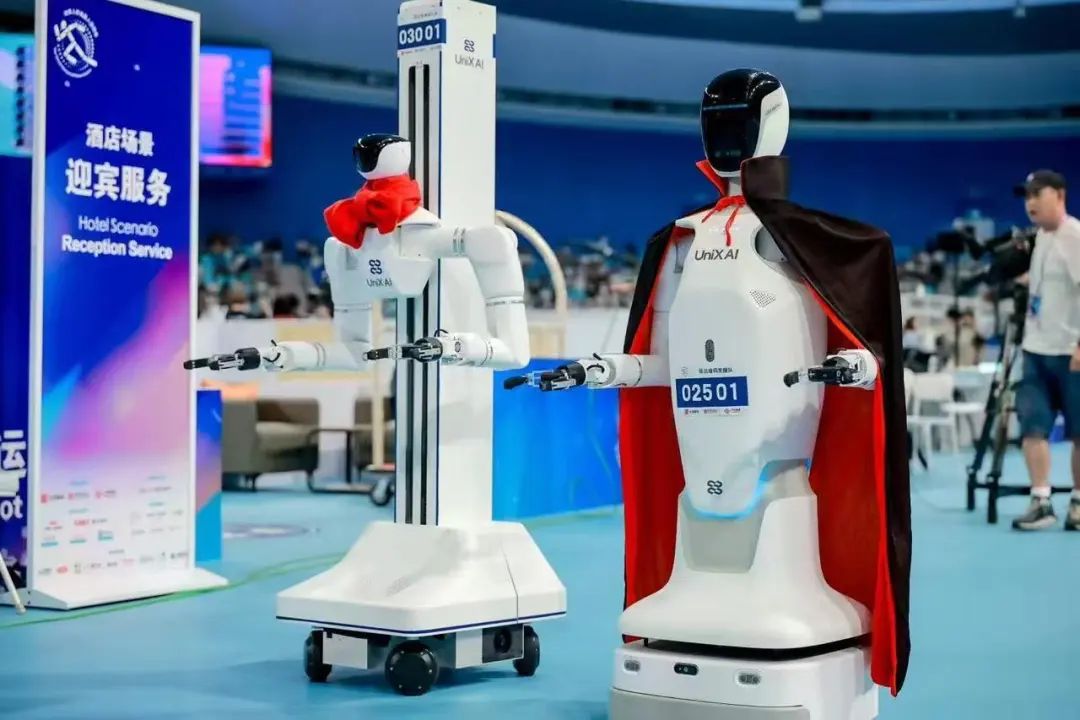
Core Insights - Unix AI's robots achieved significant recognition at the World Humanoid Robot Games, winning two golds and one silver in hotel cleaning and concierge service categories, leading to increased interest from hotel clients [1][7] - The company focuses on "C-end" scenarios, such as hotels and nursing homes, to develop and refine its robots' capabilities, which can later be applied to various other sectors [1][9] - Unix AI employs a unique technical approach that breaks down required actions into key points and motion trajectories, allowing robots to learn efficiently from minimal data [3][17] Group 1: Competition Impact - Following the competition, Unix AI experienced a surge in inquiries, with over ten hotel clients visiting the company for consultations [1][7] - The competition not only showcased the robots' capabilities but also served as a platform for improving their performance through practical challenges faced during preparation [7][12] Group 2: Technical Approach - Unix AI's strategy involves deploying robots in real-world scenarios to gather data, which is then used to enhance their learning and operational efficiency [3][12] - The company does not currently pursue the mainstream Vision-Language-Action (VLA) approach due to a lack of sufficient data, opting instead for a more grounded method [2][18] Group 3: Product Development - The Wanda series robots, including the second and third generation, were showcased at the competition, with the third generation designed for enhanced performance in practical applications [26][28] - The company emphasizes the importance of self-developed hardware to maintain control over costs, quality, and data consistency across different robot generations [24][25] Group 4: Market Positioning - Unix AI's focus on the hotel cleaning sector is strategic, as it allows for high error tolerance and the ability to collect valuable training data in less sensitive environments compared to industrial settings [10][11] - The company believes that mastering skills in "C-end" scenarios will facilitate the transition to other applications, such as households and restaurants [9][10]


机器人能跑能跳能搏击,为何仍陷“成长烦恼”?
第一财经· 2025-08-12 14:38
Core Viewpoint - The article discusses the current state and challenges of the humanoid robotics industry, highlighting the need for better integration between embodied manufacturers and AI model companies, as well as the importance of data quality and quantity for advancing technology [3][6][16]. Industry Growth and Challenges - The humanoid robot market in China is experiencing strong growth, with commercial sales expected to rise from approximately 2,000 units in 2024 to nearly 60,000 units by 2030, reflecting a compound annual growth rate of 95.3% [6]. - Despite the growth, the industry faces significant challenges, including high costs, inconsistent hardware quality, data quality and scale gaps, immature software and algorithms, and a lack of supply chain standards [7][8]. Technological Development - The industry is currently divided into three main technological routes: end-to-end VLA (Vision-Language-Action), layered architectures, and brain-like models that simulate biological neurons [12]. - There is a consensus on the importance of the "small brain" technology for motion control, but the "big brain" aspect, which involves decision-making and learning, has not yet reached an ideal state [11][12]. Data Issues - A significant barrier to progress in the humanoid robotics sector is the insufficient amount of quality data available for training models. The industry currently relies on a limited dataset, with the largest public dataset containing only 1 million entries [16][17]. - Companies are exploring various methods to generate data, including using computer graphics to simulate real-world physics and creating large interactive object libraries [17]. Integration and Collaboration - The development of humanoid robots is seen as a systemic engineering challenge, where the integration of various technological routes and data sources is crucial for creating effective systems [13]. - The industry requires collaboration among multiple companies to address the full chain of model development, data acquisition, and robot functionality [18].