
Visual Intelligence

Search documents
X @Bloomberg
Bloomberg· 2026-03-01 15:00
This weekend’s Forecast newsletter unpacks Apple’s push into AI devices and visual intelligence. Plus, three ways the EU could end, and why minipigs could be the future of medicine. https://t.co/yAjHAu6aoG ...

Tim Cook Teases Apple Launch On Monday: Here's What To Expect - Apple (NASDAQ:AAPL)
Benzinga· 2026-02-26 16:55
Group 1: Upcoming Product Launches - Apple is planning to launch at least five products over three days starting March 2, including a new low-cost MacBook and the iPhone 17e [1][2] - Additional product candidates include upgraded MacBook Pro models with M5 Pro and M5 Max chips, new MacBook Air machines, iPad Air with M4, and an entry-level iPad with the A18 processor [2] Group 2: Strategic Focus on AI and Visual Intelligence - Apple is signaling a strategic push into AI wearables centered around a technology called Visual Intelligence, which enables devices to interpret their environment [3] Group 3: Supply Chain and Manufacturing Adjustments - Apple is facing an AI-driven memory chip shortage that is expected to impact the March quarter more significantly than the previous December quarter [4] - To manage supply constraints, Apple is prioritizing premium devices, including a foldable iPhone expected in fall 2026, while delaying the standard iPhone 18 to the first half of 2027 [4] - Apple plans to shift part of its Mac Mini production to a Foxconn facility in Houston, Texas, as part of a broader $600 billion U.S. investment commitment [5] Group 4: Financial Performance - Apple reported fiscal first-quarter revenue of $143.76 billion, exceeding analyst estimates of $138.42 billion, with iPhone sales increasing to $85.27 billion from $69.14 billion year-over-year [5] Group 5: Stock Performance - At the time of publication, Apple shares were down 0.91% at $271.73 [6]


X @Bloomberg
Bloomberg· 2026-02-22 13:45
Apple CEO Tim Cook is signaling that Visual Intelligence will be the defining feature of the company’s push into wearable AI devices, writes Mark Gurman.Read this week's Power On newsletter: https://t.co/lDDRC4E54k📷️: David Paul Morris/Bloomberg https://t.co/9LSy9mx7hm ...
李飞飞:不要让AI把你变愚蠢,必须守住“人”的主导权
虎嗅APP· 2025-11-25 10:19
Core Viewpoint - AI is a civilization-level technology that has a profound impact on human life and society, requiring careful management to ensure it serves humanity rather than dominating it [4][6]. Group 1: Nature of AI and Human Role - AI is a double-edged sword with both potential and risks, necessitating human guidance and control [5][7]. - The development of AI should be inclusive and open, allowing everyone to participate and shape its future, breaking the monopoly of a few tech giants [5][8]. - The current AI landscape is dominated by a few companies, primarily in the U.S., and there is a need for responsible use of technology [8] Group 2: Future of AI - "Spatial intelligence" is identified as the next key phase in AI evolution, enabling machines to understand and interact with three-dimensional spaces [5][22]. - The societal impact of AI on education, employment, and social structures requires collective responsibility from individuals, businesses, and public sectors [5][25]. - Effective governance of superintelligence is crucial, focusing on human decision-making rather than the technology itself [27][28]. Group 3: Education and Human Development - In the AI era, education should focus on nurturing curiosity, critical thinking, and responsibility in children, preparing them to be active participants rather than passive users of technology [5][31]. - The importance of teachers in society is emphasized, as they play a critical role in guiding students in the responsible use of AI tools [34][35]. Group 4: Industry Trends and Challenges - The influx of capital into the AI sector raises concerns about potential market bubbles, but the demand for AI applications in various fields remains strong [32][33]. - The environmental impact of AI's energy consumption is a pressing issue, highlighting the need for renewable energy innovations [33]. Group 5: Personal Insights and Experiences - The journey from a challenging immigrant experience to becoming a leader in AI reflects resilience and the importance of curiosity in scientific exploration [15][17][20]. - The influence of mentors and the importance of interdisciplinary approaches in AI research are acknowledged [19][11].

李飞飞最新对话
投资界· 2025-07-04 12:05
Core Viewpoint - The article emphasizes the importance of spatial intelligence in achieving Artificial General Intelligence (AGI), as articulated by AI pioneer Fei-Fei Li, who believes that understanding and interacting with the 3D world is fundamental to AI development [2][29]. Group 1: Spatial Intelligence and AGI - Fei-Fei Li asserts that without spatial intelligence, AGI is incomplete, highlighting the necessity of creating world models that capture the structure and dynamics of the 3D world [29][33]. - The understanding of 3D world modeling is deemed crucial for AI, involving tasks such as reasoning, generating, and acting within a three-dimensional context [8][33]. Group 2: ImageNet and Its Impact - The creation of ImageNet was a pivotal moment in AI, providing a large dataset that enabled significant advancements in computer vision and machine learning [12][18]. - ImageNet's challenge established benchmarks for object recognition, leading to breakthroughs in algorithms, particularly with the introduction of convolutional neural networks like AlexNet [19][24]. Group 3: Evolution of AI and Future Directions - The conversation reflects on the evolution of AI from object recognition to scene understanding and now to generative models, indicating a rapid progression in capabilities [31][27]. - Fei-Fei Li expresses excitement about the potential of generative AI and its applications in various fields, including design, gaming, and robotics, emphasizing the need for robust world models [41][42]. Group 4: Challenges in Spatial Intelligence - A significant challenge in developing spatial intelligence is the lack of accessible spatial data compared to the abundance of language data available online [36][73]. - The complexity of understanding and modeling the 3D world is highlighted, as it involves intricate interactions and adherence to physical laws, making it a more challenging domain than language processing [35][39]. Group 5: Personal Insights and Experiences - Fei-Fei Li shares her journey from academia to entrepreneurship, emphasizing the importance of curiosity and a fearless mindset in tackling difficult problems [46][55]. - The article concludes with encouragement for young researchers to pursue their passions and embrace challenges, reflecting on the transformative nature of AI and its potential to benefit humanity [77].

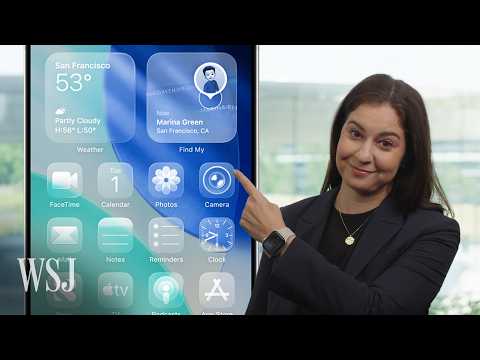
iOS 26 Features: Apple’s Liquid Glass, Visual Intelligence and More | WSJ
The Wall Street Journal· 2025-06-10 00:47
New iOS Features - Apple announces iOS 26, a major redesign with a sleek, glass-like interface across lock screen, home screen, and redesigned apps like Camera and Safari, aiming for a bigger screen feel [1][2][3] - The new OS includes call screening for unknown numbers, hold assist, and live translation, features already present in Google and Samsung devices [5][6] - Messages are enhanced with typing indicators for group chats, polls, and customizable backgrounds [6] - Apple integrates AI, including visual intelligence for screenshots with search and ChatGPT integration, and opens on-device large language models to developers [7] - iOS 26 includes smaller updates like customizable alarm snooze times, camera lens cleaning alerts, and a redesigned CarPlay with widgets [8] User Experience and Design - The "liquid glass" design aims for a translucent, real-world glass-like feel, customizing app icons and redesigning popular apps [2] - Web pages in Safari will flow edge-to-edge, dynamically shrinking the tab bar to maximize content visibility [3] - Camera app receives a more intuitive design, simplifying photo and video capture modes [3] - The new design language will extend to macOS, iPadOS, CarPlay, and more [3] - Redesigns can initially face user resistance, as seen with iOS 7, but users typically adapt over time [4] Availability - iOS 26 will be available to the public this fall, with a public beta in July, supporting iPhones as far back as the iPhone 11 [9]
苹果(Aapl.O):将Visual Intelligence扩展到iPhone屏幕。
news flash· 2025-06-09 17:45
Group 1 - The core point of the article is that Apple is expanding its Visual Intelligence capabilities to the iPhone screen, enhancing user experience and functionality [1] Group 2 - The expansion of Visual Intelligence is expected to improve the iPhone's ability to process and analyze visual data, potentially leading to new applications and features [1] - This move aligns with Apple's ongoing strategy to integrate advanced technologies into its devices, reinforcing its position in the competitive smartphone market [1]