
Consumer Services

Search documents
中国股票策略- 全球跨国企业中国情绪指数(2025 年第四季度)升至 2021 年第四季度以来最高水平-China Equity Strategy-Global MNCs China Sentiment Index (4Q25) Climbs to Highest Level since 4Q21
2026-03-18 02:29
March 17, 2026 01:10 PM GMT China Equity Strategy | Asia Pacific 1) MNCs' 4Q25 final sentiment reading improved, reaching the highest level since 4Q21 ( Exhibit 1 ): The latest sentiment reading rose to 34, 3pt higher than our 3Q25 MNCs sentiment reading, reaching the highest level since 4Q21. Meanwhile, the percentage of MNCs feeling positive was 64%, up from 3Q25 (61%) (Exhibit 2). By region, sentiment scores in the EM/APxJ showed a major increase; Global, US and Europe's also improved marginally, while J ...
中国思考-十五五规划:科技为纲、消费为辅
2026-03-12 09:08
Summary of the Conference Call on China's 14th Five-Year Plan Industry Focus - The conference call discusses the **14th Five-Year Plan (FYP)** of China, emphasizing a **technology-centric** approach and a calibrated rebalancing of the economy. Core Points and Arguments 1. **Focus on Technology and Supply-Side Policies** The 14th FYP reiterates a growth path centered on technology and supply-side policies, with clear quantitative targets for innovation and green transformation. However, the promotion of consumption is described in qualitative terms only, indicating a lack of concrete measures to stimulate consumer spending [3][8][11]. 2. **Quantitative Goals for Innovation** Specific quantitative goals include: - Average annual growth rate of R&D expenditure to exceed 7% - Increase the share of the digital economy in GDP from 10.5% to approximately 12.5% by 2030 - Maintain labor productivity growth above GDP growth [7][11][12]. 3. **Moderate Consumption Promotion** Despite an increase in the household consumption rate being a major goal, the plan lacks binding quantitative targets for consumption as a percentage of GDP. This aligns with past policy styles that avoid setting specific numerical goals for macroeconomic structural reforms [3][11]. 4. **Green Transition Goals** The plan aims to increase the share of non-fossil energy consumption in total energy consumption to 25% by the end of the plan period, indicating a shift from administrative reduction targets to a transformation of the energy system [8][12]. 5. **Challenges in Implementation** The plan highlights the need for a unified national market framework to regulate local government behavior. However, actual implementation may face challenges due to entrenched local interests and the need for reforms in local government assessment and tax systems [8][11]. 6. **GDP Growth Forecast** The GDP growth forecast for the year is maintained at 4.8% for real growth and 4.1% to 4.2% for nominal growth, reflecting a cautious outlook amid ongoing structural adjustments in the economy [8][13]. Other Important but Overlooked Content 1. **Sector-Specific Plans** There is an expectation of a series of industry-specific plans to translate the macro goals of the 14th FYP into actionable strategies within the next 6 to 12 months, focusing on technology independence, social security reform, and addressing employment impacts from AI [8][11][12]. 2. **Social Welfare Reforms** The plan includes clearer policy guidance for social welfare reforms, such as increasing pension support and easing access to social security for migrant workers, indicating a more systematic approach to social support [12]. 3. **Addressing AI Employment Impact** The government plans to release documents addressing the employment impacts of AI, which may include support for retraining and the creation of new high-tech jobs [12]. 4. **Institutional Reforms to Combat "Involution"** The focus is on establishing a more unified market entry system and regulatory framework to curb local protectionism and unhealthy competition, which may slow down the pace of implementation due to existing local interests [11][12]. This summary encapsulates the key insights from the conference call regarding China's 14th Five-Year Plan, highlighting the emphasis on technology and innovation while acknowledging the challenges in promoting consumption and implementing reforms.
推荐几个好用的投诉平台,帮你快速维权
Xin Lang Cai Jing· 2026-02-26 07:29
Core Viewpoint - The article emphasizes the importance of utilizing various complaint platforms to effectively address consumer disputes in daily life, highlighting their unique advantages and suitable scenarios for use [1][8]. Group 1: National Complaint Platforms - The 12315 platform is described as the official complaint channel under the State Administration for Market Regulation, suitable for issues related to product quality, price fraud, and false advertising, with a processing time of 7 to 15 working days [2][10]. - The platform supports multiple access methods including mobile apps and mini-programs, making it a fundamental resource for consumers needing official intervention [2][10]. Group 2: Internet Complaint Platforms - Black Cat Complaint is highlighted as an efficient and transparent platform, allowing users to submit complaints in under 5 minutes and track progress in real-time [3][11]. - The platform features a "Red and Black List" for businesses, encouraging prompt responses from companies and providing consumers with insights into service quality [3][11]. Group 3: Industry-Specific Complaint Channels - The article notes that consumers can benefit from industry-specific complaint channels, which often yield better results compared to general platforms [5][13]. Group 4: Social Media as a Complaint Tool - Social media platforms like Weibo and Xiaohongshu are mentioned as effective tools for amplifying consumer voices, especially when official channels are slow to respond [6][14]. - It is advised to maintain a factual approach when using social media for complaints, and to also file formal complaints through established platforms to create dual pressure on companies [7][14]. Group 5: Summary of Recommendations - The article concludes that selecting the appropriate complaint channel is crucial for effective consumer advocacy, with options including 12315 for official enforcement, Black Cat for efficiency and transparency, industry-specific platforms for targeted issues, and social media for broader impact [8][16].
Consumer Spending Persists Despite Slower Income Gains
PYMNTS.com· 2026-02-20 21:41
Core Insights - Consumer spending is shifting towards services as spending on goods softens, indicating a deliberate spending posture and a slower pace of overall growth in the U.S. economy [1][5] Economic Indicators - Personal income rose by 0.3% month over month in December, while personal consumption expenditures increased by 0.4%. Disposable income growth matched November's 0.3% gain, but wages and salaries only expanded by 0.2%, the slowest increase since June [3][4] - Real GDP grew at an annualized rate of 1.4% in the fourth quarter of 2025, down from 4.4% in the third quarter, marking the slowest year-end growth since 2018. For the full year, GDP increased by 2.2% [8][12] Consumer Behavior - Spending on goods declined by 0.1% in December, the first drop in six months, while services expenditures rose by 0.7%. Durable goods were the weakest category, falling by 0.3% [4] - Households are reallocating their spending towards services such as housing, healthcare, travel, and dining, while discretionary goods purchases are showing signs of constraint [5] Labor Market Insights - The Labor Economy workers, earning $25 per hour or less, represent over one-third of U.S. employees and account for 15.1% of total U.S. spending, equivalent to more than $1.7 trillion annually [6] - Only 29.4% of Labor Economy workers expect their financial situation to improve by 2026, while nearly half anticipate unchanged pay and rising monthly expenses [7] Consumer Sentiment - Consumer sentiment improved slightly in February, with the University of Michigan's final sentiment index rising by 0.4% from January. However, the February reading remains 12.5% below its year-ago level [13][14] - Nearly 46% of consumers cited high prices as a strain on personal finances, although inflation expectations eased modestly [14] Credit and Spending Behavior - Credit usage, particularly Buy Now Pay Later (BNPL) options, remains a structural component of household cash-flow management, especially among younger consumers [15][16] - In December, 25% of bridge millennials used BNPL, a 56% increase from November, indicating that BNPL is becoming a recurring budget infrastructure for specific cohorts [16]


Porch(PRCH) - 2025 Q4 - Earnings Call Transcript
2026-02-11 23:02
Financial Data and Key Metrics Changes - Full year 2025 adjusted EBITDA reached $77 million, an 11-fold increase over 2024, translating into $65 million in cash flow from operations [3][13] - Q4 gross profit was $91 million, resulting in an 81% gross margin, while Q4 adjusted EBITDA was $23 million, a 21% margin [5][15] - Statutory surplus at the reciprocal grew approximately $50 million year-over-year, ending 2025 at $155 million, a 47% increase [6][11] Business Line Data and Key Metrics Changes - Insurance services revenue for Q4 was $75.7 million, contributing 67% to total revenue, with an 86% gross margin [15][16] - Software and Data segment revenue was $22.3 million, a 3% increase year-over-year, while Consumer Services revenue was $16.6 million, a 2% increase [17][18] - Reciprocal written premium (RWP) for Q4 was $126 million, exceeding expectations, with a significant increase in new customer additions [4][28] Market Data and Key Metrics Changes - The number of active agencies more than doubled year-over-year, with quote volumes increasing nearly 3x compared to the previous year [25][26] - New business premiums in November increased 61% compared to the January to October average, with December seeing a further 104% increase [6][27] Company Strategy and Development Direction - The company aims for $600 million in organic reciprocal written premium for 2026, representing a 25% growth rate, supported by increased agency and quote volumes [4][22] - Porch Insurance was launched in Texas, providing a unique product that includes additional coverages and services, enhancing agent incentives [7][52] - The company focuses on building a data-driven underwriting advantage, which has resulted in strong loss ratios and profitability [8][9] Management's Comments on Operating Environment and Future Outlook - Management expressed confidence in achieving the 2026 targets, citing strong momentum in new customer acquisition and improved conversion rates [4][34] - The company noted that the competitive landscape is shifting towards independent agents, which aligns with its distribution strategy [82] Other Important Information - The company authorized a $2.5 million share repurchase program, reflecting confidence in its financial position [21] - The 2026 guidance includes expectations for revenue growth of 13%-17%, with adjusted EBITDA projected between $98 million to $105 million [22] Q&A Session Questions and Answers Question: Can you provide insight into the pricing actions taken to drive acceleration and the flexibility for future pricing adjustments? - Management indicated that there is significant margin in the system, allowing for targeted pricing adjustments to drive conversion rates without dramatic changes [39][40] Question: How should the RWP to EBITDA conversion be viewed as the company scales RWP? - The company highlighted strong operating discipline, maintaining fixed operating expenses while increasing revenue, which supports improved EBITDA conversion rates [42][43] Question: What is the outlook for the competitive landscape and how does it impact the business? - Management noted a shift from in-house agents to independent agents, which is beneficial for the company as it works primarily with independent agents [82]

Porch(PRCH) - 2025 Q4 - Earnings Call Presentation
2026-02-11 22:00
Q4 2025 Earnings Presentation February 11, 2026 Copyright 2026 Porch Group, Inc. All rights reserved Disclaimers Financial Targets Porch is providing guidance and targets for future periods in this presentation, based on current market conditions, assumptions, and expectations as of the date of this presentation. Actual results may vary due to a number of factors, and there is no guarantee that we will be able to achieve these results. Please refer to the below for important disclaimers and a description of ...
内需稳健叠加出口走强 美国三季度GDP增速创近两年新高
Zhi Tong Cai Jing· 2026-01-22 14:36
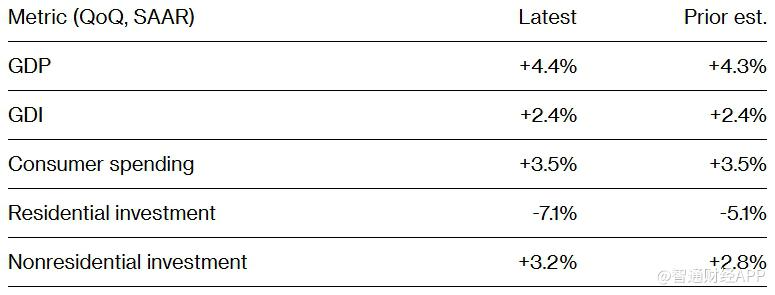
Economic Growth - The U.S. economy showed a better-than-expected growth performance in Q3, with a real GDP annualized growth rate of 4.4%, marking the fastest growth in nearly two years [1] - This growth is supported by strong exports and a reduction in the drag from inventory, contributing to the strongest consecutive quarters of growth since the recovery from the COVID-19 pandemic in 2021 [1] Key Metrics - GDP growth was reported at +4.4%, slightly above the prior estimate of +4.3% [2] - Consumer spending increased by 3.5%, with service spending growing at the fastest rate in three years and goods spending accelerating compared to the previous quarter [3] - Business investment rose by 3.2%, driven by sustained growth in computer equipment spending and record-high investments in data centers for artificial intelligence infrastructure [3] Labor Market and Inflation - Initial jobless claims remain low, indicating a robust labor market [3] - The preferred inflation measure of the Federal Reserve, the PCE price index excluding food and energy, rose by 2.9% in Q3, consistent with previous data [3] Trade and Consumer Behavior - Despite fluctuations in trade policy, consumer and business spending have remained resilient, providing support to the economy [2] - Economists are focusing on the "private domestic final sales" metric, which grew by 2.9% in Q3, indicating steady domestic demand [3]
亚洲新兴市场股票策略 - 2026 年展望更新:应对不确定世界的稳健策略-Asia EM Equity Strategy 2026 Outlook Update – A Robust Approach for an Uncertain World
2026-01-22 02:44
Summary of the Investor Presentation | Asia Pacific Industry Overview - The presentation focuses on the Asia Emerging Markets (EM) equity strategy for 2026, emphasizing a robust approach amid rising multipolar world risks [1][3]. Core Insights and Arguments - **Market Positioning**: The recommendation is to maintain tight market-risk positions with a slight preference for Japan over Emerging Markets (EM) in 2026 [8]. - **Volatility Expectations**: High volatility is anticipated to persist throughout 2026, with a significant reduction in upside to base case targets following strong market rallies in December and early January [8]. - **Stock Selection**: Emphasis on stock selection through GEM, APxJ, China, Japan, and Thematic Focus Lists to generate Alpha in uncertain market conditions [8]. - **Valuation Concerns**: There are concerns regarding high valuations and rising geopolitical risks in Asia, despite attractive opportunities in core Morgan Stanley thematics [8]. - **Japan's Fiscal Sustainability**: The risks related to fiscal sustainability in Japan are considered overstated, with the Yen viewed as undervalued. Earnings estimate revisions for Japan are among the strongest in the coverage universe [8]. - **China's Economic Outlook**: A moderately constructive view on China is maintained, particularly regarding AI exposure, with expectations that reflation will not become evident until 2027 [8]. - **Country Recommendations**: - Overweight (OW) positions in India, Brazil, UAE, and Singapore. - Underweight (UW) positions in Saudi Arabia, Indonesia, and Taiwan, with a positive outlook on India's cyclical recovery as 2026 progresses [8]. Financial Metrics and Projections - **Earnings and Valuations**: - The base-case earnings and valuations for December 2026 show a preference for Japan, with the TOPIX index target set at 3,600, reflecting a 2% decrease from the current price of 3,656 [9]. - The MSCI EM index target is set at 1,400, indicating a 6% decrease from the current price of 1,485 [9]. - The MSCI APxJ index target is 730, a 4% decrease from the current price of 759 [9]. - **Earnings Per Share (EPS) Projections**: - TOPIX EPS for fiscal years 2025, 2026, and 2027 are projected at ¥185 (+9%), ¥198 (+7%), and ¥225 (+14%) respectively [11]. - Consensus EPS for the same periods are ¥188 (+10%), ¥201 (+7%), and ¥224 (+11%) [11]. Additional Important Insights - **Market Allocation**: Current active allocations show a slight overweight in Japan and India, while underweight positions are noted in Saudi Arabia and Indonesia [30]. - **Sector Preferences**: Core overweight positions are recommended in Financials, Consumer Discretionary/E-commerce, and Industrials (Defense), while Energy is underweighted [8]. - **Long-term Trends**: The presentation indicates a wide bear to bull price target range for 2026, reflecting ongoing structural trends in the market [13]. This summary encapsulates the key points from the investor presentation, highlighting the strategic outlook for Asia EM equities in 2026, along with specific recommendations and financial projections.
iShares Global Consumer Discretionary ETF (RXI US) - Investment Proposition
ETF Strategy· 2026-01-18 21:40
Core Viewpoint - iShares Global Consumer Discretionary ETF (RXI) provides diversified exposure to companies reliant on discretionary spending, capturing both traditional brands and digital platforms, with a growth-cyclical profile sensitive to various economic factors [1] Group 1: Investment Strategy - RXI targets sectors such as retail, apparel, autos, consumer services, online commerce, and select durable goods, reflecting a broad spectrum of consumer discretionary spending [1] - The ETF's turnover is systematic, aimed at maintaining representative coverage as consumer preferences and retail formats evolve [1] - Investors can expect factor tilts towards momentum and growth during economic expansions, with a potential shift towards quality when market leaders consolidate their share [1] Group 2: Portfolio Utility - RXI can serve as a cyclical satellite for expressing a global consumer thesis, a factor-completion sleeve to enhance growth exposure, or a tactical overlay during shifts in consumption and interest rates [1] - It is suitable for macro-aware allocators looking to time cyclical tilts and long-horizon investors seeking diversified access to global consumer trends [1] Group 3: Market Conditions - Supportive market conditions for RXI include falling real yields and improving consumer confidence, while it may underperform during economic downturns or defensive rotations [1] - A key risk to monitor is the sensitivity to consumer-cycle drawdowns and high exposure to dominant sub-industries [1]

美国经济-三季度 GDP:消费强劲;AI 支出延续;贸易额外提振增长-US Economics-3Q GDP Strong consumption; AI spend continues; an extra boost from trade
2025-12-24 02:32
Summary of Key Points from the Conference Call Industry Overview - The conference call primarily discusses the **US Economics** sector, focusing on the **3Q GDP** performance and its components, particularly the impact of **AI spending** and trade dynamics on economic growth. Core Insights and Arguments - **Real GDP Growth**: The real GDP rose by **4.3% quarter-over-quarter annualized rate** in 3Q, surpassing both the internal estimate of **3.0%** and the consensus estimate of **3.3%** [1][21] - **Consumption Contribution**: Consumption increased by **3.5%**, contributing approximately one-third of the GDP upside, with goods spending up **3.1%** and services spending up **3.7%** [1][5] - **Net Exports**: Net exports contributed **1.6 percentage points** to GDP growth, with exports rising by **8.8%** and imports falling by **4.7%** [1][4] - **AI Spending**: AI-related expenditures accounted for nearly all the increase in capital expenditures, contributing **0.2 percentage points** to real GDP growth, although this was offset by imports of AI-related capital goods [1][8] - **Inflation Metrics**: Core PCE prices rose by **2.9%**, aligning with expectations, while headline PCE was at **2.8%** [1][4][7] Additional Important Insights - **Personal Income Trends**: Real disposable personal income saw a minimal increase of **0.05%**, indicating a slowdown compared to the first half of the year, with the saving rate dropping from **5.0%** in 2Q to **4.2%** in 3Q [1][6] - **Software Spending Fluctuations**: The contribution of software spending to GDP growth was affected by significant price swings, with real spending reported at **19%** in 1Q, **27%** in 2Q, and only **3%** in 3Q [1][9] - **Residential Investment Decline**: Real residential investment fell by **5.1%** in 3Q, marking the third consecutive quarter of decline [1][19] - **Trade Dynamics**: The trade sector showed strength, particularly in exports of aircraft, computers, and business services, which surged significantly [1][20] Conclusion - The conference call highlighted a robust economic performance in 3Q driven by strong consumption and trade, while also noting the complexities introduced by AI spending and inflation dynamics. The data suggests potential challenges ahead, particularly in personal income growth and residential investment trends.