建材

Search documents
行业比较周跟踪(20260223-20260301):A股估值及行业中观景气跟踪周报-20260301
Shenwan Hongyuan Securities· 2026-03-01 12:53
Group 1: A-Share Valuation - The overall valuation of A-shares as of February 27, 2026, shows the CSI All Share (excluding ST) with a PE of 22.8x and a PB of 1.9x, positioned at the historical 83rd and 53rd percentiles respectively [2][5] - The Shanghai Stock Exchange 50 Index has a PE of 11.5x and a PB of 1.3x, at the historical 58th and 37th percentiles [2][5] - The CSI 300 Index has a PE of 14.1x and a PB of 1.5x, at the historical 64th and 38th percentiles [2][5] - The CSI 500 Index shows a PE of 38.8x and a PB of 2.7x, at the historical 71st and 63rd percentiles [2][5] - The ChiNext Index has a PE of 43.3x and a PB of 5.7x, at the historical 43rd and 66th percentiles [2][5] Group 2: Industry Valuation Comparison - Industries with PE valuations above the historical 85th percentile include Real Estate, Automation Equipment, Retail, Electronics (Semiconductors), and IT Services [2] - Industries with PB valuations above the historical 85th percentile include Industrial Metals, Minor Metals, Defense, Electronics (Semiconductors), and Communications [2] - The White Goods industry has both PE and PB valuations below the historical 15th percentile [2] Group 3: Industry Midstream Sentiment Tracking - In the New Energy sector, the price of polysilicon futures dropped by 4.8%, and the spot price fell by 3.7%, indicating weak sentiment due to subdued demand [2][3] - In the Technology TMT sector, the Philadelphia Semiconductor Index decreased by 2.0%, while the Taiwan Semiconductor Index increased by 4.8% [3] - In the Real Estate chain, the price of rebar fell by 1.1%, while the price of cement decreased by 0.4% [3] - In the Consumer sector, the average price of live pigs dropped by 7.7%, and the wholesale price of pork fell by 3.6% [3] - In the Midstream Manufacturing sector, heavy truck sales increased by 46.0% year-on-year in January 2026, driven by favorable policies [3] Group 4: Commodity Prices and Trends - The price of Brent crude oil futures rose by 1.2% to $72.52 per barrel, influenced by geopolitical tensions in the Middle East [3] - The price of thermal coal increased by 4.0% to 751 RMB/ton, while coking coal prices fell by 2.0% to 1501 RMB/ton [3] - The price of gold increased by 3.2%, and silver prices rose by 11.6% [3]
行业比较周跟踪:A股估值及行业中观景气跟踪周报-20260301
Shenwan Hongyuan Securities· 2026-03-01 11:51
Valuation Summary - The overall valuation of A-shares as of February 27, 2026, shows the CSI All Share (excluding ST) PE at 22.8x and PB at 1.9x, positioned at the historical 83rd and 53rd percentiles respectively [2] - The Shanghai Stock Exchange 50 PE is at 11.5x and PB at 1.3x, at the historical 58th and 37th percentiles [2] - The CSI 300 PE is at 14.1x and PB at 1.5x, at the historical 64th and 38th percentiles [2] - The CSI 500 PE is at 38.8x and PB at 2.7x, at the historical 71st and 63rd percentiles [2] - The CSI 1000 PE is at 52.3x and PB at 2.8x, at the historical 75th and 63rd percentiles [2] - The National Index 2000 PE is at 64.8x and PB at 3.0x, at the historical 79th and 72nd percentiles [2] - The ChiNext Index PE is at 43.3x and PB at 5.7x, at the historical 43rd and 66th percentiles [2] - The Sci-Tech 50 PE is at 165.6x and PB at 6.5x, at the historical 95th and 72nd percentiles [2] - The ChiNext Index/CSI 300 PE ratio is 3.1 and PB ratio is 3.8, at the historical 29th and 62nd percentiles [2] Industry Valuation Comparison - Industries with PE valuations above the historical 85th percentile include Real Estate, Automation Equipment, Retail, Electronics (Semiconductors), and IT Services [2] - Industries with PB valuations above the historical 85th percentile include Industrial Metals, Minor Metals, Defense, Electronics (Semiconductors), and Communications [2] - The White Goods industry has both PE and PB valuations below the historical 15th percentile [2] Sector Insights New Energy - In the photovoltaic sector, upstream polysilicon futures prices fell by 4.8% and spot prices by 3.7%, with weak demand affecting sentiment [2] - In the battery materials sector, cobalt and nickel prices increased by 3.2% and 2.2% respectively, while lithium carbonate and hydroxide prices rose by 19.7% and 16.8% [2] Technology TMT - The Philadelphia Semiconductor Index decreased by 2.0%, while the Taiwan Semiconductor Index increased by 4.8% [3] - The DRAM output value index rose by 3.6%, with NAND prices increasing by 5.6% [3] Real Estate Chain - The price of rebar fell by 1.1%, while futures prices increased by 0.4% [3] - The national cement price index decreased by 0.4%, while glass prices rose by 1.0% [3] Consumer Sector - The average price of live pigs fell by 7.7%, and wholesale pork prices decreased by 3.6% [3] - The wholesale price index for liquor saw a slight increase of 0.03% [3] Midstream Manufacturing - Heavy truck sales increased by 46.0% year-on-year in January 2026, driven by tax incentives and subsidies [3] Cyclical Industries - The price of Brent crude oil futures rose by 1.2% to $72.52 per barrel, influenced by geopolitical tensions [3] - The price of thermal coal increased by 4.0% to 751 RMB/ton, while coking coal prices fell by 2.0% to 1501 RMB/ton [3]
建筑材料行业:双碳政策强化建材供给逻辑,CCL继续涨价,上海优化调整地产政策
GF SECURITIES· 2026-03-01 10:26
Group 1 - The report emphasizes the strengthening of supply logic in the building materials industry due to carbon neutrality policies, with a continued price increase for copper-clad laminates (CCL) and adjustments in real estate policies in Shanghai [2][14][20] - The implementation of differentiated electricity pricing policies across provinces is expected to promote technological advancements and energy-saving measures in high-energy-consuming industries, aiding in the elimination of outdated production capacity [14][15] - The report highlights a significant price increase of over 30% for CCL and adhesive films by Resonac, driven by the ongoing shortage and rising costs of key raw materials [18][19] Group 2 - The building materials industry is experiencing a recovery in demand, particularly in the consumer building materials sector, which is expected to see stable long-term demand and improved profitability for leading companies [29][32] - The national cement market price has decreased by 0.8% week-on-week, but there is potential for price increases as demand recovers [29][33] - The report notes a slight increase in float glass prices, while the trading of photovoltaic glass remains sluggish, indicating a mixed outlook for the glass segment [29][34] Group 3 - The report suggests that the building materials sector is at a historical valuation low, with potential for significant recovery in profitability as supply-side improvements support the market [29][30] - Key companies in the consumer building materials sector, such as Three Trees, Rabbit Baby, and Oriental Yuhong, are highlighted for their resilience and growth potential amid a challenging market environment [29][32] - The report indicates that the glass fiber and carbon-based composite materials sector is expected to see price increases in electronic yarns and fabrics, driven by stable demand and competitive dynamics [29][34]


策略周聚焦:实物再通胀:顺周期五朵金花
Huachuang Securities· 2026-03-01 09:45
Core Insights - The report emphasizes the cyclical recovery in five key sectors: non-ferrous metals, chemicals, building materials, steel, and machinery, driven by supply constraints and the transition of demand dynamics [1][5] - The report highlights the impact of the Two Sessions and the 14th Five-Year Plan, suggesting a focus on sectors such as communication equipment, satellite communication, and robotics, which have recently seen inflows from ETFs [1][5] Market Adjustment and Sentiment - The market adjustment before the Spring Festival appears to be complete, with a noticeable recovery in trading sentiment post-holiday [4][6] - The report notes a significant decrease in the number of companies hitting the daily limit down after the Spring Festival, indicating improved market conditions [7] - Financing inflows have rebounded significantly after the holiday, suggesting a recovery in investor confidence [9] Bull Market Characteristics - The current bull market is characterized by a "slow bull, long bull" trend, with a high Sharpe ratio indicating a favorable risk-return profile [4][11] - The report identifies three main factors contributing to this high Sharpe ratio: a reversal in the financing landscape, abundant free cash flow, and a successful transition in return on equity (ROE) dynamics [10][12] - The report anticipates that the bull market will continue as inflation returns, driving earnings growth to absorb high valuations [4][10] Sector Allocation - The report recommends focusing on the cyclical sectors mentioned earlier due to tight supply constraints and the transition in demand dynamics [5][6] - It also suggests monitoring the technology sector, particularly in areas influenced by government policies and recent ETF inflows [5][6]
本期HALO交易,进行到哪了
Guotou Securities· 2026-03-01 07:29
- The HALO trading strategy focuses on going long on "AI-resistant and AI-dependent" heavy assets while shorting "AI-disruptible" light assets[2][11] - The strategy suggests focusing on sectors like power grid equipment, energy, mining, industrial equipment, defense, and signal towers[2][11] - Recent market performance indicates initial validation of the HALO strategy, with sectors like non-ferrous metals, military, communication, building materials, machinery, and chemicals performing well over the past quarter[2][11] - The macro strategy chart toolbox helps track the HALO trading status through metrics like crowding and industry differentiation[3][11] - Crowding: Current transaction volume share of cyclical sectors is below the median of the past 10 years, while advanced manufacturing and TMT sectors are around the 85%-90% percentile[3][11] - Industry differentiation: This indicator has been oscillating upwards since the beginning of the year and has now returned to the level of August 2025[3][11] - Historical excess returns: Cyclical sectors are in the early stages of an upward trend after a long-term bottoming, TMT sectors are at historical highs, advanced manufacturing sectors are above the median, and consumption and financial real estate sectors are still at the bottom of the past 20 years[12] - Based on the HALO trading logic and current status, the recommended mid-term allocation priority is "cyclical > advanced manufacturing > TMT"[13]
A股市场运行周报第81期:主线未彰显、震荡或继续,维持弹性、继续等待
ZHESHANG SECURITIES· 2026-02-28 07:20
Market Overview - The A-share market continued to show strong fluctuations, with major indices displaying significant divergence, where the Shanghai Composite Index rose by 1.98% for the week[10] - The ChiNext Index and the STAR 50 Index increased by 1.05% and 1.20% respectively, while the Hang Seng Technology Index fell by 1.41%[10][52] Sector Performance - The non-ferrous metals sector rebounded significantly by 9.77%, driven by rare earth and minor metals, while the media and consumer finance sectors weakened, with declines of 5.10% and 1.18% respectively[13][50] - Resource sectors such as steel, chemicals, and oil & petrochemicals saw increases of 12.27%, 7.15%, and 5.61% respectively[50] Market Sentiment and Trading Dynamics - The average daily trading volume in the Shanghai and Shenzhen markets increased to 2.42 trillion yuan, up from 2.09 trillion yuan the previous week[21] - Margin trading data showed a slight increase, with the total margin balance reaching 2.66 trillion yuan, up from 2.58 trillion yuan[29] Investment Strategy - The recommendation is to maintain flexibility in medium-term positions while being cautious and waiting for trend opportunities, and to selectively trade lower-tier stocks for short-term gains[53] - Focus on sectors such as securities, construction materials, and banking, while increasing attention to event-driven opportunities in the oil and petrochemical industries[53] Risk Factors - Risks include potential underperformance of domestic economic recovery and uncertainties in global geopolitical situations[54]
市场监管总局去年发布国家标准4929项 同比增长56%
Yang Shi Xin Wen· 2026-02-28 03:28
Group 1 - The National Market Supervision Administration (NMSA) announced the release of 4,929 national standards in 2025, representing a 56% year-on-year increase, indicating significant progress in the construction of the national standard system [1] - NMSA is focusing on emerging industries such as new energy vehicles, lithium batteries, and photovoltaics, implementing a standard enhancement action with 167 key technical standards under development [1] - In the field of artificial intelligence, NMSA has initiated a special action for 100 standards, with 15 national standards already published [1] Group 2 - NMSA has updated and upgraded over 1,800 national standards in traditional industries, including petrochemicals, building materials, and textiles, focusing on ten key industries [1] - The NMSA has made 32,000 national standards publicly available for free, achieving over 100 million views and 24 million downloads in a year, with significant interest in standards related to smart cities and safety [2] - NMSA plans to accelerate standardization reform, streamline standard levels, and enhance standards in key areas to build a unified and efficient national standard system [2]
继续舍得干 再上新台阶
Xin Lang Cai Jing· 2026-02-27 22:33
Core Insights - The article highlights the ongoing construction and economic development efforts in Suining, Sichuan, emphasizing the importance of project completion and investment to drive growth [2][3][4]. Group 1: Infrastructure Development - The construction of the Suian Industrial Avenue aims to reduce travel time between Suining's Anju District and the main urban area to approximately 10 minutes, with plans to complete the roadbed before the flood season [2]. - A total of 297 key projects have been identified for 2026, covering infrastructure, modern industries, public welfare, and ecological protection, with an annual planned investment exceeding 700 billion yuan [3]. Group 2: Industry Growth - The Sichuan Yingchuangli Electronics Technology Co., Ltd. reported a 30% increase in printed circuit board orders compared to the previous year, indicating strong demand in the electronics sector [2]. - The establishment of the green building materials industrial park in Suining is expected to meet the city's construction material needs, with a planned area of approximately 24,100 square meters [3]. Group 3: Emerging Industries - The signing of a project for a mobile hospital production facility by Sichuan Yifu Medical Technology Co., Ltd. marks a breakthrough in Suining's high-end medical equipment sector, with an expected annual revenue of over 400 million yuan upon reaching full production [5]. - The focus on future industries includes the development of a West Future Aerospace Industrial Park, aiming to establish Suining as a hub for light aircraft manufacturing and drone logistics by 2030 [6]. Group 4: Economic Performance - Suining's tourism sector experienced significant growth during the recent Spring Festival, with 6.01 million visitors generating a total revenue of 2.688 billion yuan, reflecting a year-on-year increase of 17.83% and 25.4% respectively [7]. - The city aims for a 5.5% increase in total retail sales of consumer goods for the year, supported by initiatives to boost large-scale consumption [7]. Group 5: Social Development - Plans are in place to create over 30,000 new urban jobs and increase per capita disposable income for urban and rural residents by 4.4% and 6.2% respectively [8]. - The government is committed to enhancing the business environment, aiming to optimize administrative services and promote economic efficiency [8].

实施设备更新和技术改造提质增效工程 内蒙古从这五方面发力
Xin Lang Cai Jing· 2026-02-27 10:11
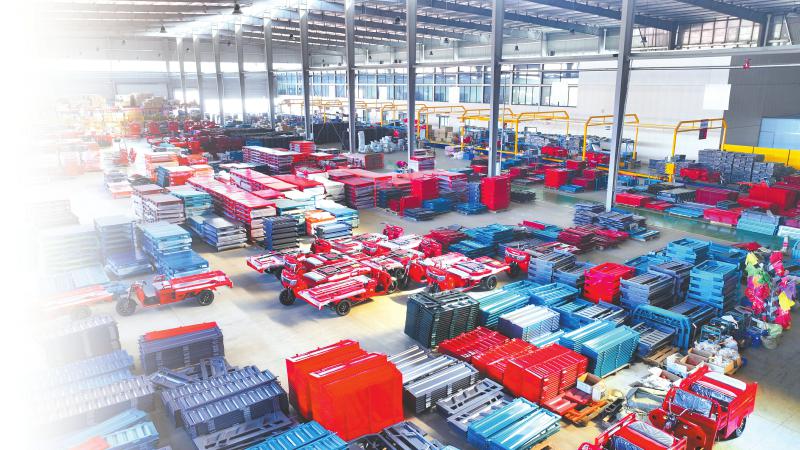
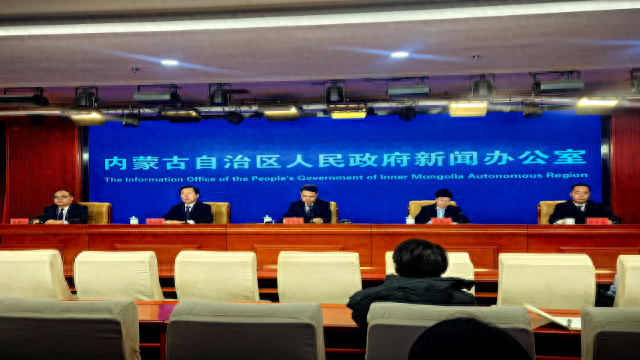
Core Viewpoint - The Inner Mongolia Autonomous Region is focusing on high-quality development by implementing equipment updates and technological transformations across ten key industries, aiming to enhance efficiency and vitality in traditional sectors [2] Group 1: Key Industry Focus - The ten key industries targeted for development include steel, non-ferrous metals, chemicals, building materials, electricity, machinery, automotive, food, pharmaceuticals, and cashmere processing [2] - The initiative aims to rejuvenate traditional industries through the adoption of digital technologies, green technologies, and advanced equipment [2] Group 2: Five Strategic Areas of Focus - **Promoting Technological Upgrades**: Support for enterprises to update equipment and accelerate the elimination of outdated machinery, promoting advanced and applicable equipment to facilitate industrial transformation and efficiency improvements [3] - **Accelerating AI Applications**: Implementation of the "AI + Manufacturing Special Action" to cultivate smart factories and explore new models of AI-enabled manufacturing, focusing on scaling and efficient application of new AI products and services [3] - **Implementing Green Low-Carbon Transformations**: Strict enforcement of energy and water consumption standards, with a focus on energy-saving and carbon-reduction modifications across various industries [4] - **Enhancing Safety Levels**: Promotion of mechanization, automation, and intelligent control in high-risk industries to improve safety through advanced equipment and technologies [5] - **Improving Quality Equipment Supply**: Accelerating the reconstruction of industrial foundations and breakthroughs in major technological equipment, promoting the application of intelligent manufacturing systems and high-end equipment [5] Group 3: Policy Support and Implementation - The Inner Mongolia Industrial and Information Technology Department will optimize and adjust policies for high-quality manufacturing development, creating five special support policies to stimulate enterprise motivation for equipment updates and technological transformations [5] - Increased efforts will be made in policy promotion, project management, and resource allocation to ensure effective implementation of equipment updates and technological transformations [5]
A股三大指数低开震荡,关注沪深300ETF易方达(510310)、A500ETF易方达(159361)等产品投资机会
Mei Ri Jing Ji Xin Wen· 2026-02-27 09:35
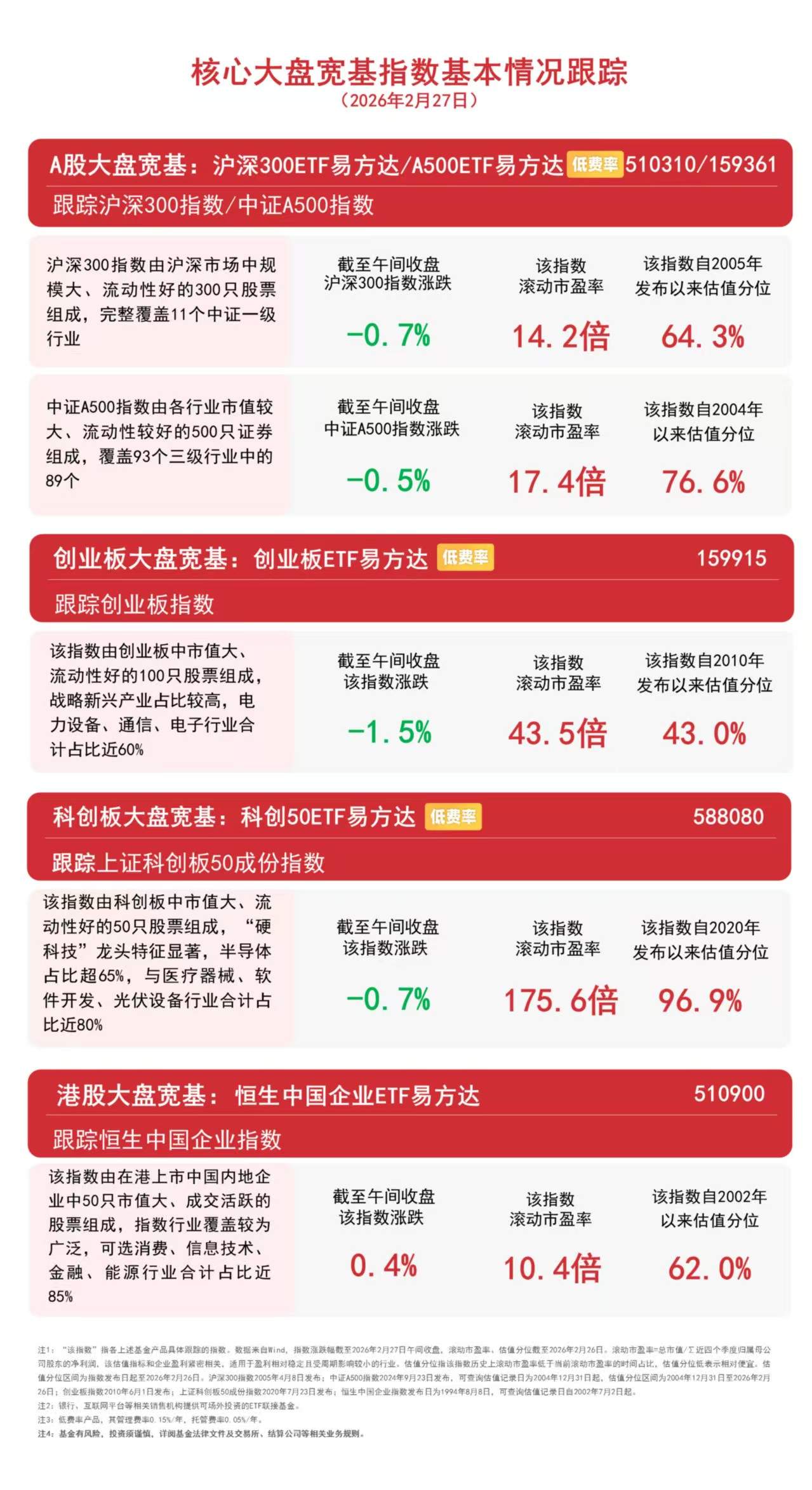
Core Viewpoint - The A-share market experienced a low opening and fluctuated throughout the morning session, with significant trading activity across various sectors, indicating mixed investor sentiment and sector performance [1]. Group 1: Market Performance - The three major A-share indices opened lower, with the Shanghai Composite Index briefly turning positive, while the total trading volume in the Shanghai, Shenzhen, and Beijing markets reached 1.6 trillion yuan [1]. - By midday, the CSI 500 Index fell by 0.5%, the CSI 300 Index decreased by 0.7%, the ChiNext Index dropped by 1.5%, and the STAR Market 50 Index declined by 0.7% [1]. - The Hang Seng China Enterprises Index increased by 0.4%, contrasting with the declines in the A-share indices [1]. Group 2: Sector Performance - Sectors such as rare earths, rare metals, cloud computing, software, and tourism showed notable gains, while construction materials, engineering machinery, wafer industry, copper-clad laminates, and CPO sectors faced declines [1]. - The CSI 300 Index consists of 300 stocks with good liquidity, covering 11 primary industries, and has a rolling P/E ratio of 14.2 times [3]. - The CSI 500 Index is made up of 500 securities with good liquidity, covering 89 out of 93 tertiary industries, and has a rolling P/E ratio of 17.4 times [3].