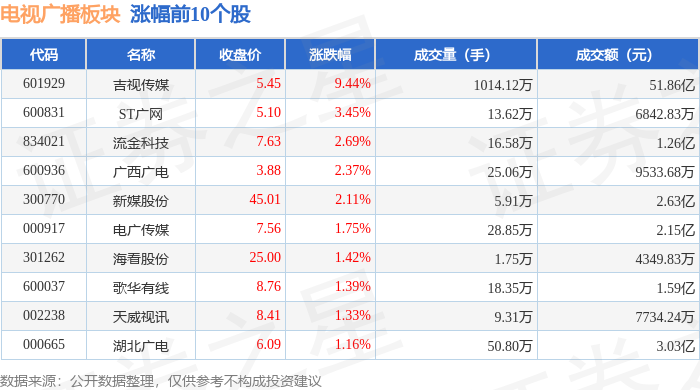
电视广播

Search documents
电视广播板块9月22日跌0.29%,吉视传媒领跌,主力资金净流出2.44亿元
Zheng Xing Xing Ye Ri Bao· 2025-09-22 08:53
Group 1 - The television broadcasting sector experienced a decline of 0.29% compared to the previous trading day, with Jishi Media leading the drop [1] - On the same day, the Shanghai Composite Index closed at 3828.58, up by 0.22%, while the Shenzhen Component Index closed at 13157.97, up by 0.67% [1] - A detailed table of individual stock performance within the television broadcasting sector was provided [1] Group 2 - In terms of capital flow, the television broadcasting sector saw a net outflow of 244 million yuan from main funds, while retail investors contributed a net inflow of 289 million yuan [2] - The net outflow from speculative funds amounted to 45.3182 million yuan [2] - A table detailing the capital flow for individual stocks in the television broadcasting sector was also included [2]


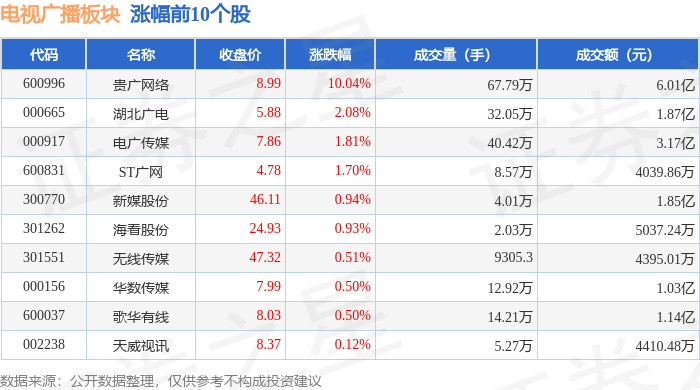
电视广播板块9月19日涨0.34%,贵广网络领涨,主力资金净流出5397.64万元
Zheng Xing Xing Ye Ri Bao· 2025-09-19 08:53
Market Overview - The television broadcasting sector increased by 0.34% compared to the previous trading day, with GuiGuang Network leading the gains [1] - The Shanghai Composite Index closed at 3820.09, down 0.3%, while the Shenzhen Component Index closed at 13070.86, down 0.04% [1] Stock Performance - GuiGuang Network (600996) closed at 66.8, up 10.04% with a trading volume of 677,900 shares and a transaction value of 601 million [1] - Hubei Broadcasting (000665) closed at 5.88, up 2.08% with a trading volume of 320,500 shares and a transaction value of 187 million [1] - Other notable performers include: - Electric Broadcasting Media (000917) at 7.86, up 1.81% [1] - ST Guangwang (600831) at 4.78, up 1.70% [1] - New Media Co. (300770) at 46.11, up 0.94% [1] Fund Flow Analysis - The television broadcasting sector experienced a net outflow of 53.9764 million from institutional investors and a net outflow of 110 million from speculative funds, while retail investors saw a net inflow of 164 million [2] - The fund flow for key stocks includes: - GuiGuang Network had a net inflow of 16.414 million from institutional investors, but a net outflow of 95.9546 million from speculative funds [3] - Hubei Broadcasting saw a net inflow of 20.1779 million from institutional investors, with a net outflow of 5.059 million from speculative funds [3] - Electric Broadcasting Media had a net inflow of 1.8656 million from institutional investors [3]





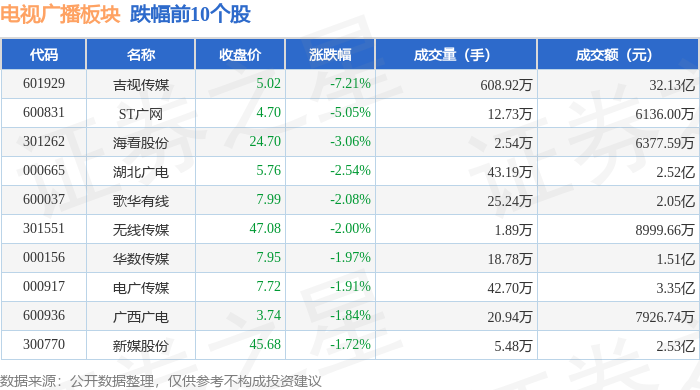
电视广播板块9月18日跌2.17%,吉视传媒领跌,主力资金净流出5.47亿元
Zheng Xing Xing Ye Ri Bao· 2025-09-18 08:59
Market Overview - The television broadcasting sector experienced a decline of 2.17% on September 18, with Jishi Media leading the drop [1] - The Shanghai Composite Index closed at 3831.66, down 1.15%, while the Shenzhen Component Index closed at 13075.66, down 1.06% [1] Individual Stock Performance - Jishi Media (601929) closed at 5.02, down 7.21% with a trading volume of 6.0892 million shares and a turnover of 3.213 billion yuan [1] - ST Guangwang (600831) closed at 4.70, down 5.05% with a trading volume of 127,300 shares and a turnover of 61.36 million yuan [1] - Hubei Broadcasting (000665) closed at 5.76, down 2.54% with a trading volume of 431,900 shares and a turnover of 252 million yuan [1] Capital Flow Analysis - The television broadcasting sector saw a net outflow of 547 million yuan from institutional investors, while retail investors had a net inflow of 555 million yuan [1] - The table of capital flow indicates that major stocks like Dongfang Mingzhu (600637) and Jiangsu Cable (600959) had mixed capital inflows and outflows [2] Detailed Capital Flow for Selected Stocks - Dongfang Mingzhu (600637) had a net inflow of 7.7881 million yuan from institutional investors, while retail investors saw a net outflow of 6.9660 million yuan [2] - Jiangsu Cable (600959) recorded a net inflow of 7.2917 million yuan from institutional investors, with a net outflow of 16.2195 million yuan from retail investors [2] - ST Guangwang (600831) experienced a significant net outflow of 12.0973 million yuan from institutional investors, while retail investors had a net inflow of 6.6598 million yuan [2]




亚洲电视控股收到联交所额外复牌指引
Zhi Tong Cai Jing· 2025-09-16 12:34
Group 1 - The company, Asia Television Holdings (00707), received additional resumption guidance from the Stock Exchange on September 12, 2025 [1] - The company is required to publish all outstanding financial results and address any audit modifications as part of the resumption process [1]
电视广播板块9月16日跌0.83%,吉视传媒领跌,主力资金净流出4.97亿元
Zheng Xing Xing Ye Ri Bao· 2025-09-16 08:52
证券之星消息,9月16日电视广播板块较上一交易日下跌0.83%,吉视传媒领跌。当日上证指数报收于 3861.87,上涨0.04%。深证成指报收于13063.97,上涨0.45%。电视广播板块个股涨跌见下表: 从资金流向上来看,当日电视广播板块主力资金净流出4.97亿元,游资资金净流出848.96万元,散户资金 净流入5.05亿元。电视广播板块个股资金流向见下表: | 代码 | 名称 | 主力净流入(元) | 主力净占比 游资净流入 (元) | | 游资净占比 散户净流入(元) | | 散户净占比 | | --- | --- | --- | --- | --- | --- | --- | --- | | 600936 广西广电 | | 393.73万 | 9.27% | -271.64万 | -6.40% | -122.09万 | -2.88% | | 000156 | 华数传媒 | 39.72万 | 0.45% | -549.44万 | -6.20% | 509.72万 | 5.75% | | 301262 海看股份 | | 3.32万 | 0.07% | -153.65万 | -3.38% | 150.34 ...
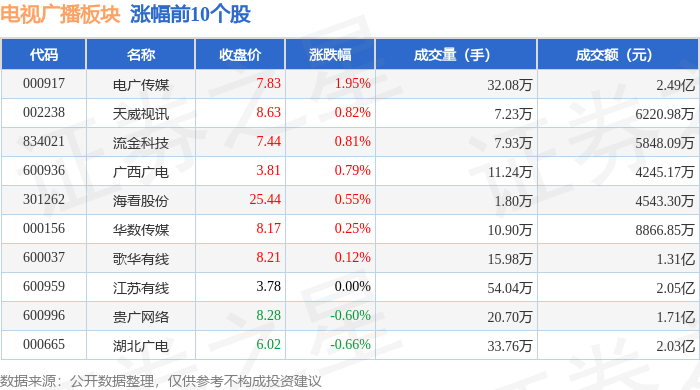
电视广播板块9月15日跌0.8%,歌华有线领跌,主力资金净流出5.34亿元
Zheng Xing Xing Ye Ri Bao· 2025-09-15 08:49
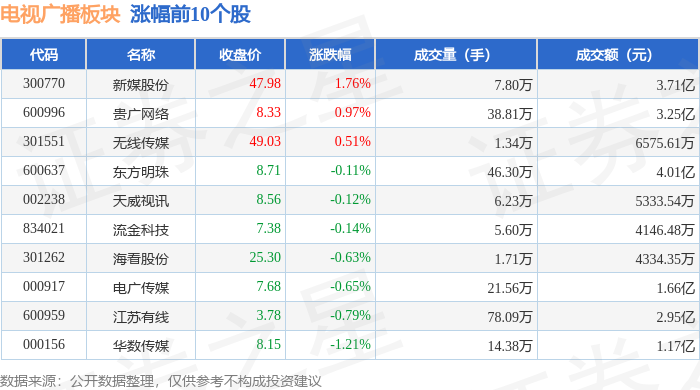
Market Overview - The television broadcasting sector experienced a decline of 0.8% compared to the previous trading day, with Gehua Cable leading the drop [1] - The Shanghai Composite Index closed at 3860.5, down 0.26%, while the Shenzhen Component Index closed at 13005.77, up 0.63% [1] Stock Performance - Notable stock performances include: - Xinhua Media (300770) closed at 47.98, up 1.76% with a trading volume of 78,000 shares and a turnover of 371 million yuan [1] - Guoguang Network (600996) closed at 8.33, down 0.97% with a trading volume of 388,100 shares [1] - Gehua Cable (600037) led the decline, closing at 8.20, down 3.64% with a trading volume of 265,300 shares and a turnover of 219 million yuan [2] Capital Flow - The television broadcasting sector saw a net outflow of 534 million yuan from major funds, while retail investors contributed a net inflow of 509 million yuan [2] - The capital flow for individual stocks indicates: - Guoguang Network had a net inflow of 12.14 million yuan from major funds, but a net outflow from retail investors [3] - Huashu Media (000156) experienced a significant net outflow of 6.32 million yuan from major funds, despite a net inflow from retail investors [3]

电视广播板块9月12日涨1.61%,吉视传媒领涨,主力资金净流出2425.89万元
Zheng Xing Xing Ye Ri Bao· 2025-09-12 08:37
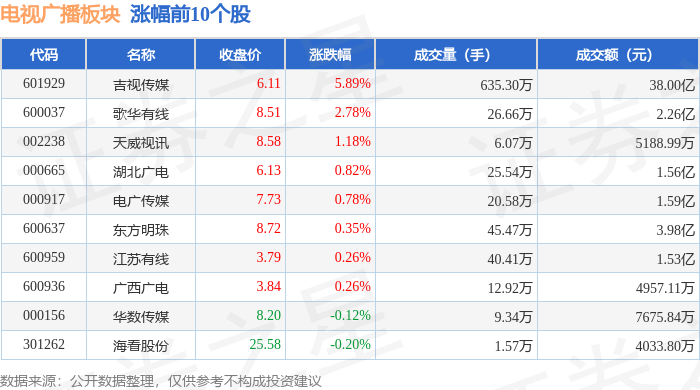
Market Overview - The television broadcasting sector increased by 1.61% compared to the previous trading day, with Jishi Media leading the gains [1] - The Shanghai Composite Index closed at 3883.69, up 0.22%, while the Shenzhen Component Index closed at 12996.38, up 0.13% [1] Individual Stock Performance - Jishi Media (601929) closed at 6.11, up 5.89%, with a trading volume of 6.35 million shares and a turnover of 3.8 billion yuan [1] - Gehua Cable (600037) closed at 8.51, up 2.78%, with a trading volume of 266,600 shares and a turnover of 226 million yuan [1] - Tianwei Video (002238) closed at 8.58, up 1.18%, with a trading volume of 60,700 shares and a turnover of 51.89 million yuan [1] - Hubei Broadcasting (000665) closed at 6.13, up 0.82%, with a trading volume of 255,400 shares and a turnover of 156 million yuan [1] - Other notable stocks include Dongfang Mingzhu (600637) and Jiangsu Cable (600959), which saw minor increases of 0.35% and 0.26% respectively [1] Capital Flow Analysis - The television broadcasting sector experienced a net outflow of 24.26 million yuan from institutional investors, while retail investors saw a net inflow of 21.2 million yuan [2] - The overall capital flow indicates a mixed sentiment, with institutional investors withdrawing funds while retail investors are actively buying [2] Detailed Capital Flow for Selected Stocks - Hubei Broadcasting (000665) had a net inflow of 25.62 million yuan from institutional investors, while retail investors had a net outflow of 11.75 million yuan [3] - Jishi Media (601929) saw a net inflow of 21.80 million yuan from retail investors, despite a significant outflow of 169 million yuan from institutional investors [3] - Guangxi Broadcasting (600936) had a net inflow of 8.35 million yuan from institutional investors, while retail investors experienced a net outflow of 8.37 million yuan [3]

电视广播板块9月11日涨0.35%,东方明珠领涨,主力资金净流出1.64亿元
Zheng Xing Xing Ye Ri Bao· 2025-09-11 08:50
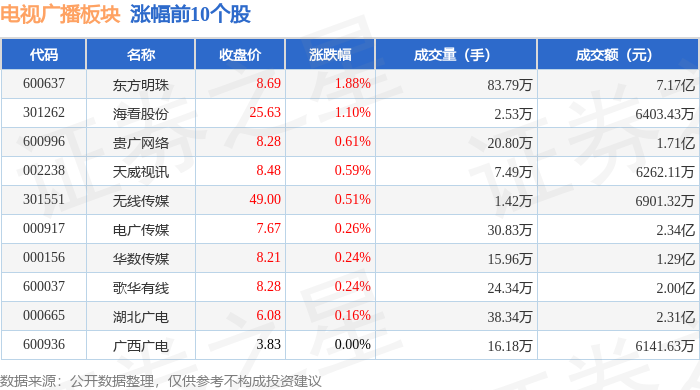
Market Overview - The television broadcasting sector increased by 0.35% compared to the previous trading day, with Oriental Pearl leading the gains [1] - The Shanghai Composite Index closed at 3875.31, up by 1.65%, while the Shenzhen Component Index closed at 12979.89, up by 3.36% [1] Individual Stock Performance - Oriental Pearl (600637) closed at 69.8, rising by 1.88% with a trading volume of 837,900 shares and a transaction value of 717 million yuan [1] - Other notable stocks include: - Haoliang Co. (301262) at 25.63, up by 1.10% [1] - Guiguang Network (600996) at 8.28, up by 0.61% [1] - Tianwei Video (002238) at 8.48, up by 0.59% [1] - Wireless Media (301551) at 49.00, up by 0.51% [1] Capital Flow Analysis - The television broadcasting sector experienced a net outflow of 164 million yuan from institutional investors and 122 million yuan from speculative funds, while retail investors saw a net inflow of 286 million yuan [2] - The capital flow for individual stocks shows: - Oriental Pearl had a net inflow of 43.39 million yuan from institutional investors, but a net outflow of 25.59 million yuan from speculative funds [3] - New Media Co. (300770) had a net inflow of 1.88 million yuan from institutional investors, with a significant outflow from speculative funds [3] - ST Guangwang (600831) faced a net outflow of 6.43 million yuan from institutional investors [3]
电视广播板块9月10日涨0.17%,新媒股份领涨,主力资金净流出1.99亿元
Zheng Xing Xing Ye Ri Bao· 2025-09-10 08:39
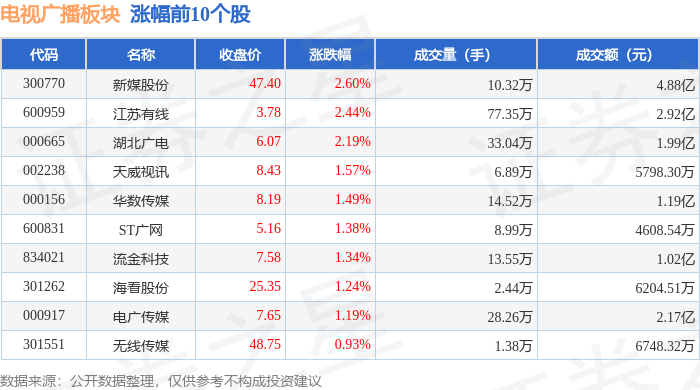
Market Overview - The television broadcasting sector increased by 0.17% compared to the previous trading day, with Xinmei Co., Ltd. leading the gains [1] - The Shanghai Composite Index closed at 3812.22, up 0.13%, while the Shenzhen Component Index closed at 12557.68, up 0.38% [1] Stock Performance - Xinmei Co., Ltd. (300770) closed at 47.40, up 2.60% with a trading volume of 103,200 shares and a transaction value of 488 million yuan [1] - Jiangsu Cable (600959) closed at 3.78, up 2.44% with a trading volume of 773,500 shares [1] - Hubei Broadcasting (000665) closed at 6.07, up 2.19% with a trading volume of 330,400 shares [1] - Other notable performers include Tianwei Video (002238) up 1.57% and Huashu Media (000156) up 1.49% [1] Capital Flow - The television broadcasting sector experienced a net outflow of 199 million yuan from institutional investors, while retail investors saw a net inflow of approximately 39.99 million yuan [2] - The overall capital flow indicates a mixed sentiment, with institutional investors pulling back while retail investors are more active [2] Individual Stock Capital Flow - Xinmei Co., Ltd. saw a net inflow of 21.53 million yuan from institutional investors, but a net outflow of 20.27 million yuan from retail investors [3] - Hubei Broadcasting had a net inflow of 15.92 million yuan from institutional investors, with retail investors also showing a net outflow [3] - Electric Broadcasting (000917) recorded a net inflow of 15.41 million yuan from institutional investors, while retail investors had a significant outflow [3]
电视广播板块9月5日涨2.11%,吉视传媒领涨,主力资金净流出5485.51万元
Zheng Xing Xing Ye Ri Bao· 2025-09-05 09:07
Market Performance - The television broadcasting sector increased by 2.11% compared to the previous trading day, with Jishi Media leading the gains [1] - The Shanghai Composite Index closed at 3812.51, up 1.24%, while the Shenzhen Component Index closed at 12590.56, up 3.89% [1] Individual Stock Performance - Jishi Media (601929) closed at 5.45, with a rise of 9.44% and a trading volume of 10.14 million shares, amounting to 5.186 billion yuan [1] - ST Guangwang (600831) rose by 3.45% to close at 5.10, with a trading volume of 136,200 shares and a turnover of 68.4283 million yuan [1] - Liujin Technology (834021) increased by 2.69% to 7.63, with a trading volume of 165,800 shares and a turnover of 126 million yuan [1] - Other notable stocks include Guangxi Broadcasting (600936) up 2.37% to 3.88, and Xinmei Co. (300770) up 2.11% to 45.01 [1] Fund Flow Analysis - The television broadcasting sector experienced a net outflow of 54.8551 million yuan from institutional funds, while retail investors saw a net outflow of 94.3458 million yuan [1] - Conversely, speculative funds recorded a net inflow of 149 million yuan [1] Detailed Fund Flow for Selected Stocks - Xinmei Co. (300770) had a net inflow of 27.6436 million yuan from institutional funds, but a net outflow of 18.7962 million yuan from retail investors [2] - Hubei Broadcasting (000665) saw a net inflow of 11.5122 million yuan from institutional funds, with retail investors experiencing a net outflow of 1.3832 million yuan [2] - ST Guangwang (600831) had a net inflow of 4.1724 million yuan from institutional funds, while retail investors faced a net outflow of 1.1527 million yuan [2]