
Medical Services

Search documents
中西医协同打造创新示范基地
Xin Lang Cai Jing· 2026-01-19 22:17
Core Viewpoint - The establishment of the Yunnan Provincial Digital Orthopedics Key Laboratory and the Chinese-Western Medicine Collaborative Innovation Demonstration Base marks a significant advancement in integrating modern digital orthopedic technologies with traditional Chinese medicine practices in the field of orthopedic disease prevention, diagnosis, treatment, and rehabilitation [1] Group 1 - The demonstration base is supported by the Yunnan Provincial First People's Hospital's research capabilities in digital orthopedics, 3D printing, and intelligent surgical navigation, alongside the Yunnan Provincial Traditional Chinese Medicine Hospital's expertise in traditional bone-setting techniques, meridian theory, herbal fumigation, and rehabilitation training [1] - The collaboration aims to create an integrated innovation platform that combines basic research, clinical validation, and technology transformation, with a focus on breakthroughs in complex spinal diseases, joint repair, and personalized precision medicine [1] - The unveiling of the base signifies a new phase in orthopedic diagnosis and research in Yunnan Province, characterized by resource integration, complementary advantages, and collaborative efforts [1] Group 2 - The base will focus on cultivating high-quality interdisciplinary talents in Chinese-Western medicine combined orthopedics and aims to produce influential original research outcomes [1] - The ultimate goal is to ensure that the research results benefit a wide range of patients [1]
免费开源 UI 神器,100 条行业规则 + AI 推理,秒出专业级设计系统~
菜鸟教程· 2026-01-19 03:30
Core Insights - The article discusses the evolution of UI/UX design with the introduction of AI tools, highlighting the shift from traditional design methods to AI-generated solutions that streamline the design process [2][4]. Group 1: AI Tools and Their Impact - AI tools like Cursor and Claude Code have significantly improved the efficiency of UI/UX design, allowing for rapid generation of high-quality designs [4][5]. - Despite the advanced capabilities of these AI tools, there is a growing concern about the uniformity of designs, leading to aesthetic fatigue among users [4][8]. Group 2: UI UX Pro Max Plugin - The article introduces the UI UX Pro Max plugin, which is designed to provide intelligent design support across multiple platforms and frameworks [5][12]. - This plugin has garnered over 16.7k stars, indicating a strong interest and positive reception from the developer community [6]. Group 3: Features and Functionalities - UI UX Pro Max includes a comprehensive design database with styles, color palettes, fonts, and UX guidelines tailored for various industries such as technology, finance, healthcare, and e-commerce [12][16]. - The plugin offers 57 UI styles, 95 professional color palettes, 56 font combinations, and 98 UX design guidelines, ensuring a wide range of design options [20]. Group 4: Design Generation Process - Users can generate a complete design system by simply stating their requirements, such as creating a landing page for a specific service, which the AI will then execute [8][28]. - The design generation process involves searching the internal database for suitable UI styles, colors, fonts, and UX standards, resulting in a tailored output [28]. Group 5: Installation and Usage - The plugin can be installed via Claude Marketplace or through CLI commands, making it accessible for developers [27][30]. - Different AI assistants can utilize the plugin, with specific commands for each platform, ensuring versatility in usage [41][42].


群众就近看病更便捷
Xin Lang Cai Jing· 2026-01-18 22:33
Core Insights - Guizhou province has been actively enhancing its healthcare system since the start of the 14th Five-Year Plan, focusing on improving the quality and accessibility of medical resources in county-level healthcare [1][2] Group 1: Healthcare Infrastructure Development - The province has established 81 tightly-knit county medical communities and upgraded 40 county-level healthcare institutions, including the construction of 40 pediatric intensive care units and 200 county medical sub-centers [1] - The in-county consultation rate has reached over 90%, with the proportion of inpatient admissions within the county at 82.2%, exceeding the national average by 2.71 percentage points [1] - 73 county hospitals have met the national tertiary hospital standards, accounting for 92.41%, ranking 4th in the country [1] Group 2: Specialized Medical Services - A total of 216 provincial clinical specialties have been added to county hospitals, addressing the treatment needs for common and frequently occurring diseases [2] - The establishment of 361 emergency and rescue "five major centers" has been completed across 78 county hospitals, with 37 national clinical key specialties approved [2] - The county-level emergency response capabilities have significantly improved due to these developments [2] Group 3: Talent Development and Support - Initiatives like the "Qian Medical Talent Program" and "Medical Aid Expert Team to Qian" are enhancing the training of professionals in critical areas such as pediatrics and intensive care [2] - By 2025, 19 additional provincial tertiary hospitals from outside the province will participate in support programs, achieving full coverage for 70 counties [2] - The support model has shifted from "point support" to "full coverage," effectively strengthening the county-level healthcare service capacity and improving patient satisfaction [2]
我省1200名基层中医医师分批赴京接受免费培训
Xin Lang Cai Jing· 2026-01-17 22:51
Group 1 - The core theme of the training program is "Empowering Grassroots Traditional Chinese Medicine (TCM) for Collaborative Development" [1] - The program aims to provide free training in acupuncture, tuina, and other suitable TCM techniques to 1,200 grassroots TCM practitioners from Hebei province [1] - The first training session included 60 participants from various county-level TCM hospitals and community health service centers [1] Group 2 - The training will consist of 21 sessions throughout the year, focusing on both theoretical instruction and practical exercises [1] - A specialized teaching team has been established to tailor the training courses to meet the specific needs of grassroots practitioners in Hebei [2] - The collaboration aims to create a three-tiered platform linking specialists, experts, and trainees, ensuring over 80% of participants have access to long-term consultation with experts from Beijing TCM Hospital [2]
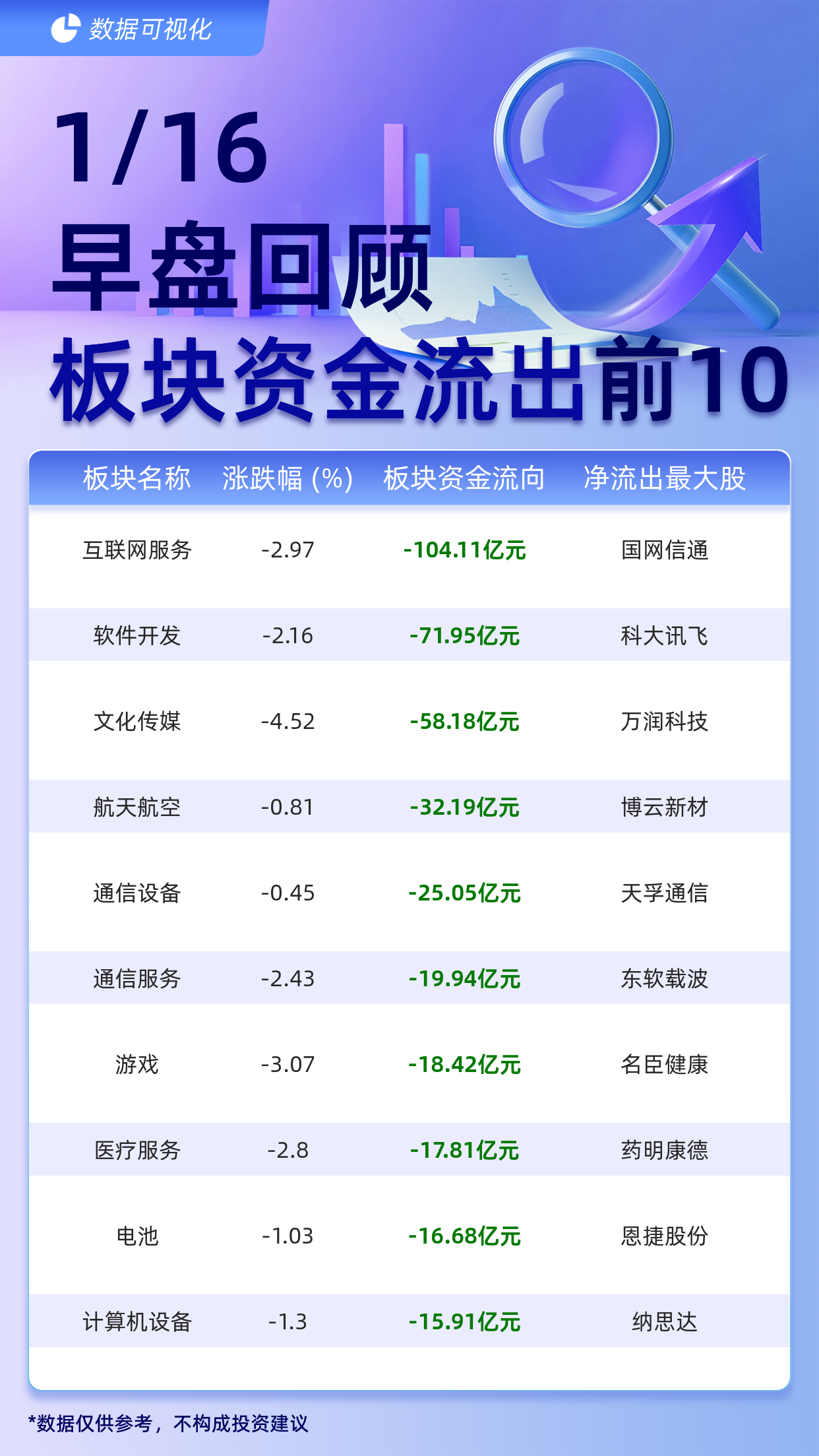
主力板块资金流出前10:互联网服务流出104.11亿元、软件开发流出71.95亿元
Jin Rong Jie· 2026-01-16 04:34
Core Viewpoint - The main market experienced a net outflow of 33.352 billion yuan in major funds as of January 16, with significant withdrawals from various sectors [1]. Sector Summary - **Internet Services**: Experienced a decline of 2.97% with a net outflow of 10.411 billion yuan, primarily affected by Guo Wang Xin Tong [2]. - **Software Development**: Saw a decrease of 2.16% and a net outflow of 7.195 billion yuan, with major impact from Ke Da Xun Fei [2]. - **Cultural Media**: Faced a drop of 4.52% and a net outflow of 5.818 billion yuan, influenced by Wan Run Ke Ji [2]. - **Aerospace and Aviation**: Recorded a slight decline of 0.81% with a net outflow of 3.219 billion yuan, affected by Bo Yun Xin Cai [2]. - **Communication Equipment**: Experienced a minor decrease of 0.45% and a net outflow of 2.505 billion yuan, primarily impacted by Tian Fu Tong Xin [2]. - **Communication Services**: Saw a decline of 2.43% with a net outflow of 1.994 billion yuan, influenced by Dong Ruan Zai Bo [2]. - **Gaming**: Experienced a drop of 3.07% with a net outflow of 1.842 billion yuan, primarily affected by Ming Chen Jian Kang [3]. - **Medical Services**: Faced a decline of 2.8% with a net outflow of 1.781 billion yuan, influenced by Yao Ming Kang De [3]. - **Batteries**: Recorded a decrease of 1.03% with a net outflow of 1.668 billion yuan, primarily impacted by En Jie Gu Fen [3]. - **Computer Equipment**: Experienced a decline of 1.3% with a net outflow of 1.591 billion yuan, influenced by Na Si Da [3].
总投资6.21亿元,西咸新区秦汉新城2个重点项目今日开工
Xin Lang Cai Jing· 2026-01-16 02:28
Core Insights - The construction of the National Emergency Medical Rescue Base (Shaanxi) and the Traditional Chinese and Western Medicine Collaborative "Flagship" Hospital has commenced, with a total investment of approximately 6.21 billion yuan [1] Group 1: National Emergency Medical Rescue Base (Shaanxi) Project - The project has a total investment of about 4.28 billion yuan and covers an area of approximately 34.66 acres, including the construction of an emergency medical rescue building, a helipad, and an outdoor training facility [2] - The emergency medical rescue building will house a rescue dispatch center, medical skills simulation training center, indoor training facility, and an emergency command center among other facilities [2] - The helipad, located on the roof of the emergency medical rescue building, will accommodate rescue helicopters up to 17 meters in length and will be integrated into the national emergency dispatch system [2] - The project aims to significantly enhance the region's emergency response and medical rescue capabilities, thereby improving the distribution of quality medical resources and ensuring public health and safety [2] Group 2: Traditional Chinese and Western Medicine Collaborative "Flagship" Hospital Project - This project has a total investment of approximately 1.93 billion yuan and spans about 14.80 acres, focusing on the construction of a new integrated hospital building and the renovation of existing facilities [3] - The new hospital will include a traditional Chinese medicine experience inheritance studio, a preventive medicine center, and a clinical research center, with a total of 88 beds across four wards [3] - The renovation will enhance existing facilities, adding 94 beds and improving services related to traditional Chinese and integrated medicine [3] - This initiative is a key step in exploring innovative collaborative development paths for traditional Chinese and Western medicine, aiming to provide high-quality and efficient medical services [3] - The health sector is a leading industry in the Qinhan New City, with various resources and projects rapidly gathering in the area, including the operation of the Qinhan Health Technology Industrial Park [3]
海南健康岛建设晒“成绩单” 全省优质医疗资源布局更均衡
Hai Nan Ri Bao· 2026-01-16 01:41
Core Insights - Hainan's health development is achieving significant progress, with a focus on high-quality healthcare and balanced resource distribution across the province [2][3] Group 1: Healthcare Resource Distribution - The deployment of quality medical resources is becoming more balanced across Hainan, with major projects like Shanghai Ruijin Hospital Hainan Hospital Phase II and Provincial People's Hospital South Campus enhancing county-level hospital capabilities [3] - By 2025, all county-level hospitals are expected to meet service standards, supported by 50 provincial clinical medical centers [3] - The "grassroots examination, upper-level diagnosis" model covers 87.8% of township health centers, exceeding national requirements [3] Group 2: Emergency Response and Digital Health - Hainan has established a unified life rescue network, achieving a 98.26% average emergency response rate within 3 minutes and an average arrival time of 16.39 minutes, surpassing national averages [3] - The "Health Hainan" app allows residents to access their electronic health records quickly, promoting digital health services and reducing the need for in-person visits [3] Group 3: Pharmaceutical Cost Reduction - The average price of drugs and medical supplies has decreased by over 50%, with the introduction of a "machine audit" system improving prescription compliance to 98.60% [4] - The number of drug categories for centralized procurement has expanded to over 1,400, contributing to lower healthcare costs [4] Group 4: Childcare Support - Hainan has added 3,608 new affordable childcare spots, with a total of 43,376 childcare vouchers issued, alleviating the financial burden on families [6] - The implementation of the "2025 Embedded Childcare Service Institution Construction Implementation Plan" supports community and workplace childcare initiatives [6]
告别重复检查,山东1468家医疗机构实现检查结果共享
Qi Lu Wan Bao· 2026-01-15 08:08
Core Insights - Shandong Province's health system has made significant advancements in service delivery, focusing on mutual recognition of medical services and data sharing, with over 15 million mutual recognitions achieved [1][3] Group 1: Data Sharing and Technology Integration - A unified platform called "Lu Medical Mutual Recognition" has been established, connecting 1,468 medical institutions and covering all secondary and above public hospitals, enabling real-time monitoring and data sharing [3] - The "Lu Cloud Imaging" system has been enhanced, with daily uploads of 200,000 test reports and over 4TB of medical imaging data processed, improving efficiency in data transmission [3] - Patients can access their test reports and imaging results via hospital WeChat accounts, allowing for convenient mobile access to their medical information [3] Group 2: Accessibility and Community Engagement - The mutual recognition service has been expanded to include township health centers, community health service centers, and private medical institutions, making it easier for residents to access services locally [4] - Collaborative efforts within medical alliances have been strengthened, resulting in a 10.9% increase in two-way referral services across all counties [4] - Cross-province mutual recognition initiatives are being implemented, with Shandong and Henan provinces set to achieve online mutual recognition of test results by December 2025 [4] Group 3: Quality Assurance and Standards - A comprehensive quality control system has been established, incorporating provincial, municipal, and county-level evaluations to reduce quality disparities between urban and rural areas [4] - The mutual recognition standards have been standardized and updated dynamically, with 429 mutual recognition projects now covering common diseases and treatment needs [4] - Medical institutions are guided to optimize their testing projects based on clinical necessity, ensuring support for mutual recognition efforts [4] Future Directions - Shandong plans to further expand coverage of grassroots medical institutions, deepen cross-province cooperation, and enhance platform functionalities to improve the quality of mutual recognition services [5]
A股午盘丨创业板指跌1.02%,AI应用概念股下挫
Xin Lang Cai Jing· 2026-01-15 03:58
Market Performance - The Shanghai Composite Index fell by 0.6% [1] - The Shenzhen Component Index decreased by 0.44% [1] - The ChiNext Index dropped by 1.02% [1] - The STAR Market Index declined by 2.02% [1] Sector Performance - AI applications, commercial aerospace, stablecoins, CRO, medical services, and intelligent driving concept stocks all experienced declines [1] - Retail and brokerage sectors had the largest drops [1] - Energy metals and chemical sectors showed resilience and performed well against the market trend [1]

A股午评:沪指跌0.6%险守4100点,超3600股下跌!AI应用板块大幅回调
Ge Long Hui· 2026-01-15 03:35
Market Overview - The three major A-share indices collectively declined, with the Shanghai Composite Index falling by 0.6% to 4101.52 points [1] - The Shenzhen Component Index decreased by 0.44%, while the ChiNext Index dropped by 1.02% [1] - The North Stock 50 index experienced a significant decline of 2.31% [1] Trading Activity - The total market turnover was 189.52 billion yuan, which represents a decrease of 35.06 billion yuan compared to the previous day [1] - Over 3600 stocks experienced a decline during the trading session [1] Sector Performance - The gold, lithium mining, and other non-ferrous metal sectors saw a counter-trend increase [1] - Hotel and tourism stocks experienced a general rise [1] - Conversely, sectors such as AI applications, military electronics, commercial aerospace, and medical services collectively underwent a correction [1]