
Mortgage

Search documents
Trump’s mortgage bond plan shows limited impact as market risks cloud housing outlook
The Economic Times· 2026-01-23 05:33
Core Viewpoint - The administration's plan to purchase up to $200 billion in mortgage-backed securities is unlikely to significantly reduce mortgage rates or improve housing affordability, as the primary issue in the U.S. housing market is insufficient supply rather than demand or financing [1][10]. Mortgage Rates and Market Impact - Analysts believe the bond purchase program will have only a modest effect on borrowing costs, with mortgage bond yields narrowing slightly compared to U.S. Treasury yields, but the overall impact remains limited [2][11]. - Benchmark 30-year mortgage rates fell to 6.15% by the end of 2025, down from just under 8% in late 2023, with rates briefly dipping to their lowest since 2022 following the announcement of bond purchases [3][11]. - Recent data from the Mortgage Bankers Association indicates that mortgage rates have declined further, reaching their lowest level since September 2024, which has increased refinancing activity [4][11]. Federal Reserve and Bond Purchases - The Trump administration has confirmed that mortgage bond purchases are in progress, but operational details remain sparse, with the Federal Housing Finance Agency not disclosing the pace or total volume of purchases [6][11]. - Treasury Secretary Scott Bessent stated that the initiative aims to counteract the Federal Reserve's reduction of its mortgage-backed securities holdings, which have decreased from approximately $2.7 trillion in mid-2022 to about $2 trillion [7][11]. Economic Perspectives - Economists and central banking experts question the rationale behind offsetting the Fed's runoff, suggesting that the primary market impact of balance-sheet policies occurs at the announcement stage rather than during gradual reductions [8][11]. - Several Federal Reserve officials have expressed skepticism regarding the effectiveness of bond purchases in resolving housing affordability issues, emphasizing structural supply constraints as the main factor keeping prices elevated [8][11]. External Factors - Rising yields on longer-dated government bonds, particularly the 10-year U.S. Treasury yield, have climbed to their highest level in months, posing new challenges for falling mortgage rates amid a global bond selloff [8][11]. - Geopolitical tensions related to trade threats and confrontations with allies have negatively impacted demand for U.S. assets, including Treasuries, which could lead to higher borrowing costs and undermine any limited benefits from mortgage bond purchases [9][11].


Mortgage rates tick higher but remain near 3-year low
Fox Business· 2026-01-22 21:32
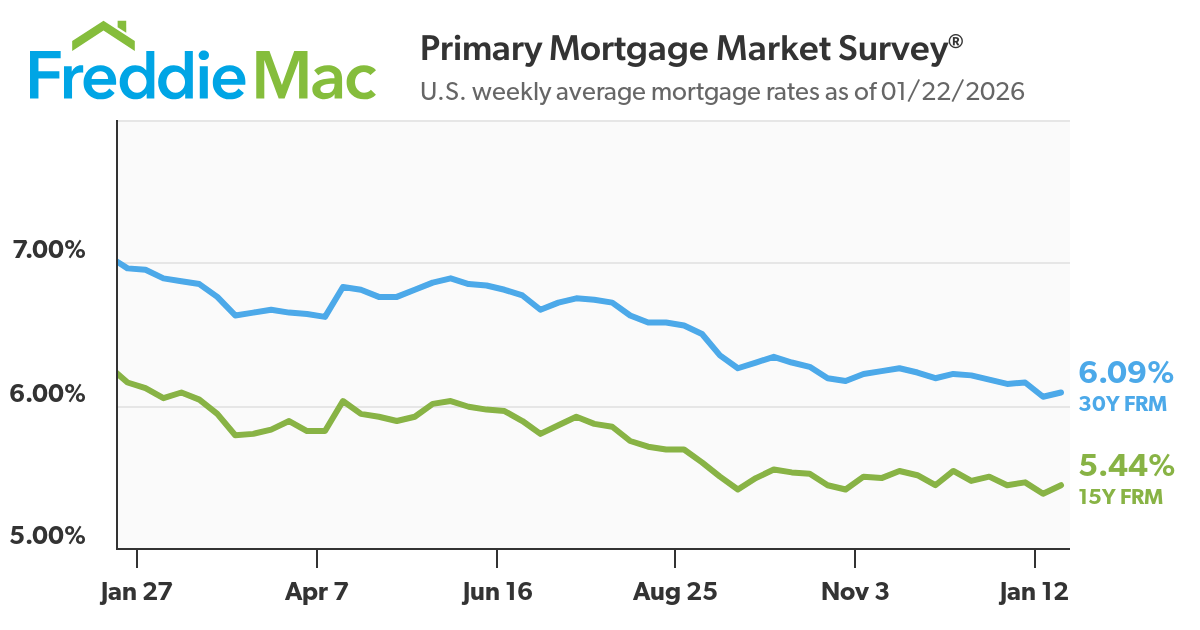
Mortgage Rates - The average rate on the benchmark 30-year fixed mortgage increased to 6.09% from 6.06% last week, remaining the lowest in three years [1] - A year ago, the average rate on a 30-year loan was 6.96% [1] - The average rate on a 15-year fixed mortgage rose to 5.44% from 5.38% last week [5] Market Dynamics - The improving economy and lower mortgage rates compared to last year are attracting more homebuyers [4] - The 10-year Treasury yield was around 4.25% as of Thursday afternoon, influencing mortgage rates [4] - Recent policy decisions, including the announcement of Fannie Mae and Freddie Mac buying $200 billion in mortgage-backed securities, have contributed to rate volatility [8] Buyer Behavior - Homebuyers are encouraged to shop around for the best mortgage rates, as multiple quotes can lead to significant savings [4] - Uncertainty around the implementation of new policies may limit their immediate impact on the housing market [9]

Mortgage Rates Remain the Lowest in Three Years
Globenewswire· 2026-01-22 17:06
Primary Mortgage Market Survey® U.S. weekly average mortgage rates as of 01/22/2026 MCLEAN, Va., Jan. 22, 2026 (GLOBE NEWSWIRE) -- Freddie Mac (OTCQB: FMCC) today released the results of its Primary Mortgage Market Survey® (PMMS®), showing the 30-year fixed-rate mortgage (FRM) averaged 6.09%. “With the economy improving and the average 30-year fixed-rate mortgage nearly a percentage point lower than last year, more homebuyers are entering the market,” said Sam Khater, Freddie Mac’s Chief Economist. “Buy ...
Average US long-term mortgage rate edges higher, but still near lowest point in more than 3 years
Yahoo Finance· 2026-01-22 17:04
Mortgage Rates Overview - The average long-term U.S. mortgage rate increased to 6.09% from 6.06% last week, remaining near its lowest level in over three years, compared to 6.96% a year ago [1] - The average rate for 15-year fixed-rate mortgages rose to 5.44% from 5.38% last week, down from 6.16% a year ago [2] Influencing Factors - Mortgage rates are affected by the Federal Reserve's interest rate policies, bond market expectations regarding the economy and inflation, and generally follow the 10-year Treasury yield [3] - The recent increase in mortgage rates coincides with a rise in the 10-year Treasury yield, which increased to 4.27% from 4.17% due to geopolitical tensions and market turbulence [4] Housing Market Conditions - The U.S. housing market has been experiencing a sales slump since 2022, attributed to rising mortgage rates, high home prices, and a shortage of homes due to low construction rates [5] - Economic uncertainty and job market concerns are causing potential buyers to hesitate, although a recent decline in mortgage rates has led to a temporary boost in existing home sales, which rose by 5.1% in December [6] Refinancing Trends - Applications for mortgage refinancing loans surged by 20% last week, making up nearly 62% of all home loan applications, while applications for home purchase loans increased by 5% [7] - Economists predict that mortgage rates may decrease further this year, but the average rate for a 30-year mortgage is expected to remain above 6%, approximately double the rate from six years ago [7] Homeowner Dynamics - A significant portion of U.S. homes with outstanding mortgages have fixed rates of 5% or lower, with over half having rates at or below 4%, making it challenging for these homeowners to refinance at higher rates [8]
Property Data, Construction Products; Webinars and Training; STRATMOR on Operational Readiness
Mortgage News Daily· 2026-01-22 16:49
Group 1: Industry Trends and Developments - Optimal Blue is hosting a webinar on January 27 to discuss the benefits of mandatory delivery in hedging strategies, emphasizing the importance of data-driven decisions in secondary marketing execution [1] - Planet has enhanced its correspondent sales team by hiring Scott Henley, who brings over 30 years of experience in the mortgage industry, to support correspondent partners in several states [2] - APB Wholesale's One-Time Close Construction loans are innovating construction financing by combining construction and permanent financing into a single loan, streamlining the process for borrowers [3] - Citi Correspondent Lending is focusing on growth for 2026, introducing enhancements to its Non-Agency Jumbo program, including increased loan amounts and cash-out limits [3] - ICE is providing comprehensive property data covering 99.99% of U.S. properties, which is crucial for lenders to make informed decisions in a competitive mortgage market [3] Group 2: Operational Readiness and Customer Experience - STRATMOR emphasizes the need for lenders to be operationally ready for a potential increase in loan volume, highlighting the importance of consistent processes and real-time feedback for strong borrower experiences [5][6] - Lenders are encouraged to integrate customer experience into their operating models to enhance scalability and protect business during demand fluctuations [6] Group 3: Market Insights and Economic Indicators - The mortgage market is seeing sub-6 percent rates, with mandatory loan sale delivery potentially offering a 10-50 basis point advantage over best efforts when managed effectively [11] - Recent economic data shows construction spending declined by 0.6% in September but rebounded by 0.5% in October, indicating a flat overall activity since August, with private residential improvements contributing to the October gain [14] - Ginnie Mae II 30-year aggregate speeds increased by 3% to a 12.4 one-month CPR, with varying prepayment speeds across different loan types, highlighting the importance of servicer behavior in prepayment risk [15]

Jim Cramer Warns Housing Market's Comeback Could Collapse If Mortgage Rates 'Go Sky High' Again
Yahoo Finance· 2026-01-21 12:01
Core Viewpoint - A sharp rise in mortgage rates could reverse the U.S. housing market's recovery, which has recently begun to show signs of improvement due to lower borrowing costs [1][2]. Group 1: Mortgage Rate Trends - The average 30-year fixed-rate mortgage fell to 6.06% for the week ending January 15, 2026, marking the lowest level since late 2022 [2]. - The 15-year fixed rate dropped to 5.38%, leading to a noticeable increase in purchase applications and refinance volume [3]. Group 2: Policy Interventions - President Donald Trump's directive for Fannie Mae and Freddie Mac to purchase $200 billion in mortgage-backed securities (MBS) contributed to the decline in mortgage rates [3]. - This intervention increased demand for MBS and narrowed the spread to Treasuries, briefly pushing some daily quoted rates to 5.99% [4]. Group 3: Economic Concerns and Criticism - The policy has drawn criticism from economists who warn that diverting funds from Treasury purchases could lead to higher long-term yields and rekindle inflation [5]. - Critics like Peter Schiff and Mohamed El-Erian have labeled the strategy as a misallocation of credit and highlighted the risks of political interference in markets [6]. Group 4: Market Outlook - Industry observers believe the housing market is poised for a solid spring sales season if mortgage rates remain favorable [4]. - Cramer's concerns emphasize the fragility of the current market thaw, suggesting that any rebound in rates could re-lock homeowners and stall market momentum [6].
Mortgage and refinance interest rates today, January 21, 2026: Rates jump as Trump pushes Greenland agenda
Yahoo Finance· 2026-01-21 11:00
Core Insights - Mortgage rates have increased significantly due to President Trump's actions regarding Greenland, leading to the highest yield on 10-year Treasurys in five months [1] - The average 30-year fixed mortgage rate is currently at 6.05%, while the 15-year fixed rate is at 5.50% [1][16] Mortgage Rates Overview - Current national average mortgage rates include: - 30-year fixed: 6.05% - 20-year fixed: 6.12% - 15-year fixed: 5.50% - 5/1 ARM: 6.34% - 7/1 ARM: 6.42% - 30-year VA: 5.54% - 15-year VA: 5.24% - 5/1 VA: 5.18% [5] Refinance Rates - Today's mortgage refinance rates are generally higher than purchase rates, although this is not always the case [3] Market Trends - Recent fluctuations in mortgage rates were influenced by political events, with rates dropping when proposals for home affordability were announced and rising again due to international tensions [17] - Despite recent increases, 30-year mortgage rates remain approximately half a point lower than they were a year ago [17]
Homebuyers now have a Greenland problem: Mortgage rates jump on geopolitical, tariff turmoil
Yahoo Finance· 2026-01-20 18:17
Core Insights - Recent trade tensions, particularly between President Trump and European leaders over Greenland, are causing mortgage rates to rise, reversing a previous decline [1][3][4] - The average rate for a 30-year mortgage increased by 14 basis points to 6.21%, following geopolitical developments [1][4] - The stock and bond markets experienced a sell-off due to rising geopolitical tensions, with the S&P 500 dropping 1.5% and the 10-year Treasury yield rising to 4.275% [4] Mortgage Market Impact - The recent increase in mortgage rates is attributed to multiple factors, including bond yields and market volatility, which have affected the demand for mortgage-backed securities [4][5] - The rise in rates threatens to stall the housing market's recovery, which many economists anticipated would begin in 2026 if rates continued to decline [6][7] - Despite the current volatility, mortgage rates are still nearly a percentage point lower than a year ago, resulting in significant savings for borrowers [7][8]
401(k) for a home? Trump administration’s new proposal could change how Americans buy
The Economic Times· 2026-01-17 20:35
Core Viewpoint - President Trump is planning a new rule allowing Americans to use funds from their 401(k) retirement accounts for home down payments, aimed at addressing housing affordability issues in a challenging market [1][2][18]. Group 1: 401(k) Withdrawal Plan - The proposed plan would permit individuals to withdraw money from their 401(k) accounts for home down payments, which is currently restricted and incurs penalties for most [2][18]. - Under existing regulations, early withdrawals from a 401(k) before age 59½ incur a 10% tax penalty in addition to regular income taxes [2][18]. - Hassett provided an example where a buyer could use 10% of their 401(k) for a down payment and then count 10% of the home's equity as an asset within the 401(k), allowing for potential growth of the retirement account [3][4][18]. Group 2: Housing Affordability Initiatives - The administration is exploring various strategies to enhance housing affordability, with the 401(k) proposal being one of several recent initiatives [9][18]. - Trump has expressed intentions to ban large investors from purchasing single-family homes, arguing that such practices disadvantage regular buyers [9][10][18]. - A significant mortgage bond-buying plan worth $200 billion has been ordered, aimed at lowering mortgage rates and making homeownership more affordable [12][18]. Group 3: Market Reactions and Future Plans - Following the bond-buying announcement, mortgage rates briefly fell below 6%, marking a significant decrease not seen in years, which led to a 40% increase in mortgage refinance demand the following week [12][18]. - The White House has not yet clarified whether there will be a cap on withdrawals from 401(k) accounts or when the new plan will take effect [7][18]. - The final details of the 401(k) home down payment proposal are still under discussion and will be closely monitored by potential homebuyers and savers [14][18].
Better Home & Finance (NasdaqGM:BETR) FY Conference Transcript
2026-01-16 18:47
Summary of Better Home & Finance FY Conference Company Overview - **Company**: Better Home & Finance (NasdaqGM: BETR) - **Industry**: Home finance and mortgage industry - **Founded**: Approximately 10 years ago by CEO Vishal Garg - **Business Model**: Utilizes a machine learning-driven AI matching engine to connect consumer credit, income, asset, and property data with investor preferences for mortgage and home equity loans Key Financial Metrics - **Growth in Loan Volume**: Increased by approximately 20% in the past year [4] - **Revenue Growth**: Grew by about 50% [4] - **Home Equity Business Growth**: Expanded over 10X, becoming the fastest-growing home equity platform in America [4] - **Revenue per Loan**: Increased from $7,400 to $8,500 [4] - **Contribution Margin**: Improved from $500 to $1,700 per loan [4] - **Labor Cost per Fund**: Reduced from $2,900 to $2,500, significantly lower than the industry average of over $9,000 [5] Product and Technology Developments - **AI Integration**: The company has integrated GenAI into its existing machine learning engine, enhancing efficiency and unit economics [3] - **Tinman Platform**: Represents a comprehensive end-to-end solution for the mortgage industry, consolidating multiple systems into one workflow [9][10] - **AI Loan Processing**: 70% of loans can be processed as one-day mortgages, with 44% going from lock to commitment letter in under a minute [10] - **Future Projections**: Anticipates that over 90% of loans will be processed entirely via AI in the coming years, potentially reducing labor costs to below $1,000 per loan [11] Market Position and Competitive Landscape - **Market Size**: U.S. homes represent a total asset value of approximately $34 trillion, with a mortgage market of about $15 trillion [6] - **Market Share**: At peak in 2021, Better held nearly 2% market share in the overall mortgage market [6] - **Competitors**: Direct competitors include Rocket Mortgage and loanDepot, with a shift towards a platform-based model rather than direct-to-consumer [26] - **Unique Selling Proposition**: Better's platform offers a unique per-funded loan pricing model, which is attractive to mortgage brokers and lenders [29] Strategic Partnerships and Growth Initiatives - **Partnerships**: Collaborations with major financial institutions and mortgage originators to implement the Tinman platform [15][17] - **Market Trends**: The company is positioned to benefit from a potential increase in refinancing as interest rates stabilize [27] - **Consumer Demand**: Over 2 million pre-approved consumers are waiting to purchase homes, indicating significant future demand [33] Challenges and Concerns - **Affordability Issues**: Concerns about housing affordability and the availability of homes to meet demand [33] - **Scaling Operations**: The need to scale operations effectively to handle increased demand when market conditions improve [34] - **Regulatory Changes**: Potential changes in capital gains tax thresholds could incentivize homeowners to sell, impacting market dynamics [34] Conclusion - Better Home & Finance is positioned for significant growth in the home finance sector, leveraging advanced AI technology and strategic partnerships to enhance its competitive edge. The company anticipates a favorable macroeconomic environment that could stimulate demand for its services in the coming years.