Venture Capital

Search documents
Discord and Mercor investor Niko Bonatsos departs General Catalyst, plans new VC firm
Yahoo Finance· 2026-01-07 23:31
After leading General Catalyst’s seed strategy for years, Niko Bonatsos has departed the firm. Known for backing an IPO-hopeful Discord and the $10 billion startup Mercor, Bonatsos told TechCrunch he intends to launch a new early-stage VC firm alongside “friends.” Bonatsos is the latest investor to leave General Catalyst, a firm that recently expanded beyond the traditional venture model. Over the last few years, General Catalyst unveiled a wealth management business, a strategy focused on PE-style AI ro ...
Lux Capital lands $1.5B for its largest fund ever
Yahoo Finance· 2026-01-07 20:09
Core Insights - Lux Capital has closed a $1.5 billion ninth fund, marking the largest fund in the firm's history [1] - Despite a decline in new VC funds raised in the U.S. to a 10-year low in 2025, limited partners continue to invest in Lux Capital [1] Investment Focus - The firm has a history of investing in defense technologies, which have become highly sought after due to recent geopolitical shifts [2] - Lux was an early investor in Anduril, valued at $30.5 billion, and Applied Intuition, valued at $15 billion, both of which have secured significant contracts with the Pentagon [2] AI Investments - Lux has made early investments in AI startups prior to the industry's rapid growth following the launch of ChatGPT [3] - Notable early-stage AI investments include Hugging Face, Runway AI, and MosaicML, the latter of which was acquired by Databricks for $1.3 billion in 2023 [3] Exits and Performance - The firm has achieved significant exits from investments, including Recursion Pharmaceuticals, which went public in 2021, and Auris Health, sold to Johnson & Johnson for up to $6 billion in 2019 [4] - The latest fundraising effort has increased Lux's total assets under management to $7 billion [4]
Crystal Ball: Where venture capital and private equity are headed in 2026
Fortune· 2026-01-07 12:38
Core Insights - The private markets are experiencing a shift towards larger firms, with a focus on differentiation and scale for survival [2] - Private equity is expected to see a 20% increase in transaction volume in 2026 compared to 2025, driven by favorable market conditions [3] - Venture capital is consolidating around mega-funds and niche specialists, leaving generalist firms at risk [4] Private Equity - In 2026, private equity firms will prioritize capital return over capital growth, leading to increased M&A and IPO activity [3] - The decline in interest rates is expected to enhance liquidity and market activity, with a more stable environment for long-term value creation [3] - Sectors with defensive demand and operational upside will attract more capital, with returns driven by execution rather than multiple expansion [3] Venture Capital - Major venture firms are expected to launch mutual funds to gather more assets, capitalizing on regulatory changes [4] - The "generalist middle" is collapsing, with capital consolidating around larger funds and niche specialists [4] - LPs will have increased negotiating power due to a smaller number of active allocators, impacting fundraising for emerging managers [5] Startups - Many AI startups are facing challenges due to market saturation and price wars, with few expected to succeed [6] - Founders are advised to focus on operational discipline and fundamentals as the market resets [6] - A significant increase in startup formation and product releases is anticipated, driven by easier access to technology [6] Recent Deals - xAI raised $20 billion in Series E funding, indicating strong investor interest in AI [8] - Hg is acquiring OneStream for approximately $6.4 billion, highlighting ongoing consolidation in the private equity space [10] - PicPay filed for an IPO on Nasdaq, reporting $1.7 billion in revenue for the year ending September 30 [16] Funds - BV Investment Partners raised $2.5 billion for its seventh fund, focusing on business services and IT sectors [17]


一级市场「国进民退」?国家队直投渗透率已经到45%了
Sou Hu Cai Jing· 2026-01-07 08:37
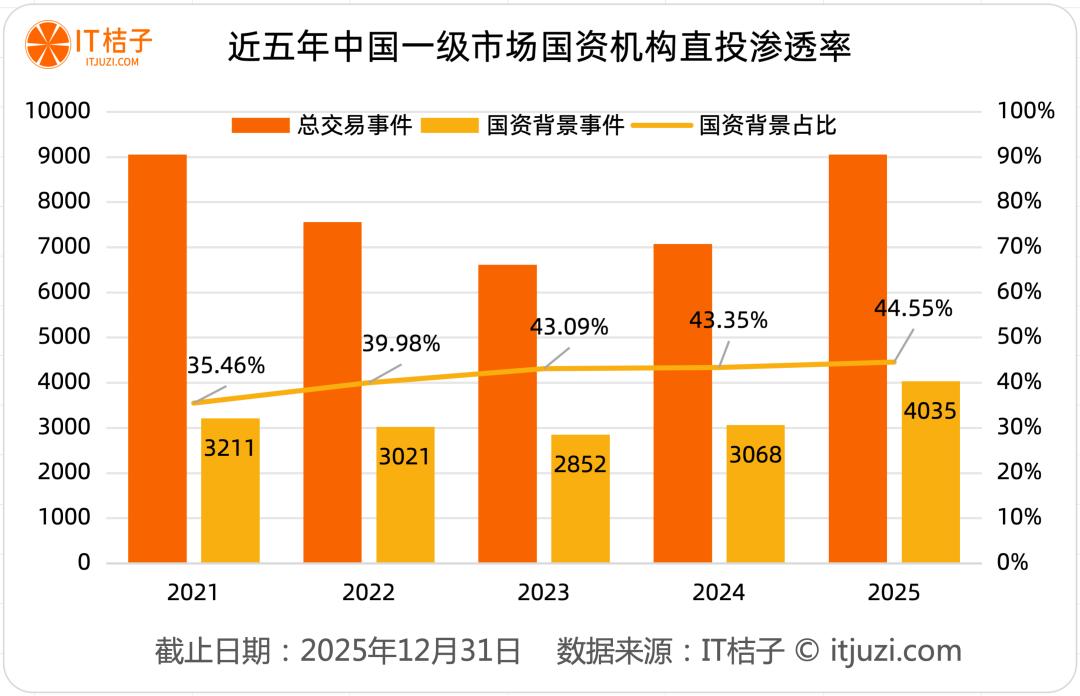
作者 | IT桔子团队 排版 | 王梓璇 来源|IT 桔子 图片 | AI生成 "请回答中国创投 2025: 国资崛起,国家队在创投市场直接投资的活跃度有多高?" 过去五年,中国一级市场经历了深刻的结构性变革。 从定义上看,国资背景的机构是指由政府部门、国央企、事业单位或其他国有资本直接或间接控股的投资机构。 从范围上看,本文统计的国资背景机构主要包括两大类: 第一类是政府引导基金。这是最典型的国资投资主体,包括国家级产业基金和地方政府引导基金。例如国家集成电路产业投资基金、北京国管、深创投、 广州基金等。 第二类是国企/央企投资平台。中央企业和地方国企设立的产业投资基金或企业创投(CVC),如中移创新基金、尚颀资本、招商局资本、中信资本等。 需要特别说明的是,市场上还存在一类机构——它们由民营团队管理,但其管理的基金中有国资作为LP(有限合伙人)参与。这类头部市场化机构数量 不少,在本文统计中,这类机构仍被视为市场化机构,不在本文的「国资背景机构」统计范围之内。 IT 桔子最新数据显示,国资背景机构在一级市场的渗透率从2021年的35.46%稳步攀升至2025年的44.55%,增长了9.09个百分点。 这意 ...

证券代码:000672 证券简称:上峰水泥 公告编号:2026-001
Zhong Guo Zheng Quan Bao - Zhong Zheng Wang· 2026-01-06 23:49
Core Viewpoint - Gansu Shanfeng Cement Co., Ltd. plans to invest 90 million yuan in a private equity fund, Suzhou Ruicun Venture Capital Partnership, focusing on semiconductor materials and related sectors to enhance its sustainable competitive advantage [2][19]. Group 1: Investment Overview - The company will invest 90 million yuan through its wholly-owned subsidiary, Ningbo Shangrong Logistics Co., Ltd., in collaboration with Suzhou Industrial Park Lanpu Venture Capital Management Partnership [2]. - The total subscription amount for the Suzhou Ruicun Fund is 173 million yuan, with Ningbo Shangrong holding a 52.02% stake [2]. - The investment direction of the fund includes hard technology fields such as semiconductor materials, equipment, and components [2]. Group 2: Partner Information - The partner, Suzhou Industrial Park Lanpu Venture Capital Management Partnership, was established on April 8, 2016, with a registered capital of 25 million yuan [3]. - Lanpu Venture Capital specializes in equity investments in the semiconductor and integrated circuit industries, focusing on early-stage investments [3][4]. Group 3: Fund Structure and Management - The fund has a 7-year operational period, with a 4-year investment phase and a 3-year exit phase, extendable under certain conditions [5]. - The fund will operate independently with its own accounting and management structure, overseen by an investment decision committee [9][10]. Group 4: Financial Implications - The investment aligns with the company's strategic focus on semiconductor and new materials, contributing positively to its industrial structure optimization and transformation [19]. - The funding will come from the company's own resources, ensuring no adverse impact on its financial and operational status [19].

一级市场“国进民退”?国家队直投渗透率已经到45%了
3 6 Ke· 2026-01-06 11:32
Core Insights - The Chinese primary market has undergone significant structural changes over the past five years, marking the entry into the "national team era" where state-owned capital is a dominant player rather than a supplementary force [1][4]. Group 1: National Capital Penetration - The penetration rate of state-owned institutions in the primary market has steadily increased from 35.46% in 2021 to 44.55% in 2025, a rise of 9.09 percentage points [2][12]. - Currently, more than 4 out of every 10 investment transactions in the primary market involve state-owned institutions [3]. - The number of investment events involving state-owned institutions showed resilience, with participation in 3,211 transactions in 2021, dropping to 2,852 in 2023, but rebounding to 4,035 by 2025, a five-year high [9][12]. Group 2: Market Dynamics and Changes - The increase in state-owned capital penetration signifies a shift in investment decision-making logic, focusing more on strategic alignment with national policies and long-term value creation [16]. - Entrepreneurs are adjusting their financing strategies to align with state policies, making it crucial for them to gain recognition from state-owned institutions [17][18]. - The competitive landscape is evolving, with state-owned institutions leveraging their advantages in capital scale and risk tolerance, while private VC/PE firms maintain their unique value in decision-making efficiency and market sensitivity [19]. Group 3: Future Outlook - The current growth trend suggests that the penetration rate of state-owned capital could exceed 50% in the next 2-3 years, leading to a new phase where state capital is predominant and private capital is supplementary [20]. - This transition presents both opportunities, such as stable funding for innovation, and challenges, including maintaining market vitality and balancing strategic direction with market efficiency [21][22].
洋河做LP,参设一支母基金
FOFWEEKLY· 2026-01-06 10:05
Core Viewpoint - The article highlights the active participation of industrial Limited Partners (LPs) in the investment market, particularly focusing on the establishment of a new mother fund by a major liquor company, which signals a broader trend of revitalization in the investment landscape [2][3][4]. Group 1: Fund Establishment and Investment Strategy - The newly registered mother fund in Suqian City has a total scale of 1.5 billion yuan, with significant contributions from Suqian Industrial Development Group and Yanghe Distillery [5]. - The fund's investment focus includes intelligent manufacturing sectors such as robotics, artificial intelligence, and data industries, with a commitment to early, small, long-term, and hard technology investments [6]. - The fund has a lifespan of 15 years, with an investment period of 8 years and an exit period of 7 years, and it will not hold more than 30% of shares in any single investment [6]. Group 2: Market Trends and LP Activity - Since 2025, the primary market has shown signs of recovery, with institutional LP contributions reaching approximately 1.24 trillion yuan in the first three quarters, a 9% year-on-year increase [8]. - The number of newly registered funds has increased by 15.18% year-on-year, indicating a growing interest from LPs, particularly industrial LPs, who are leading in investment frequency [8]. - The investment landscape is characterized by a busy schedule for investors and fundraising teams, reflecting a significant uptick in activity across both investment and fundraising sectors [9][10]. Group 3: National Policy and Market Structure - The entry of "national team" funds into the venture capital market marks a significant shift, with increased government support for industrial investments [14]. - The establishment of the National Venture Capital Guidance Fund and regional mother funds aims to inject substantial capital into the market, focusing on future industries like artificial intelligence and advanced manufacturing [15]. - The ongoing support from national-level funds is expected to address market funding gaps and foster a more sustainable investment environment, with projections for continued market recovery into 2026 [15][17].


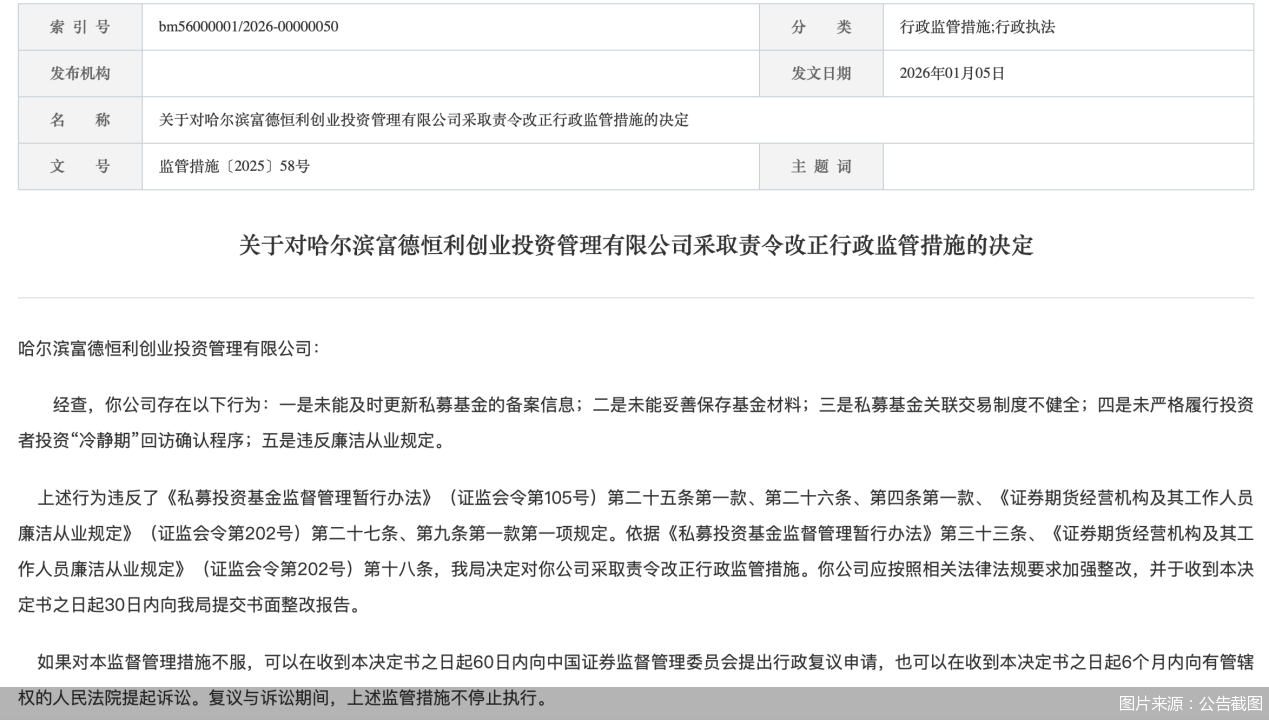
因违反廉洁从业规定等违规行为,哈尔滨富德恒利创投被监管责令改正
Bei Jing Shang Bao· 2026-01-05 11:40
Group 1 - The core viewpoint of the article is that Heilongjiang Securities Regulatory Bureau has imposed administrative corrective measures on Harbin Fude Hengli Venture Capital Management Co., Ltd. due to various regulatory violations [1] Group 2 - The violations identified include failure to timely update private fund filing information, inadequate preservation of fund materials, lack of a sound related party transaction system, and non-compliance with investor "cooling-off period" confirmation procedures [1] - The company’s legal representative and general manager, Shi Zhijian, is held primarily responsible for these violations and has received a warning letter as an administrative regulatory measure [1]
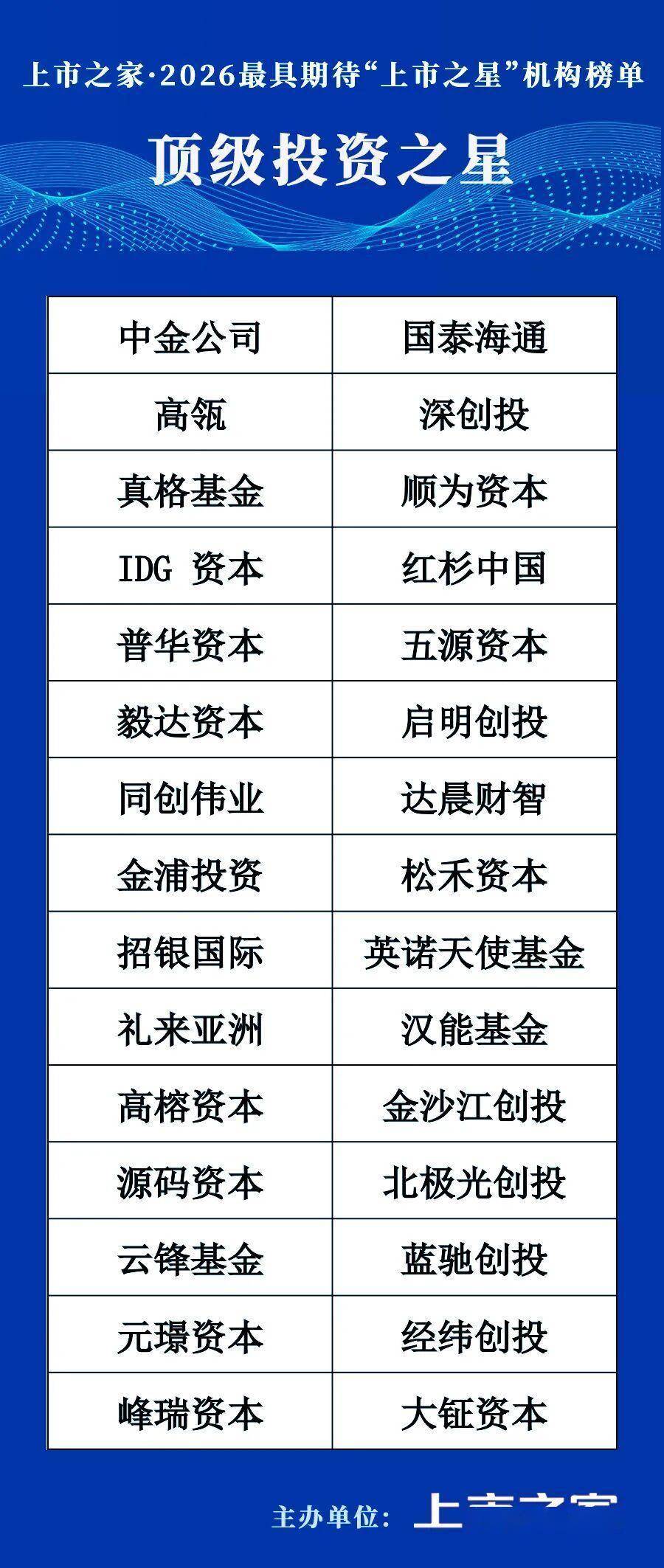
中金公司、高瓴、深创投等企业斩获上市之家2026最具期待“顶级投资之星”
Sou Hu Cai Jing· 2026-01-05 02:37
Core Insights - The "2026 Most Anticipated IPO Stars" list was announced on January 4, highlighting top investment firms in the industry [1] Group 1: Award Winners - A total of 30 investment firms received the "Top Investment Star" award, including notable names such as CICC, Guotai Junan, Hillhouse Capital, and Sequoia China [1][2] - Other recognized firms include IDG Capital, ZhenFund, and Shunwei Capital, showcasing a diverse range of investment strategies and focuses [1][3]

“不以单个项目成败论英雄”:创投考核逻辑重塑,投后赋能常态化
2 1 Shi Ji Jing Ji Bao Dao· 2026-01-04 09:39
Core Viewpoint - The venture capital industry is undergoing a shift in assessment logic, moving from evaluating individual project success to focusing on overall effectiveness and post-investment empowerment, as indicated by recent guidelines from the National Development and Reform Commission [1][4][11] Group 1: Changes in Assessment Logic - The assessment criteria for government investment funds are being recalibrated to reflect the long-term capabilities of institutions rather than short-term project outcomes [3][4] - The previous short assessment cycles are being replaced with a focus on overall effectiveness and post-investment support, acknowledging the extended project cycles in the venture capital market [3][4] - The new assessment framework aims to reduce the emphasis on individual project performance and instead evaluate the institution's ability to create sustainable value over time [4][11] Group 2: Institutional and Policy Adjustments - The adjustment in assessment logic is not only a regulatory change but also a response to deeper shifts in the industrial environment and capital structure, which are reshaping the role of venture capital institutions [5][7] - As state-owned capital increases in the funding structure, venture capital is expected to contribute not only to financial returns but also to national strategies and industrial upgrades [7][11] - Local governments are aligning their policies with these changes, emphasizing collaboration with investment institutions to enhance the innovation ecosystem [10][11] Group 3: Practical Implications for Venture Capital - Venture capital institutions are increasingly adopting a holistic approach to investment, focusing on long-term value creation rather than short-term financial returns [6][8] - The practice of post-investment empowerment is becoming a critical component of venture capital strategies, particularly in the early-stage technology investment sector [8][9] - Successful models, such as the "hard technology champion enterprise entrepreneurship camp," illustrate the importance of providing comprehensive support to entrepreneurs beyond initial funding [9][10] Group 4: Local Government Initiatives - Local governments are enhancing their innovation ecosystems by building collaborative frameworks with investment institutions and technical service providers [10] - The focus has shifted from merely providing space for projects to ensuring that companies can validate, transform, and grow within the local environment [10][11] - The integration of venture capital institutions into regional innovation systems is becoming essential for fostering innovation-driven industrial clusters [10][11]