IT Services

Search documents
IT selloff shock: Nifty IT logs worst fall in February since 2008 global financial crisis; is this crash a buying opportunity?
The Times Of India· 2026-02-24 10:20
Core Insights - The Nifty IT index experienced a significant decline of over 21% in February, marking its worst monthly performance since the 2008 financial crisis, driven by macroeconomic weaknesses and fears of disruption from AI technologies [4][8] - The announcement from AI startup Anthropic regarding its Claude tool's ability to streamline COBOL code heightened concerns about traditional IT service revenue streams, leading to a sharp selloff in tech stocks, including a 13% drop in IBM shares [4][8] - Despite the steep decline, the Nifty IT index is now trading at an eight-year low relative to the Nifty 500, attracting interest from contrarian investors seeking value opportunities [5][8] Market Sentiment and Expert Opinions - Market experts advise caution, emphasizing that while lower valuations may seem attractive, the sector is facing significant disruption and uncertainty regarding long-term growth [6][9] - Earnings growth in the IT sector has been sluggish, with historical growth rates remaining in single digits or barely reaching double digits, indicating underlying issues predating current AI concerns [6][9] - Analysts suggest that high dividend yields and free cash flow yields may not be sustainable if growth continues to weaken, and companies need to demonstrate clear strategies for adapting to AI technologies [6][9] Technical Analysis - Technical indicators suggest further downside risk for the Nifty IT index, with key support levels identified at 29,961, 28,800, and 27,200, while resistance is noted at 36,200 [7][9] - The index has entered a bearish phase, confirmed by breaking below crucial support levels and forming a pattern of lower highs and lower lows, indicating weakening momentum [7][9] - Experts recommend a wait-and-watch strategy, advising against new long positions and suggesting shorting opportunities on rebounds until clearer signs of growth stability emerge [8][9]



Nifty IT’s 21% February crash is worst since the 2008 global financial crisis. More pain or perfect time to buy?
The Economic Times· 2026-02-24 09:22
Core Insights - The announcement by AI startup Anthropic regarding its Claude tool's ability to streamline COBOL code has raised concerns about potential disruptions to established revenue streams for technology companies, leading to significant declines in tech stocks, including a 13% drop in IBM shares, marking its worst single-day selloff in about 25 years [1][11]. Market Performance - In the latest trading session, IT stocks experienced declines of up to 8%, with the Nifty IT index falling over 21% in February alone, its worst monthly performance since the 2008 global financial crisis [2][11]. - The Nifty IT index is now trading at an eight-year low relative to the Nifty 500, attracting the attention of contrarian investors seeking value [2][11]. Earnings and Growth Concerns - The IT sector has shown sustained underperformance, with earnings growth remaining in single digits or barely reaching double digits over the past 3, 5, and 10 years, attributed to commoditization of services, pricing pressure, and sluggish demand from key Western markets [5][11]. - The introduction of AI disruption could further weaken the earnings trajectory of the sector, raising concerns about the sustainability of high dividend yields and attractive free cash flow yields [6][11]. Technical Analysis - The Nifty IT index has entered a bearish phase, confirmed by breaking below a crucial 10-month low of 30,918, indicating a structural trend reversal [8][11]. - Immediate support levels are identified at 29,961, with further support at 28,800 and 27,200 in case of deeper declines, while resistance levels are noted at 30,300 intraday and 31,300 on a closing basis [7][11]. Investment Strategy - Experts recommend a cautious approach, suggesting a wait-and-watch strategy due to the uncertainty surrounding AI-led disruptions and their impact on traditional IT services [9][11].

Kyndryl and University of Liverpool to Spearhead Health Innovation with Agentic AI
Prnewswire· 2026-02-24 09:00
Core Insights - Kyndryl and the University of Liverpool are collaborating to develop next-generation healthcare technologies using AI, specifically through Kyndryl's Agentic AI Framework and the University's research expertise [1] - The initiative aims to enhance patient interaction and healthcare services, particularly for underserved populations, by creating AI-driven solutions such as conversational AI services [1] - The collaboration aligns with the Liverpool City Region's Life Sciences Innovation Zone, positioning the area as a hub for health and life sciences innovation [1] Group 1: Collaboration Details - The partnership will co-develop blueprints for healthcare technologies, focusing on AI projects that improve patient experiences [1] - Phase one of the collaboration will evaluate conceptual AI projects aimed at enhancing patient interaction and healthcare service utilization [1] - The projects will utilize population health datasets and testbed environments to create a library of innovation-ready models [1] Group 2: Impact and Goals - The collaboration seeks to address significant health disparities in the Liverpool area, where life expectancy can differ by up to 15 years between affluent and disadvantaged communities [1] - The initiative aims to provide more preventive and personalized care while effectively targeting resources to assist vulnerable populations [1] - Kyndryl's AI innovation lab, launched in May 2025, will play a crucial role in developing solutions for real-world health challenges [1] Group 3: Institutional Background - Kyndryl is a leading provider of mission-critical enterprise technology services, operating in over 60 countries [1] - The University of Liverpool is a prominent research-intensive institution with an annual turnover of £708.3 million and a research income of £163.1 million [1] - The University is ranked among the top 150 universities globally and is a member of the Russell Group, reflecting its significant academic influence [1]


Cognizant selected for global AI-driven workplace services transformation
Prnewswire· 2026-02-24 09:00
Group 1 - Cognizant has been selected by a major commercial vehicle manufacturer to transform and modernize its global workplace services through a multi-year partnership focused on AI and automation [1] - The initiative will utilize Cognizant WorkNEXT™, an AI-powered digital platform designed to enhance workplace operations and user experience across global factories and offices [1] - The CEO of Cognizant emphasized the importance of applying AI, automation, human-centric design, and responsible governance to create a resilient and future-ready environment for the workforce [1] Group 2 - The partnership aims to improve efficiency, adaptability, and user satisfaction within the operations of the commercial vehicle manufacturer [1] - Cognizant's approach includes building adaptive, integrated, and human-centric workplaces that balance AI-driven automation with high-touch support [1] - The collaboration reflects Cognizant's commitment to helping clients modernize technology and transform experiences in a rapidly changing business landscape [1]


Market volatility to persist amid geopolitical and tariff uncertainty: Amnish Aggarwal
The Economic Times· 2026-02-24 05:59
Trade Relations and Market Volatility - The trade relations with the US remain volatile, with an interim arrangement in place but uncertainty persists due to geopolitical factors [1][5] - Caution is advised regarding the US deal, while better terms of trade are noted with the EU [1][5] - Overall market volatility is expected to continue in the near term due to tariff policies and geopolitical issues [1][5] Impact of Artificial Intelligence on IT Services - The impact of artificial intelligence on IT services is uncertain, with no significant decline in growth rates or margin pressure observed yet [1][5] - The transformation due to AI is ongoing, and it is anticipated that the market will take time to adjust [1][5] - The IT services sector has been underweight for a couple of years due to this uncertainty [1][5] Financial Services and Digital Lending - Digital lending platforms present a value unlock potential, focusing on cash flow utilization and leveraging existing telecom infrastructure [1][5] - The effectiveness of screening processes and control over lending and collections is crucial for scaling up [1][5] - The impact on financials and value unlocking is expected to take a long time to materialize [1][5] Auto Sector Performance - The auto sector has shown mixed but generally positive momentum post-GST, with robust performance in the last few months [3][5] - Two-wheelers have performed well, while passenger vehicles (PVs) have seen a later push; however, some fatigue is noted in entry-level cars [3][5] - Selectivity is key in the auto space, with strong demand in the farm sector but potential impacts from El Nino on tractor demand [3][5] Metals Sector Outlook - In the ferrous space, demand is good, and profitability is expected to improve in Q4, with incremental returns possible from current levels [3][5] - For non-ferrous metals like aluminum, the peak performance has likely been reached, with companies like Hindustan Zinc benefiting from price action [3][5] - The outlook remains positive for the ferrous sector [3][5]

Sensex, Nifty Plunge on IT Selloff, Global Trade Worries
Rediff· 2026-02-24 05:21
Core Viewpoint - Indian stock markets, represented by Sensex and Nifty, experienced a sharp decline due to significant selloffs in IT stocks, driven by fears of AI disruption and concerns over global trade [4][5]. Market Performance - The Sensex and Nifty indices fell nearly 1 percent in early trading, with the Nifty declining by 230.15 points, or 0.89 percent, to 25,482.85 [6][4]. - IT stocks such as Eternal, HCL Technologies, and Infosys saw the most significant declines, with Eternal dropping 3.82 percent [7][5]. Contributing Factors - Rising crude oil prices, with Brent Crude increasing by 1 percent to $72.13 per barrel, added to the negative sentiment in the market [11]. - Renewed global trade concerns, particularly related to US President Donald Trump's tariff remarks, further weighed on investor sentiment [4][5]. Investor Behavior - Foreign Institutional Investors (FIIs) were net buyers, purchasing equities worth Rs 3,483.70 crore, while Domestic Institutional Investors (DIIs) were net sellers, offloading stocks worth Rs 1,292.24 crore [10][5]. Analyst Insights - Market analysts noted that the weakness in tech stocks is likely to persist due to potential AI impacts, with a focus on the upcoming State of the Union address by US President Trump for insights on trade policies [8][9]. - The ongoing tariff situation between the EU and the US, influenced by recent Supreme Court verdicts, suggests further volatility in markets [9].

Markets slump nearly 1% on IT rout; Trump tariff worries hit investor sentiment
The Hindu· 2026-02-24 05:04
Market Overview - Equity benchmark indices Sensex and Nifty fell nearly 1% in early trade on February 24, 2026, primarily due to a significant selloff in IT stocks amid concerns over AI-led disruption [1] - The BSE Sensex dropped 813.13 points, or 0.97%, to 82,481.53, while the NSE Nifty declined 230.15 points, or 0.89%, to 25,482.85 [1][2] Sector Performance - IT stocks were notably affected, with Eternal leading the decline at 3.82%, followed by HCL Technologies, Infosys, Tech Mahindra, and Tata Consultancy Services among others [2] - Conversely, State Bank of India, Axis Bank, PowerGrid, Asian Paints, Kotak Mahindra Bank, and Tata Steel were among the gainers [2] Global Influences - Rising crude oil prices, with Brent Crude increasing by 1% to $72.13 per barrel, contributed to negative investor sentiment [5] - Renewed concerns over global trade were triggered by U.S. President Donald Trump's tariff remarks, impacting market dynamics [1][4] Investor Sentiment - The ongoing weakness in tech stocks is expected to persist, as indicated by the performance of Indian IT companies' American Depository Receipts (ADRs) [3] - Market participants are closely monitoring Trump's State of the Union address for potential implications on market conditions [3] Institutional Activity - Foreign Institutional Investors (FIIs) purchased equities worth ₹3,483.70 crore, while domestic institutional investors were net sellers of stocks worth ₹1,292.24 crore on February 23 [5]
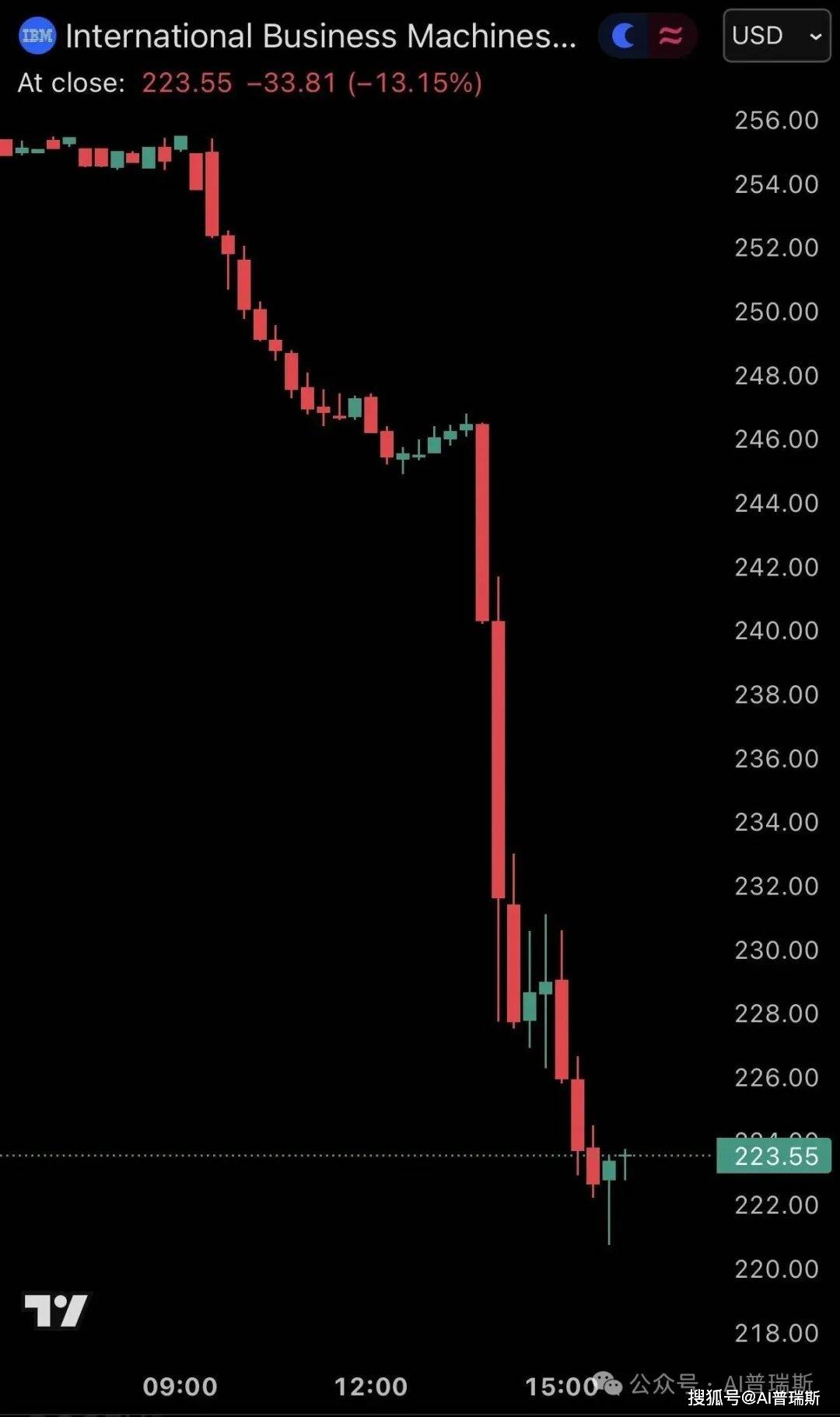
单日跌13%!IBM遭遇Anthropic利润重估,创25年来最大日跌幅
Sou Hu Cai Jing· 2026-02-24 04:12
AIPress.com.cn报道 2月24日消息,IBM周一收盘暴跌13.15%,报223.35美元,创下自2000年10月以来最大单日跌幅。 | USD | IBM International Business Machines.. | | | --- | --- | --- | | | At close: 223.55 -33.81 (-13.15%) | | | 256.00 | | | | 254.00 | | | | 252.00 | | | | 250.00 | | | | 248.00 | | | | 246.00 | | | | 244.00 | | | | 242.00 | | | | 240.00 | | | | 238.00 | | | | 236.00 | | | | 234.00 | | | | 232.00 | | | | 230.00 | | | | 228.00 | | | | 226.00 | | | | 00100 | | 223 55 | 2月份累计跌幅已达27%,若维持至月末,将成为至少自1968年以来最大单月跌幅。 触发因素来自,Anthropic宣布其Claude ...
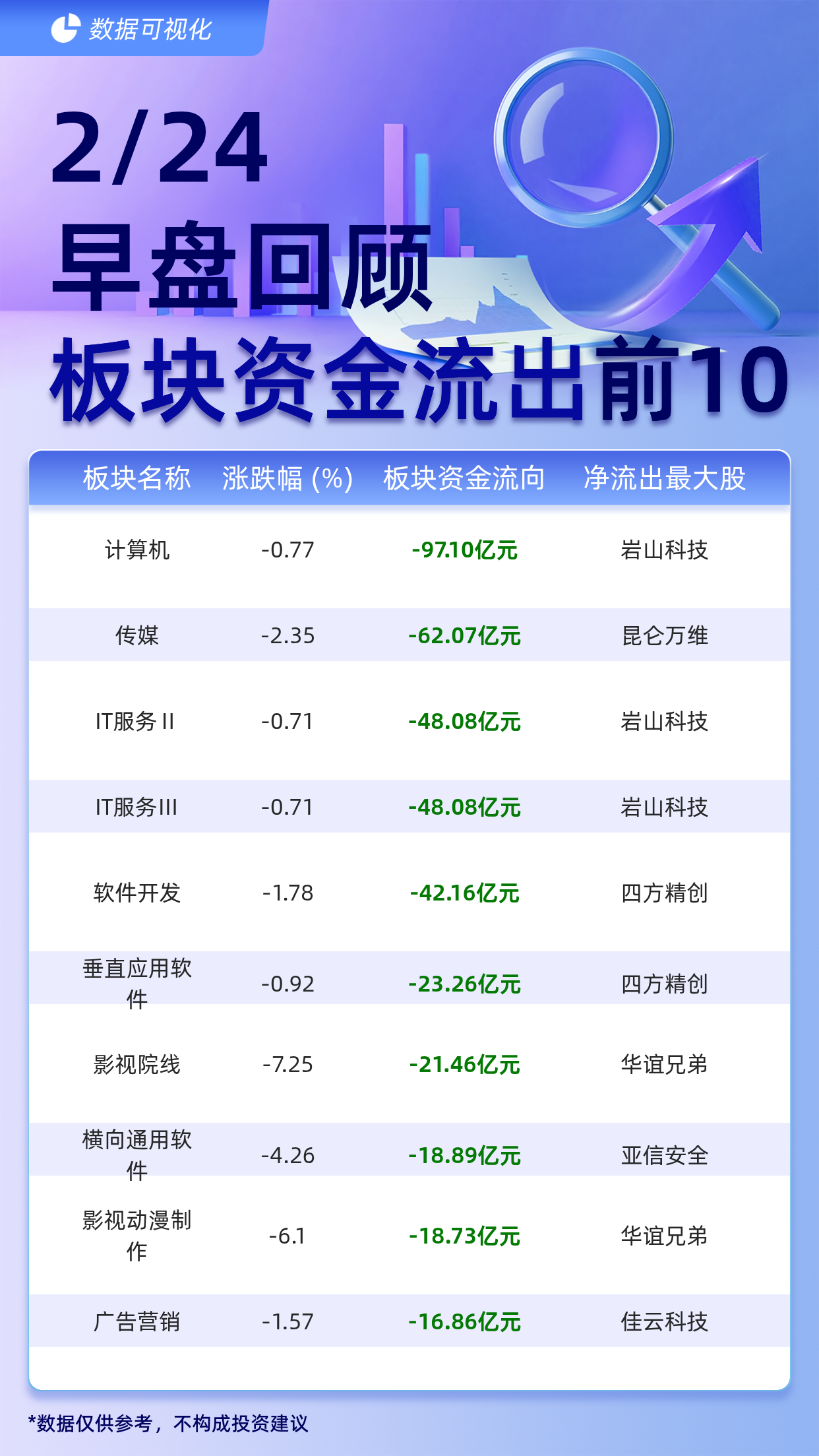
主力板块资金流出前10:计算机流出97.10亿元、传媒流出62.07亿元
Jin Rong Jie· 2026-02-24 03:50
Group 1 - The main market saw a net inflow of 12.298 billion yuan as of February 24 [1] - The top ten sectors with the largest capital outflows included Computer (-9.71 billion yuan), Media (-6.207 billion yuan), and IT Services II (-4.808 billion yuan) [1][2] - The Computer sector experienced a decline of 0.77%, while the Media sector fell by 2.35% [2] Group 2 - The IT Services III sector also saw a decrease of 0.71% with a net outflow of 4.808 billion yuan [2] - Software Development declined by 1.78% with a capital outflow of 4.216 billion yuan [2] - The Film and Television sector had the largest percentage drop at -7.25%, with a net outflow of 2.146 billion yuan [3]


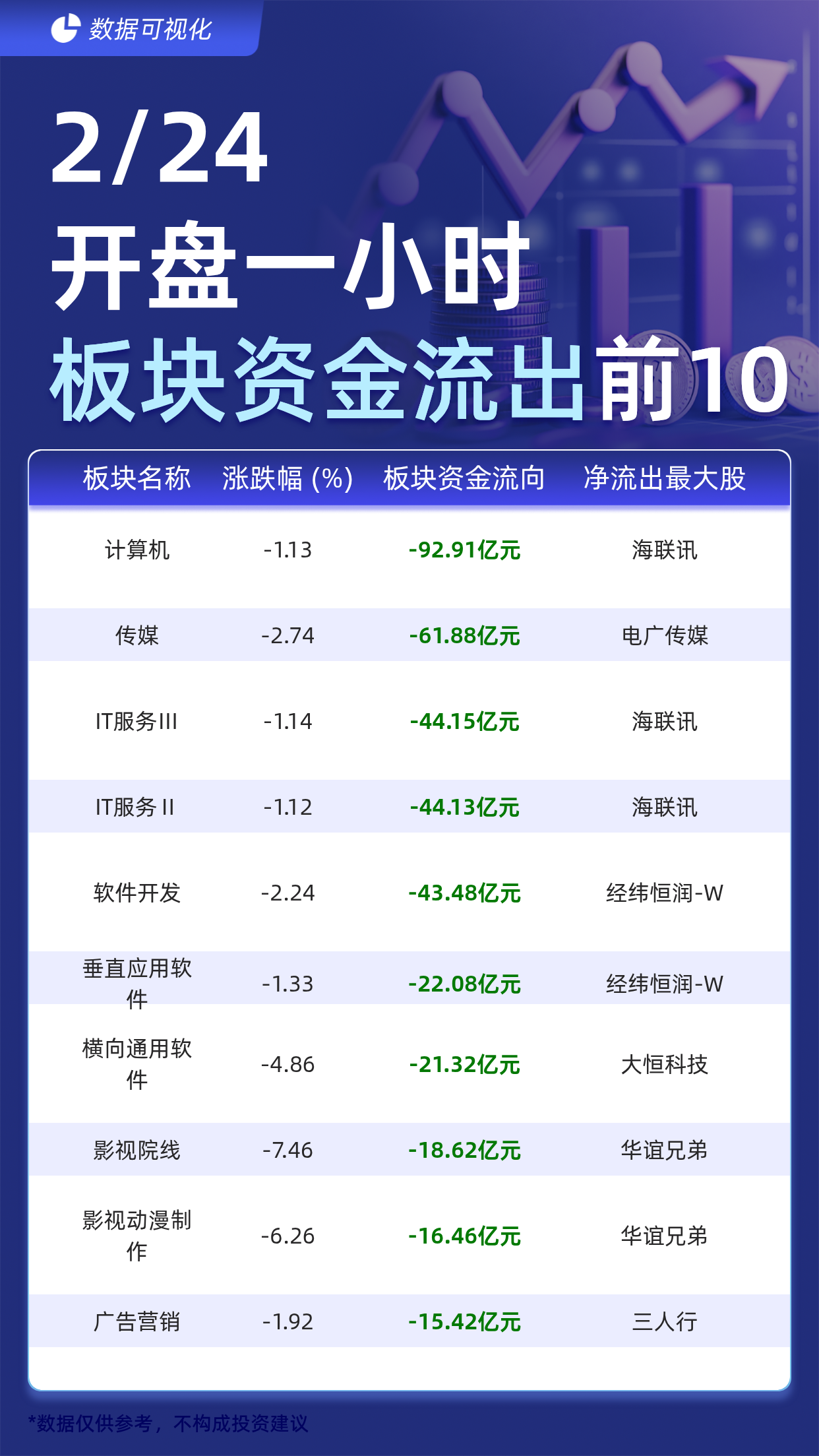
主力板块资金流出前10:计算机流出92.91亿元、传媒流出61.88亿元
Jin Rong Jie· 2026-02-24 02:48
Core Viewpoint - The main market experienced a net inflow of 6.99 billion yuan in principal funds as of February 24, with significant outflows observed in various sectors, particularly in technology and media [1]. Group 1: Sector Performance - The computer sector saw a decline of 1.13% with a net outflow of 9.29 billion yuan, primarily impacted by Hai Lian Xun [2]. - The media sector experienced a drop of 2.74% with a net outflow of 6.19 billion yuan, led by Dianguang Media [2]. - IT Services III and II both recorded declines of 1.14% and 1.12%, respectively, with net outflows of 4.41 billion yuan each, also affected by Hai Lian Xun [2]. - The software development sector fell by 2.24% with a net outflow of 4.35 billion yuan, influenced by Jingwei Hengrun-W [2]. Group 2: Additional Sector Details - Vertical application software decreased by 1.33% with a net outflow of 2.21 billion yuan, impacted by Jingwei Hengrun-W [3]. - Horizontal general software faced a significant decline of 4.86% with a net outflow of 2.13 billion yuan, primarily due to Da Heng Technology [3]. - The film and television sector saw a notable drop of 7.46% with a net outflow of 1.86 billion yuan, led by Huayi Brothers [3]. - The animation production sector declined by 6.26% with a net outflow of 1.65 billion yuan, also influenced by Huayi Brothers [3]. - The advertising and marketing sector experienced a decrease of 1.92% with a net outflow of 1.54 billion yuan, primarily affected by Sanrenxing [3].